Vorticism
Vorticism was a short-lived British avant-garde movement founded in London in 1914 by Wyndham Lewis, which combined the fragmented forms of Cubism and the machine-age energy of Futurism in hard, angular compositions, and which was announced in the magazine BLAST.
In 1913 the poet Ezra Pound named the vortex as the point of maximum energy, and the following year the name gave London its own avant-garde. Wyndham Lewis had quarrelled with Roger Fry at the Omega Workshops and set up the Rebel Art Centre in Great Ormond Street with Edward Wadsworth, William Roberts and others. Its loud pink magazine, BLAST, appeared in 1914 with a manifesto blasting and blessing everything from the weather to the British Academy. Henri Gaudier-Brzeska supplied a sculptor's voice, and Jacob Epstein's Rock Drill stood close by.
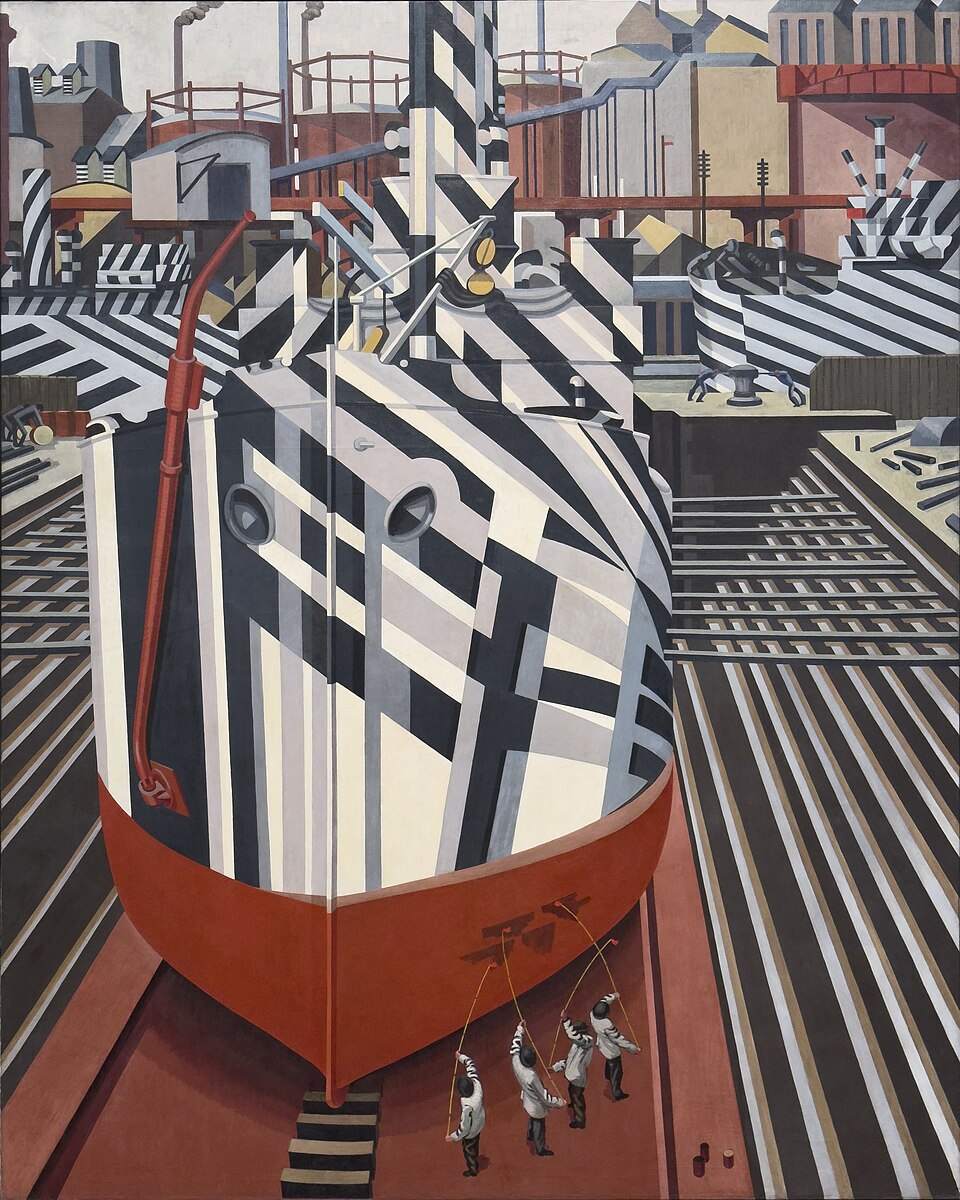
The Vorticists held just one exhibition of their own in Britain, at the Doré Galleries in London in June 1915, and a second issue of BLAST followed that summer. The war scattered them. Gaudier-Brzeska enlisted in the French army, Lewis and Roberts served in the British one, and Wadsworth turned to dazzle camouflage for ships. David Bomberg and C. R. W. Nevinson shared its concerns but kept their distance, Nevinson having sided with the Italian Futurist Marinetti. A last show at the Penguin Club in New York in 1917 and a failed attempt to regroup in 1920 brought it to a close. Tate's exhibition The Vorticists, in 2011, restored much of its reputation.
At a glance
- When
- 1914 to about 1919
- Where
- London
- Leading artists
- Wyndham Lewis, Henri Gaudier-Brzeska, Edward Wadsworth, William Roberts
Characteristics of Vorticism
- Hard angles
- Jagged, clean-edged forms that look cut from metal.
- Machine imagery
- Cranes, ships and the modern city, in forms that echo them.
- A sense of energy
- Compositions that spiral around a still centre, like the vortex in the name.
- Harsh colour
- Metallic greys and strident pinks and greens.
- A British attitude
- A cooler, more aggressive stance than the Futurists, whom they rejected.
Vorticist artists
Every artist below has a page on this site, with a short biography and what a valuation of their work turns on.
The Vorticists
- Wyndham LewisBritish painter and writer who founded Vorticism and edited the magazine BLAST.
- Henri Gaudier-BrzeskaFrench sculptor who worked in London and was a founding figure of Vorticism.
- Edward WadsworthBritish painter and printmaker, a signatory of Vorticism and later a painter of marine still lifes in tempera.
- William RobertsBritish painter, a Vorticist in his youth, later known for tubular figures of London life.
Close to the movement
- David BombergBritish painter of geometric early compositions, later of expressive landscapes, and an influential teacher.
- Jacob EpsteinAmerican-born British sculptor of controversial public carvings and powerful bronze portraits.
- C.R.W. NevinsonFuturist painter of the First World War, whose machine-like soldiers made him the most famous young artist in England.
Famous Vorticist works
- BLAST, No. 1Wyndham Lewis, editor, 1914
- Hieratic Head of Ezra PoundHenri Gaudier-Brzeska, 1914
- Torso in Metal from 'The Rock Drill'Jacob Epstein, 1913–16, Tate, London
- WorkshopWyndham Lewis, about 1914–15, Tate, London
- Dazzle-ships in Drydock at LiverpoolEdward Wadsworth, 1919, National Gallery of Canada, Ottawa
- The Vorticists at the Restaurant de la Tour Eiffel: Spring, 1915William Roberts, 1961–62, Tate, London
What a valuation turns on
Vorticist works from 1914 and 1915 are very scarce, as many paintings have been lost, and anything that appears attracts close attention. Drawings and works on paper come up more often, along with Wadsworth's woodcuts and copies of BLAST itself. Most artists associated with the movement are represented on the market by later work, which is valued separately from their brief Vorticist phase.
A work's date needs evidence, such as exhibition history, a published reference or an inscription. Walter Michel's catalogue is the reference for Lewis, and the William Roberts Society's for Roberts. Copies of BLAST are judged on the state of the fragile pink cover and spine. Bronzes by Gaudier-Brzeska should be identified as lifetime or posthumous casts.
Common questions
What is Vorticism?
Vorticism was a British avant-garde movement founded in London in 1914 by Wyndham Lewis. It used hard, angular forms inspired by machinery and drew on Cubism and Futurism.
Who were the Vorticists?
Wyndham Lewis, Edward Wadsworth, William Roberts, Henri Gaudier-Brzeska, Helen Saunders and Jessica Dismorr, with the poet Ezra Pound, who gave the movement its name.
What is the difference between Vorticism and Futurism?
Both embraced the machine age. The Vorticists rejected Futurism's blurred movement and love of speed in favour of hard, static structure around a still centre.
What was BLAST?
BLAST was the Vorticists' magazine, edited by Wyndham Lewis, with two issues in 1914 and 1915. It is known for its pink cover, huge type and manifestos.
How do I sell a work by Wyndham Lewis, Wadsworth or Roberts?
Send photographs of the front, any signature or marks, and the back for a free, confidential valuation, with any labels or documents. We check the work against the published record, look at condition, and compare a confidential private sale with auction.