

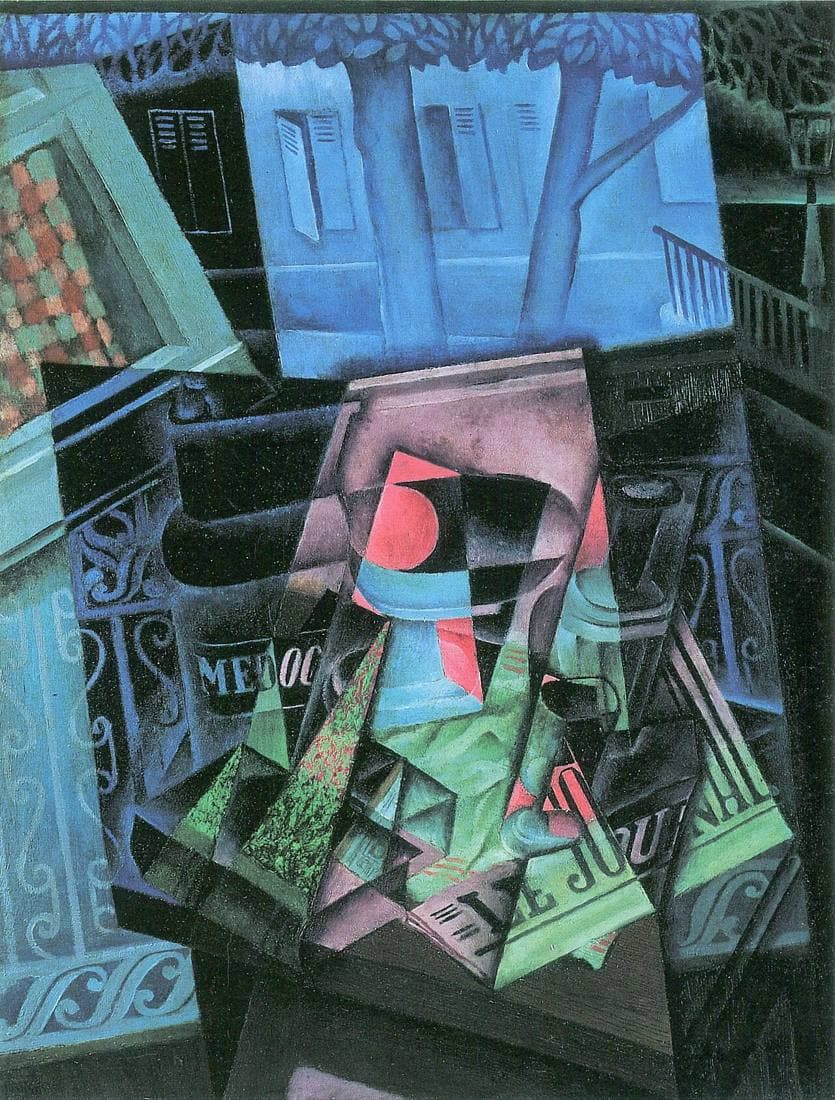
Cubism
Cubism was a revolution in painting begun in Paris by Pablo Picasso and Georges Braque in 1907–08, which showed objects from several viewpoints at once, broken into geometric planes, and gave up the single fixed perspective that had ruled since the Renaissance.
Picasso painted Les Demoiselles d'Avignon in 1907: five figures broken into angular planes, their faces drawn from Iberian sculpture and African masks. Braque saw it in Picasso's studio and answered the following summer with landscapes at L'Estaque built from Cézanne-like blocks; Louis Vauxcelles, the critic who had named the Fauves, wrote in November 1908 that Braque reduced everything to 'cubes'. For the next six years the two worked so closely that Braque compared them to two mountaineers roped together.
Art historians divide what followed in two. In Analytic Cubism, from about 1909 to 1912, objects were taken apart into small faceted planes in browns, greys and ochres until they almost disappeared. In Synthetic Cubism, from 1912, the process reversed: pictures were built up from flat, brightly coloured shapes, and Picasso and Braque began gluing in newspaper, wallpaper and printed labels, inventing collage and papier collé. Juan Gris, Fernand Léger, Albert Gleizes, Jean Metzinger and the painters of the Section d'Or took Cubism into the Salons; Robert and Sonia Delaunay and František Kupka turned it towards pure colour, which the poet Guillaume Apollinaire called Orphism; and from it came Futurism, Vorticism, Constructivism and much of abstract art.
At a glance
- When
- 1907 to the 1920s
- Where
- Paris
- Leading artists
- Pablo Picasso, Georges Braque, Juan Gris, Fernand Leger
Characteristics of Cubism
- Several viewpoints
- An object seen from more than one side at once, on a flat surface.
- Geometric planes
- Forms broken into facets, cubes and cylinders.
- A muted palette
- Browns, greys and ochres in Analytic Cubism, so colour does not distract from structure.
- Collage
- Real materials glued in, from newspaper to wallpaper, in Synthetic Cubism.
- Everyday subjects
- Still lifes of bottles, glasses, guitars and newspapers; portraits of friends and dealers.
- Letters and words
- Stencilled letters and fragments of print within the picture.
Cubist artists
Every artist below has a page on this site, with a short biography and what a valuation of their work turns on.
Picasso, Braque and the Cubists
- Pablo PicassoFifty thousand works across seventy-five years, in every medium there is — which makes identification the whole job.
- Georges BraqueInvented Cubism alongside Picasso, then spent forty years quietly not being him.
- Juan GrisSpanish Cubist of clear, coloured still lifes, the most methodical painter of the movement.
- Fernand LegerCame back from the trenches convinced that painting should look like machinery, and made it.
- Albert GleizesCo-wrote the book that explained Cubism, then spent decades arguing about what it meant.
- Diego RiveraMexican muralist who painted walls in Mexico City, Detroit and San Francisco, and easel pictures beside them.
Orphism and after
- Robert DelaunayPainted the Eiffel Tower breaking apart, then discs of pure colour; Apollinaire called the result Orphism.
- Sonia DelaunayTook abstraction off the canvas and onto dresses, cars, book covers and dance floors.
- František KupkaCzech illustrator and one-time spiritualist medium who painted some of the first abstract pictures shown in Paris.
- Gino SeveriniThe Futurist in Paris, who painted dancers as shattered light and later returned to order.
Famous Cubist works
- Les Demoiselles d'AvignonPablo Picasso, 1907, Museum of Modern Art, New York
- Houses at L'EstaqueGeorges Braque, 1908, Kunstmuseum Bern
- Portrait of Ambroise VollardPablo Picasso, 1910, Pushkin Museum, Moscow
- Still Life with Chair CaningPablo Picasso, 1912, Musée Picasso, Paris
- Portrait of Pablo PicassoJuan Gris, 1912, Art Institute of Chicago
- Still Life before an Open Window, Place RavignanJuan Gris, 1915, Philadelphia Museum of Art
What a valuation turns on
Cubist paintings of 1907 to 1914 by Picasso and Braque are museum pictures, and most of what comes to market as 'Cubist' is later work by the same artists, works on paper, prints, or paintings by the wider circle: Gris, Léger, Gleizes, Metzinger, Louis Marcoussis, Gino Severini and many lesser-known painters of the Section d'Or. Picasso's and Braque's prints, many made long after Cubism, are a large market of their own.
Cubism has been faked a great deal, partly because its vocabulary is easy to imitate and partly because the second rank of Cubist painters is thinly documented. For each of the main artists there is a catalogue raisonné, and for some a committee that will review a work. 'Cubist school' or 'circle of' describes a different object from a signed work in the catalogue, and is valued as one.
Common questions
What is Cubism?
Cubism is a style of painting and sculpture developed in Paris from 1907 by Pablo Picasso and Georges Braque, in which objects are broken into geometric planes and shown from several viewpoints at once, rather than from a single fixed point of view.
Who invented Cubism?
Pablo Picasso and Georges Braque, working closely together in Paris between 1907 and 1914. Picasso's Les Demoiselles d'Avignon of 1907 and Braque's L'Estaque landscapes of 1908 are its starting points.
What is the difference between Analytic and Synthetic Cubism?
Analytic Cubism, from about 1909 to 1912, broke objects down into small faceted planes in a near-monochrome palette. Synthetic Cubism, from 1912, built pictures up from flat, coloured shapes and pasted materials such as newspaper and wallpaper.
Who are the most famous Cubist artists?
Pablo Picasso, Georges Braque, Juan Gris and Fernand Léger, with Albert Gleizes, Jean Metzinger, Robert and Sonia Delaunay, František Kupka and, for a time, Diego Rivera.
How do I sell a Cubist painting or a Picasso print?
Send photographs of the front, the signature and the back, with any labels or certificates, for a free, confidential valuation. We check the work against the artist's catalogue raisonné, or the print against the catalogue of prints, and compare a confidential private sale with auction.
