Futurism
Futurism was an Italian movement launched by the poet Filippo Tommaso Marinetti in 1909, which glorified speed, machines and the modern city and set out to sweep away the past; its painters, Umberto Boccioni, Giacomo Balla, Carlo Carrà, Luigi Russolo and Gino Severini, broke forms apart to show movement and energy.
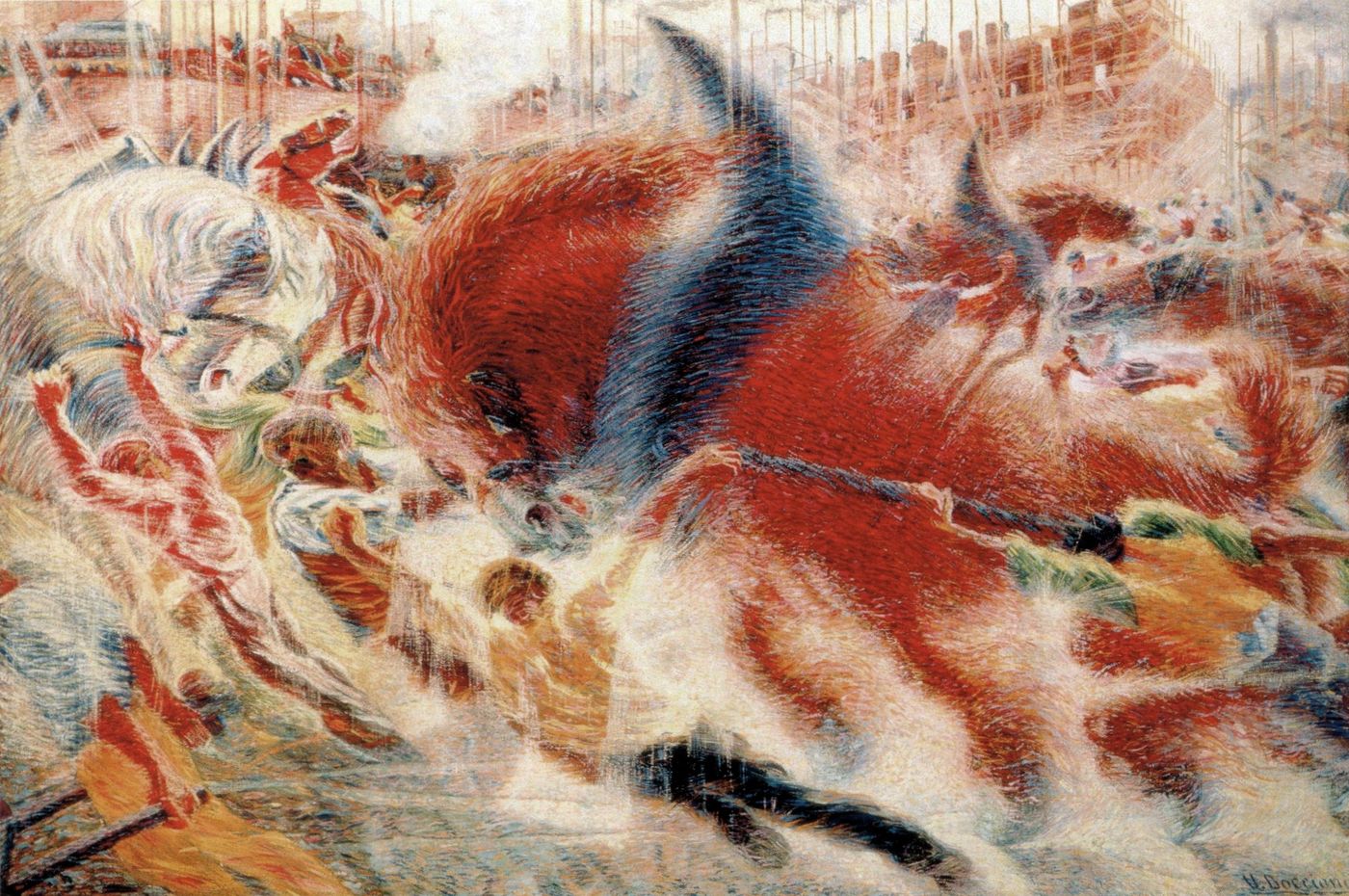
Marinetti published the Founding and Manifesto of Futurism on the front page of the Paris newspaper Le Figaro on 20 February 1909. It declared a racing car more beautiful than the Victory of Samothrace and called for the destruction of museums and libraries. The painters issued manifestos of their own in 1910, and after seeing Cubism in Paris they joined its fractured planes to their own subject, dynamism: Boccioni's The City Rises, Balla's Dynamism of a Dog on a Leash, Severini's dancers at the Bal Tabarin. The Futurist exhibition that toured Europe in 1912, from Paris to the Sackville Gallery in London and on to Berlin, made them famous.
The First World War broke the first group apart, and a second generation of Futurists, working through the 1920s and 1930s, turned to aeropittura, painting from the air. In Britain C. R. W. Nevinson signed a Futurist manifesto with Marinetti in 1914 and painted the war in a hard, mechanical manner learned from them, while Wyndham Lewis and the Vorticists defined themselves against it. Russian Cubo-Futurism, Dada and Art Deco all borrowed from Futurism, and its closeness to Mussolini's regime in the 1920s and 1930s has coloured its reputation since.
At a glance
- When
- 1909 to about 1916, and after
- Where
- Milan, Paris and London
- Leading artists
- Gino Severini
Characteristics of Futurism
- Speed and machines
- Cars, trains, aeroplanes and electric light as the heroes of modern life.
- Dynamism
- Movement shown by repeating forms in sequence, as in a series of photographs.
- Lines of force
- Diagonals and interpenetrating planes that drive through the picture.
- The city
- Crowds, building sites, trams, cafés and dance halls.
- War on the past
- Manifestos, provocation and performance, and tradition rejected outright.
Futurist artists
Every artist below has a page on this site, with a short biography and what a valuation of their work turns on.
The Futurists
Famous Futurist works
- The City RisesUmberto Boccioni, 1910, Museum of Modern Art, New York
- Dynamism of a Dog on a LeashGiacomo Balla, 1912, Buffalo AKG Art Museum
- Dynamic Hieroglyphic of the Bal TabarinGino Severini, 1912, Museum of Modern Art, New York
- Unique Forms of Continuity in SpaceUmberto Boccioni, 1913
- La MitrailleuseC. R. W. Nevinson, 1915, Tate, London
What a valuation turns on
Works from the first years of Futurism, 1909 to 1916, are rare and highly prized: Boccioni's output was small, and many of the key paintings are in museums in Italy and America. Balla and Severini worked for decades longer and in other styles, Severini returning to a classical manner in the 1920s, so the date of a work, and whether it belongs to the Futurist years, matters most. Drawings, studies and prints from those years have a market of their own.
The aeropittura of the 1930s is a separate and smaller market. Futurist works have been forged, and a work that is in Italy may need an export licence to leave it, so provenance and paperwork come first. For Nevinson, the paintings and prints of the war years, 1915 to 1918, are the most sought after.
Common questions
What is Futurism?
Futurism was an Italian art movement launched by the poet Filippo Tommaso Marinetti in 1909. It celebrated speed, machines, the modern city and the energy of the new century, rejected the art of the past, and showed movement by breaking forms into repeated, overlapping planes.
Who were the Futurist artists?
Filippo Tommaso Marinetti, who founded it, with the painters Umberto Boccioni, Giacomo Balla, Carlo Carrà, Luigi Russolo and Gino Severini and the architect Antonio Sant'Elia; in Britain C. R. W. Nevinson was its leading follower.
When was Futurism?
Marinetti launched it in February 1909. Its first and most important phase lasted until about 1916, and a second generation of Futurists continued in Italy into the 1930s.
What is the difference between Futurism and Cubism?
Cubism, in Paris, broke still lifes and figures into planes to show them from several viewpoints at once. Futurism took that fractured form and added speed and movement, with subjects drawn from modern life: trains, cars, crowds and the city.
How do I sell a Futurist work?
Send photographs of the front, the signature and the back, with any labels, certificates or export papers, for a free, confidential valuation. The date of the work and its history usually decide the most; we check them, compare a confidential private sale with auction, and keep the paperwork in your name until you are paid.