
C.R.W. Nevinson valuation
Futurist painter of the First World War, whose machine-like soldiers made him the most famous young artist in England.
C. R. W. Nevinson was born in London in 1889, the son of the war correspondent Henry Nevinson, and studied at the Slade under Henry Tonks, alongside Stanley Spencer and Mark Gertler, and then in Paris in 1912 and 1913.
What a work by C.R.W. Nevinson is worth
Send photographs and whatever paperwork came with it. The first question is what the work actually is — edition or unique, when, and in what condition — because everything else follows from the answer. A valuation is free, made online from the photographs you send, and it commits you to nothing. We act for sellers across the United Kingdom, Europe and the United States.
Write to info@whitebankfineart.co.uk, or start below.
Bio
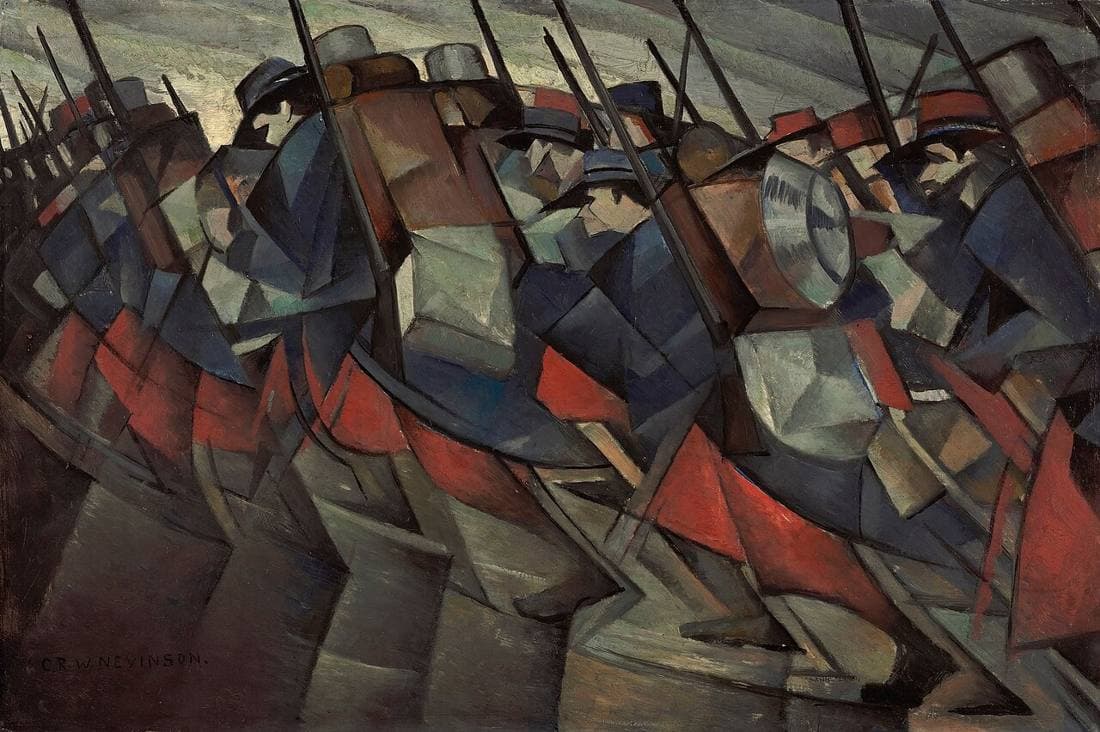
C. R. W. Nevinson was born in London in 1889, the son of the war correspondent Henry Nevinson, and studied at the Slade under Henry Tonks, alongside Stanley Spencer and Mark Gertler, and then in Paris in 1912 and 1913. He befriended the Futurist Filippo Tommaso Marinetti and co-signed with him the manifesto Vital English Art in 1914, falling out with Wyndham Lewis and the Vorticists. At the outbreak of war he served with the Friends' Ambulance Unit and the Royal Army Medical Corps, and the paintings he made from that experience, La Mitrailleuse and Returning to the Trenches among them, used the angular forms of Futurism and Cubism to show the war as a machine. In 1917 he became an official war artist and painted in a more realist manner. Later he painted New York and London, and he died in London in 1946.
Nevinson was a prolific printmaker, and his drypoints, lithographs and etchings, especially the war subjects, come up often; they were issued in editions, so the impression and the state matter. Paintings are rarer, the war paintings above all, and many are at the Imperial War Museum and Tate.
The Slade, the Futurists and La Mitrailleuse
Walter Sickert wrote that La Mitrailleuse, of 1915, now at Tate, would probably remain the most authoritative and concentrated utterance on the war in the history of painting.
He was made a Chevalier of the Légion d'honneur in 1938 and an Associate of the Royal Academy in 1939, and in the Second World War he painted airmen preparing for the Dieppe raid.
Whitebank Fine Art is an art advisory and gallery, not an auction house, and is not affiliated with any auction house or with the artist, their estate or their representatives. This page describes the range we advise on. Nothing here is investment advice.