
Art News ·
Art News: Art for Remembrance, the WW1 and WW2 Paintings and the Artists Behind Them
By Whitebank Fine Art
Remembrance Sunday falls on 8 November this year, with Armistice Day three days later. Much of what we picture when we think of the two world wars comes from artists, many of them sent by the government to record what they saw. This is a guide to war art in Britain: the official war artists, the best-known WW1 and WW2 paintings, where to see them, and what to check if a war picture has come down through your family.
What is war art?
War art is any art that records or responds to conflict, and a war artist is someone who makes it, often under an official scheme. Britain ran such schemes in both world wars, sending painters to the front and into the factories at home. Many of the results are now held by Imperial War Museums.
WW1 artists and the first official scheme
Britain's scheme began in 1916, when the government's propaganda bureau at Wellington House, run by Charles Masterman, sent the Scottish etcher Muirhead Bone to France as its first official war artist. His drawings of the Western Front were reproduced in print for the public at home. Others followed, including William Orpen, Paul Nash, C. R. W. Nevinson and Eric Kennington.
The scheme began as propaganda and became a way of remembering. In 1918 the British War Memorials Committee commissioned large paintings for a Hall of Remembrance that was never built. They include Nash's The Menin Road, Wyndham Lewis's A Battery Shelled and Stanley Spencer's Travoys Arriving with Wounded at a Dressing-Station at Smol, Macedonia.
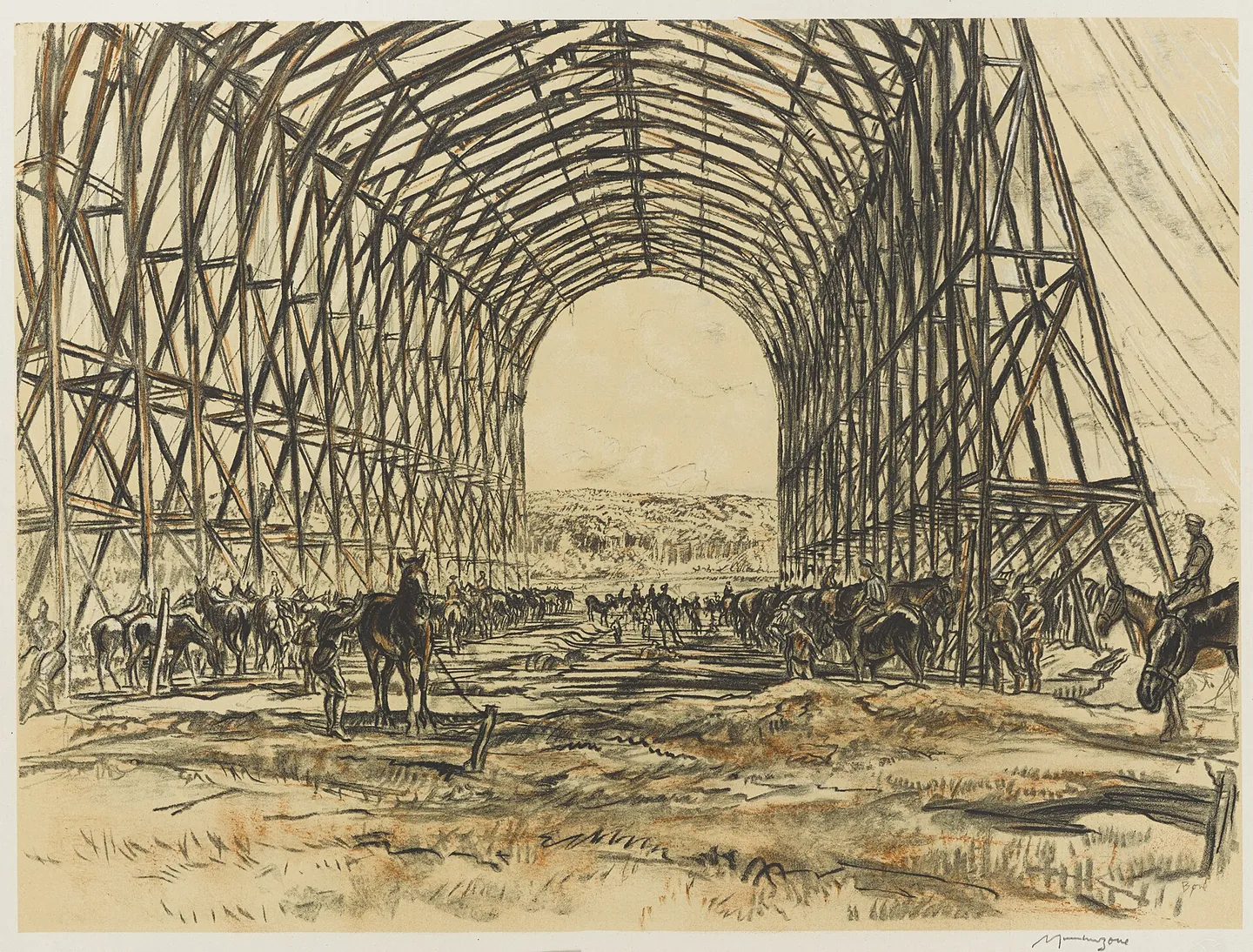
Muirhead Bone, A Stable on the Western Front, 1918. Public domain, via Wikimedia Commons.
Gassed by John Singer Sargent
Gassed is the best-known of the Hall of Remembrance paintings, and at more than six metres wide one of the largest. John Singer Sargent, then in his sixties, based it on what he saw at Le Bac-du-Sud, on the road between Arras and Doullens, in August 1918: lines of soldiers blinded by mustard gas, being led towards a dressing station. It was voted picture of the year at the Royal Academy in 1919 and belongs to Imperial War Museums.
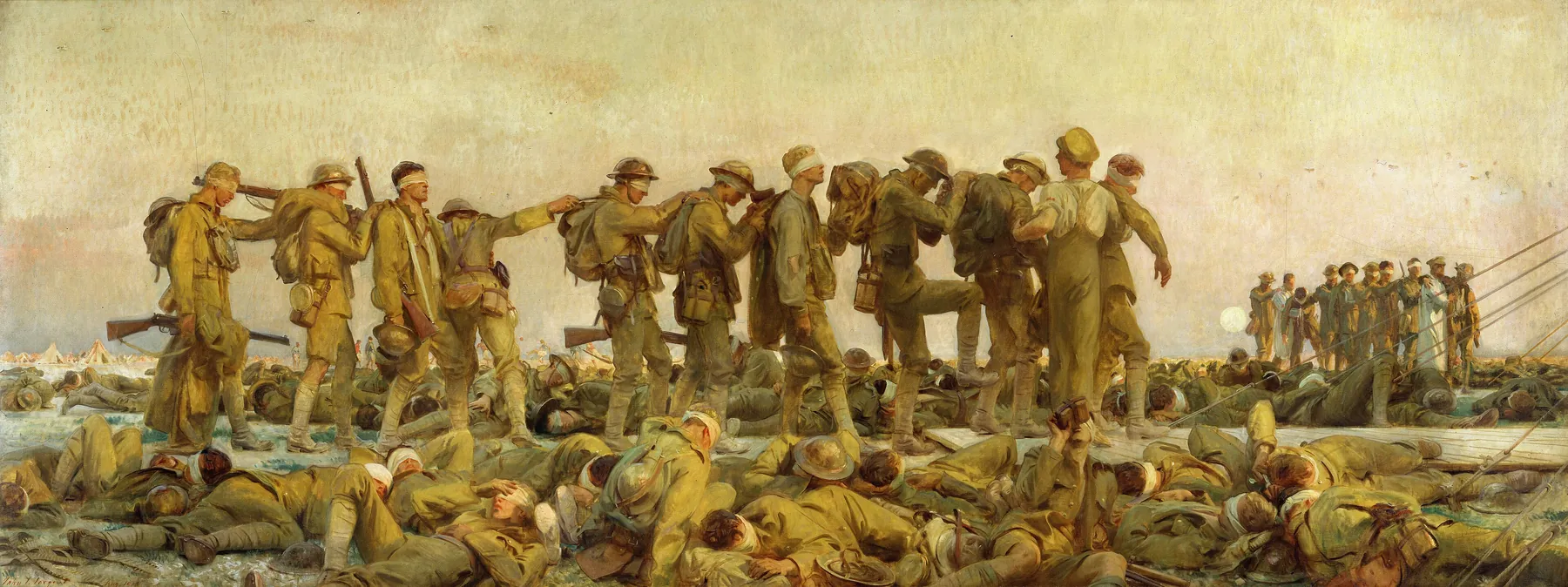
John Singer Sargent, Gassed, 1919, Imperial War Museums. Public domain, via Wikimedia Commons.
Paul Nash's war paintings
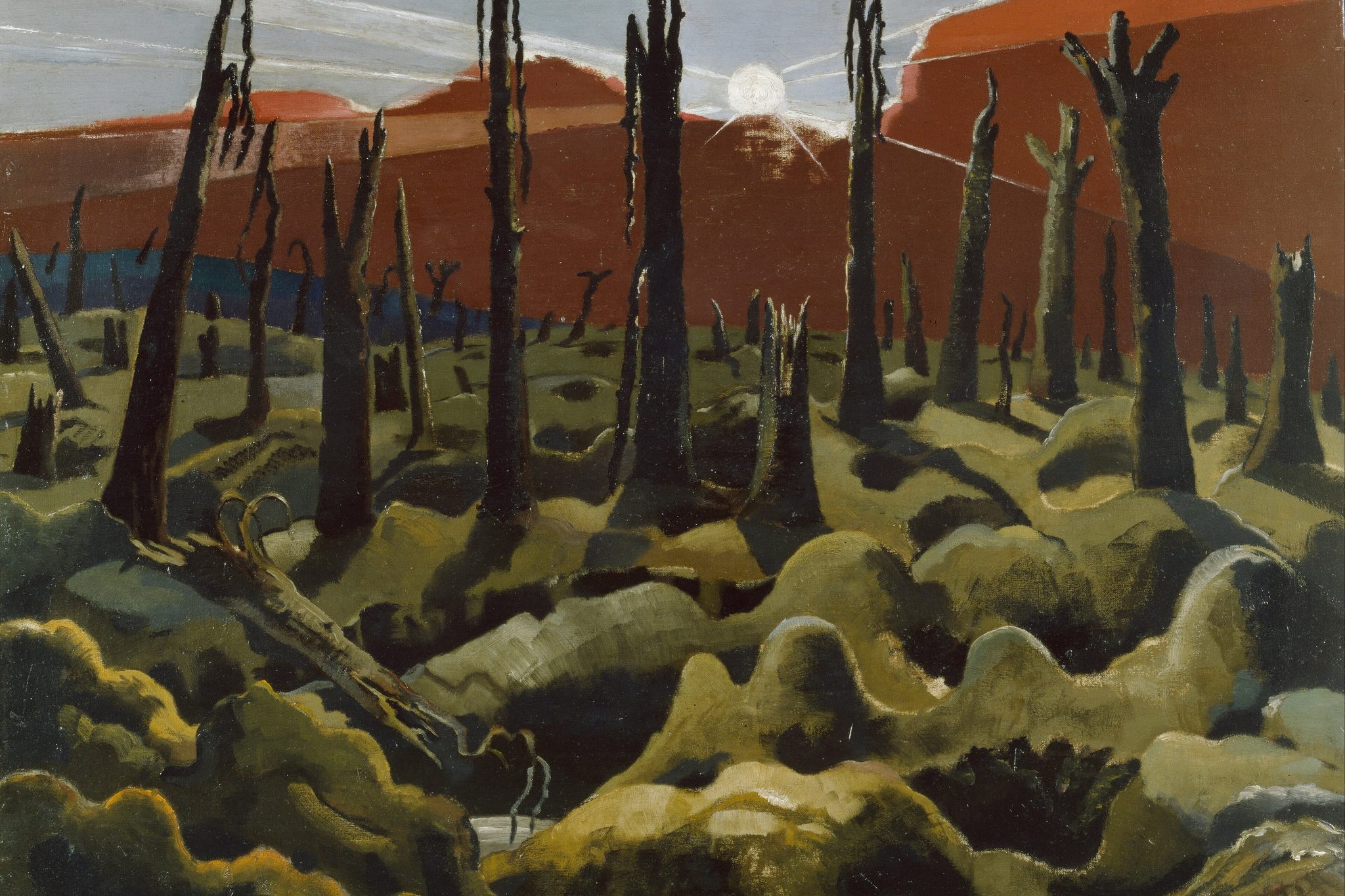
Paul Nash enlisted with the Artists Rifles and went back to the Ypres Salient in November 1917 as an official war artist. In a letter home he called himself "a messenger who will bring back word from the men who are fighting". We Are Making a New World, of 1918, shown on the cover of this post, has a pale sun rising over churned earth and broken trees, and the title is usually read as bitter irony. It was the most admired work in Void of War, his exhibition at the Leicester Galleries that year.
The Menin Road, of 1919, was his picture for the Hall of Remembrance. Its working title was A Flanders Battlefield, and it shows soldiers picking their way through a flooded, shattered wood under shafts of light.
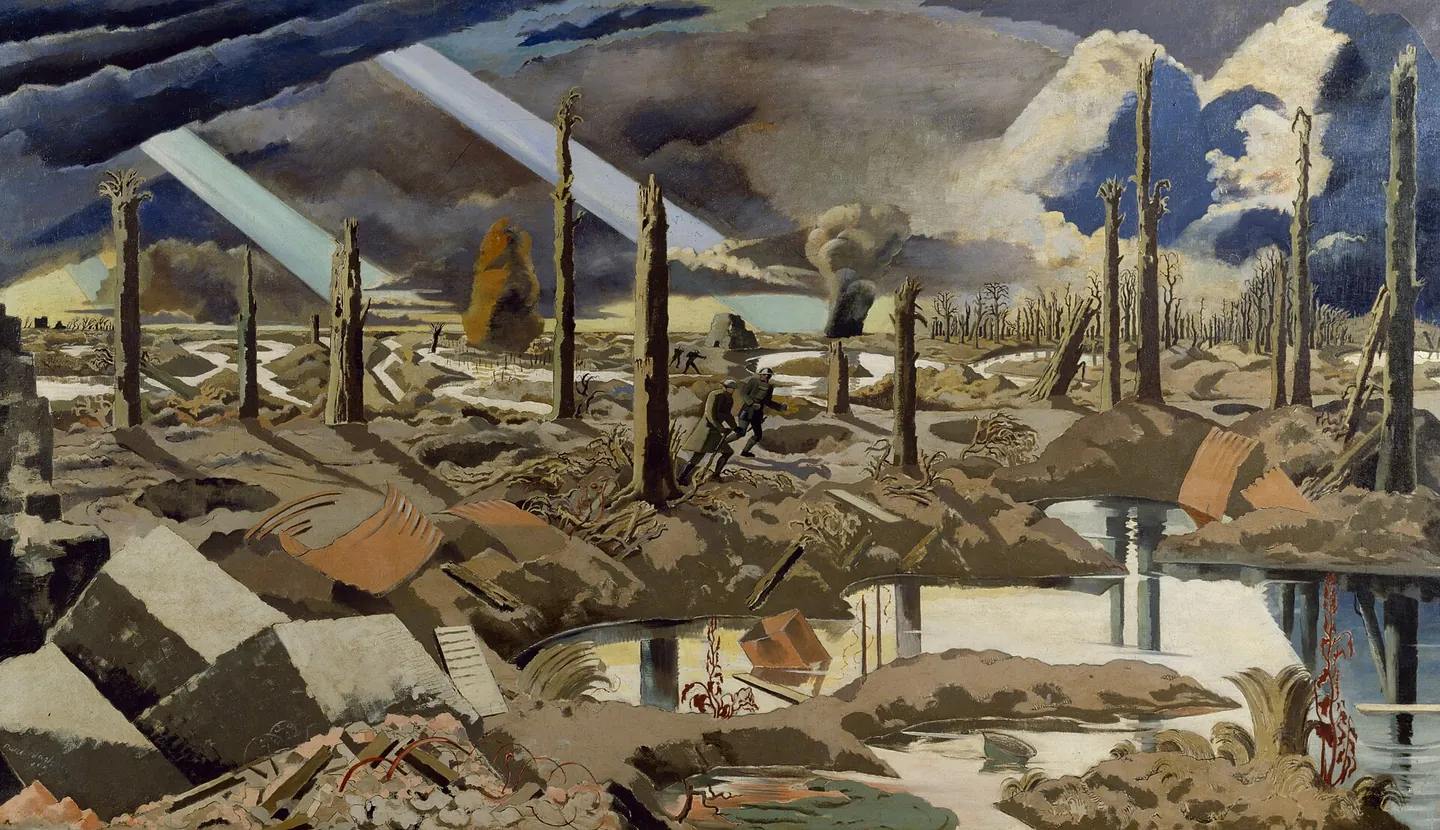
Paul Nash, The Menin Road, 1919, Imperial War Museums. Public domain, via Wikimedia Commons.
Nevinson's Paths of Glory
C. R. W. Nevinson had worked with the Friends' Ambulance Unit in France and as a medical orderly before he became an official war artist in 1917. His Paths of Glory shows two dead British soldiers lying face down in the mud, and the official censor refused to pass it. Nevinson showed it anyway at the Leicester Galleries in 1918, with a strip of brown paper across the canvas marked "censored". He was reprimanded for it, and the publicity was what he wanted. The museum bought the painting during the exhibition.
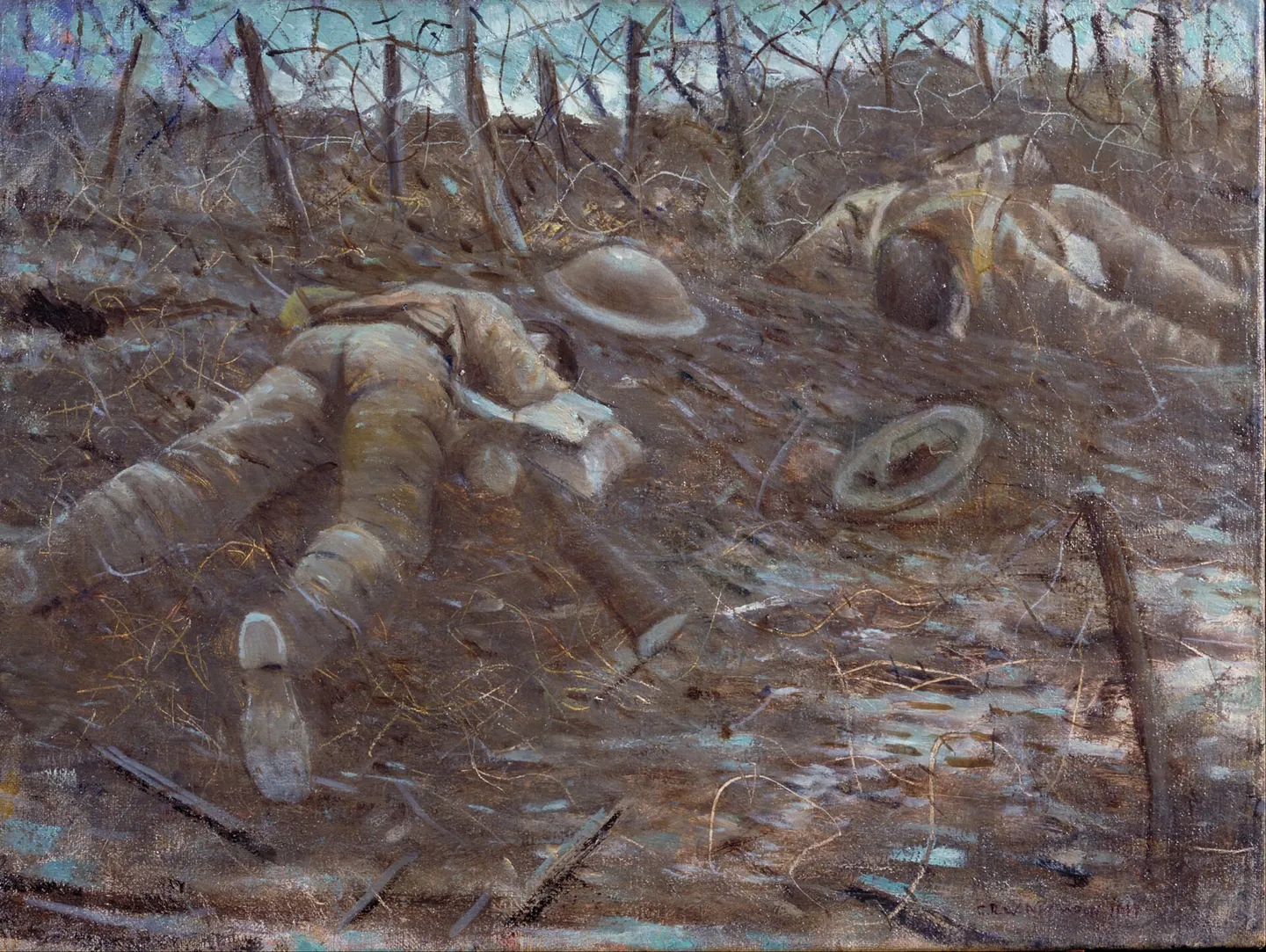
C. R. W. Nevinson, Paths of Glory, 1917, Imperial War Museums. Public domain, via Wikimedia Commons.
Orpen's To the Unknown British Soldier in France
William Orpen was commissioned in 1919 to paint the peace conference at Versailles. For the third canvas he had begun some 30 portraits of politicians and generals, and then painted them all out, leaving a coffin draped in the Union flag in the Hall of Mirrors. To the Unknown British Soldier in France was shown at the Royal Academy in 1923 with two gaunt soldiers and cherubs beside the coffin. The critics attacked it and the Imperial War Museum declined it. Orpen later painted out the figures and gave the picture to the museum in 1928, in memory of Earl Haig.
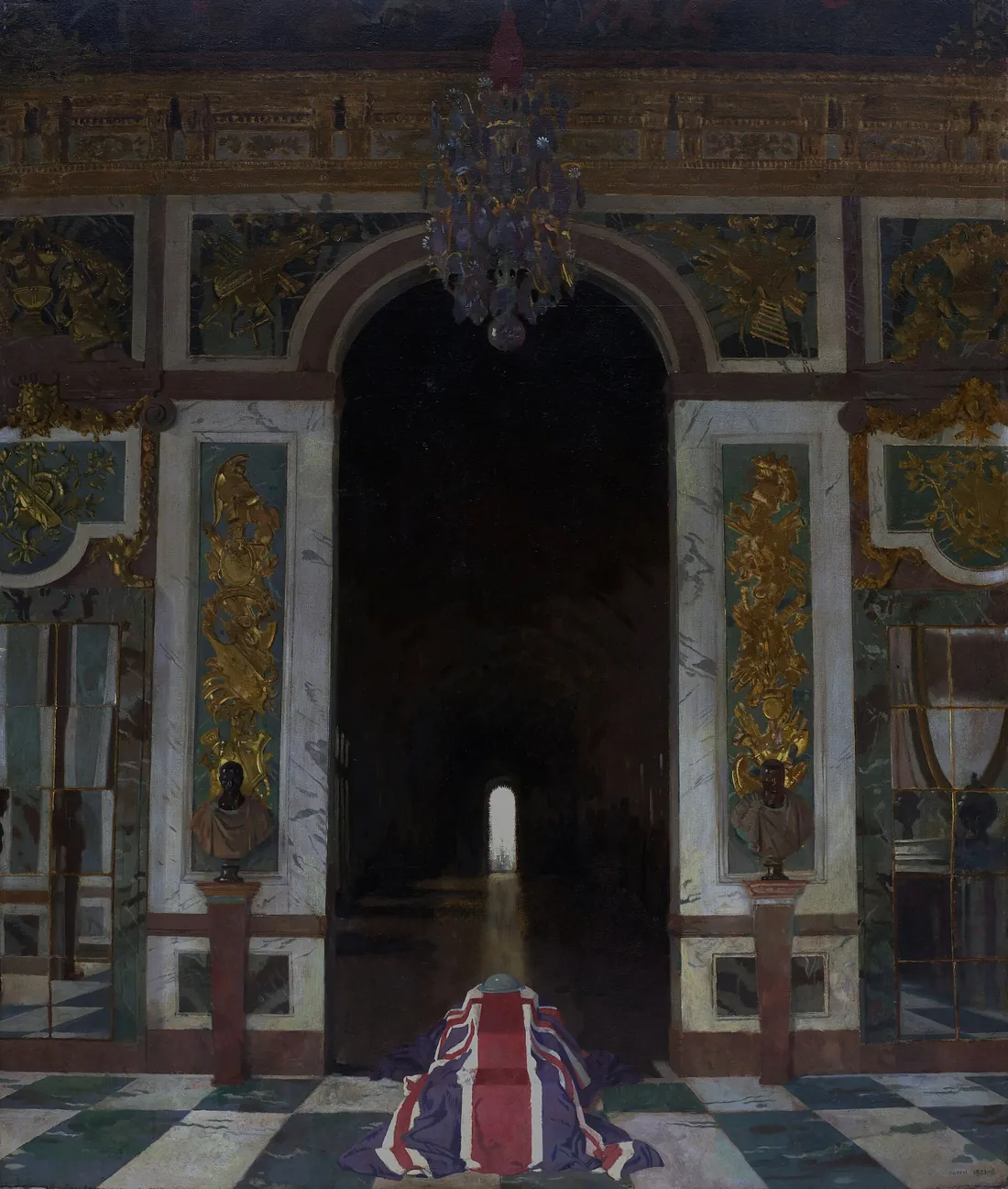
William Orpen, To the Unknown British Soldier in France, 1927, Imperial War Museums. Public domain, via Wikimedia Commons.
Women war artists
Women were given few places in these schemes, but some of the clearest records of the home front and the hospitals are theirs. Norah Neilson Gray, who volunteered with the Scottish Women's Hospital at Royaumont in France, painted its staff and patients in the abbey cloister, and Anna Airy was commissioned to paint munitions factories.
In the Second World War Laura Knight painted Ruby Loftus Screwing a Breech Ring (1943), a portrait of a young factory worker at her lathe, and later recorded the trials at Nuremberg. Evelyn Dunbar spent the war painting the Women's Land Army and other women's work on the home front.
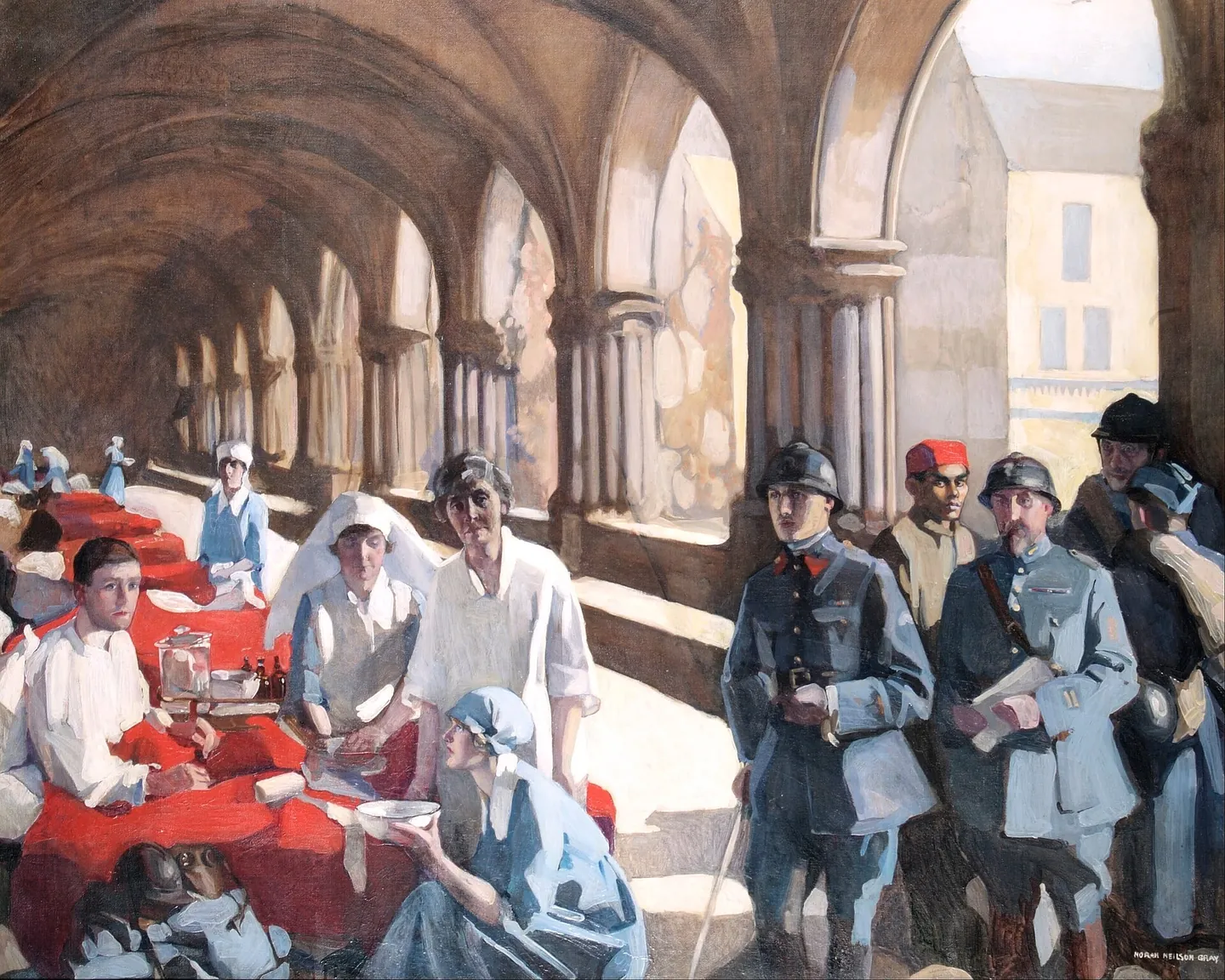
Norah Neilson Gray, The Scottish Women's Hospital: In the Cloister of the Abbaye at Royaumont, 1920, Imperial War Museums. Public domain, via Wikimedia Commons.
WW2 art and the War Artists' Advisory Committee
The Ministry of Information set up the War Artists' Advisory Committee in 1939, chaired by Kenneth Clark, the director of the National Gallery. Its official purpose was propaganda, and Clark also hoped to keep artists employed and away from the fighting. By the end of the war it had built a collection of 5,570 works, more than half of them now with Imperial War Museums.
Henry Moore drew Londoners sheltering in the Underground during the Blitz. Graham Sutherland drew bombed streets, and John Piper painted the ruins of Coventry Cathedral after the raid of November 1940. Stanley Spencer spent years in the shipyards of Port Glasgow for his Shipbuilding on the Clyde, Edward Bawden was sent to France and the Middle East, and L. S. Lowry was commissioned to paint Going to Work in 1943. Nash came back as a war artist too, and his Battle of Britain turns the fighting into vapour trails in a summer sky. His Totes Meer appears in our guide to modern British artists.
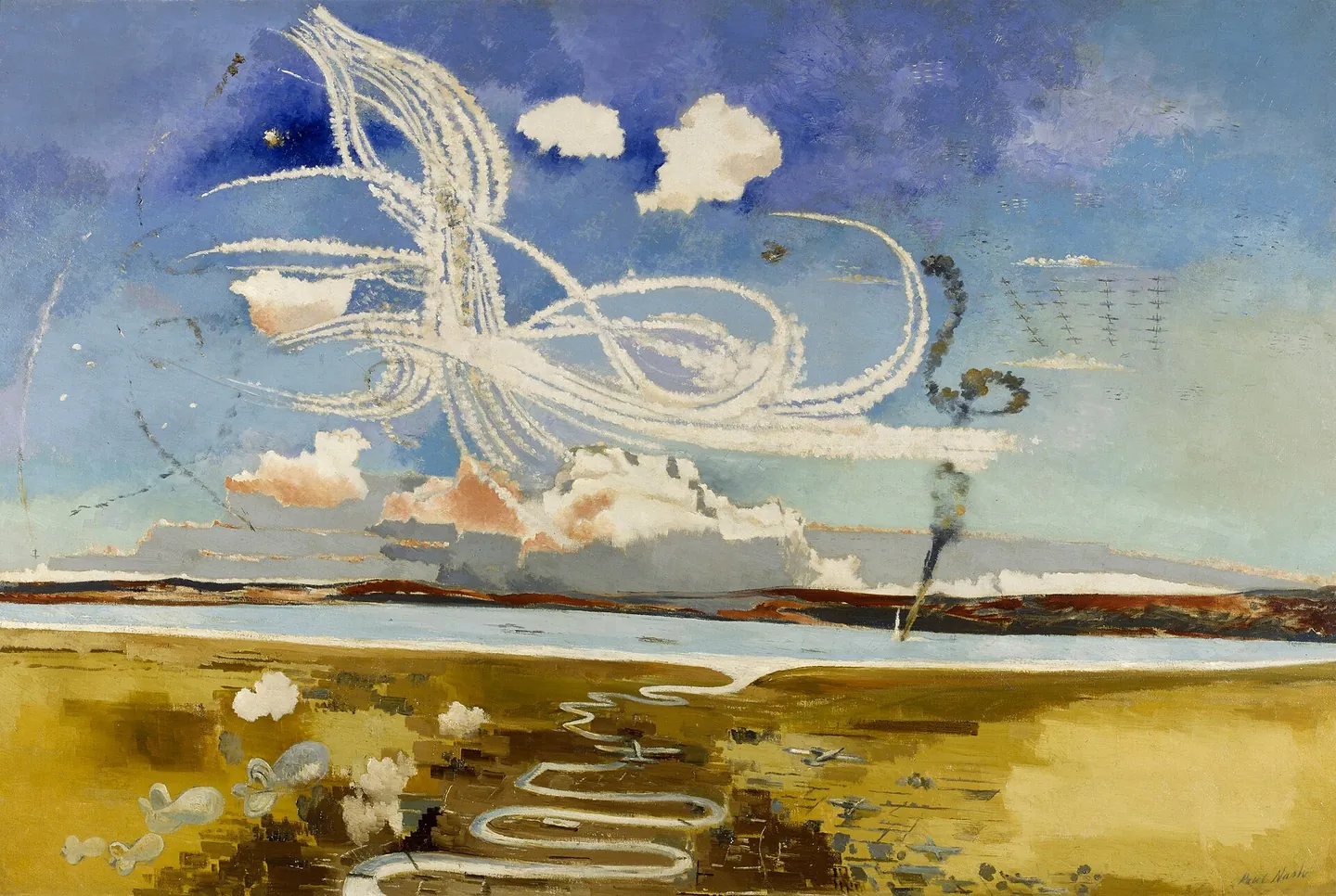
Paul Nash, Battle of Britain, 1941, Imperial War Museums. Public domain, via Wikimedia Commons.
Eric Ravilious (1903–1942), a watercolourist with a love of machinery, was attached to the Admiralty and painted ships, submarines and aircraft in cool, pale tones.
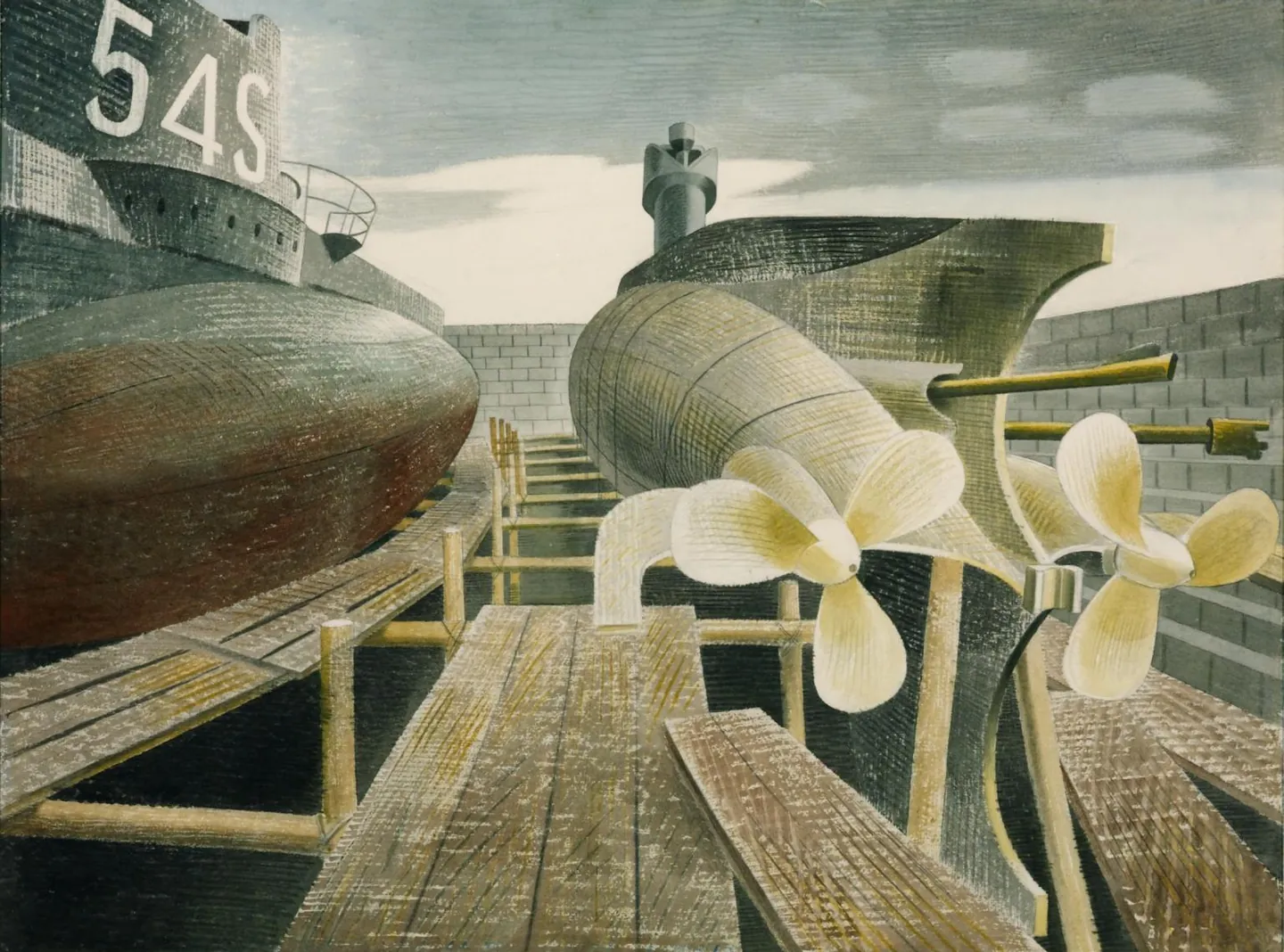
Eric Ravilious, Submarines in Dry Dock, 1940, Tate. Public domain, via Wikimedia Commons.
War paintings beyond Britain
Some of the best-known war paintings were made long before these schemes or outside Britain. Francisco de Goya's The Third of May 1808, painted in 1814, shows a French firing squad executing civilians in Madrid, and his etchings The Disasters of War are just as unsparing. Elizabeth Thompson, later Lady Butler, made her name at the Royal Academy with The Roll Call, of 1874, a line of exhausted Grenadier Guards in the snow of the Crimea.
In the twentieth century Pablo Picasso's Guernica, of 1937, answered the bombing of a Basque town, and Otto Dix, who had served in the German trenches, published his 50 etchings Der Krieg in 1924.
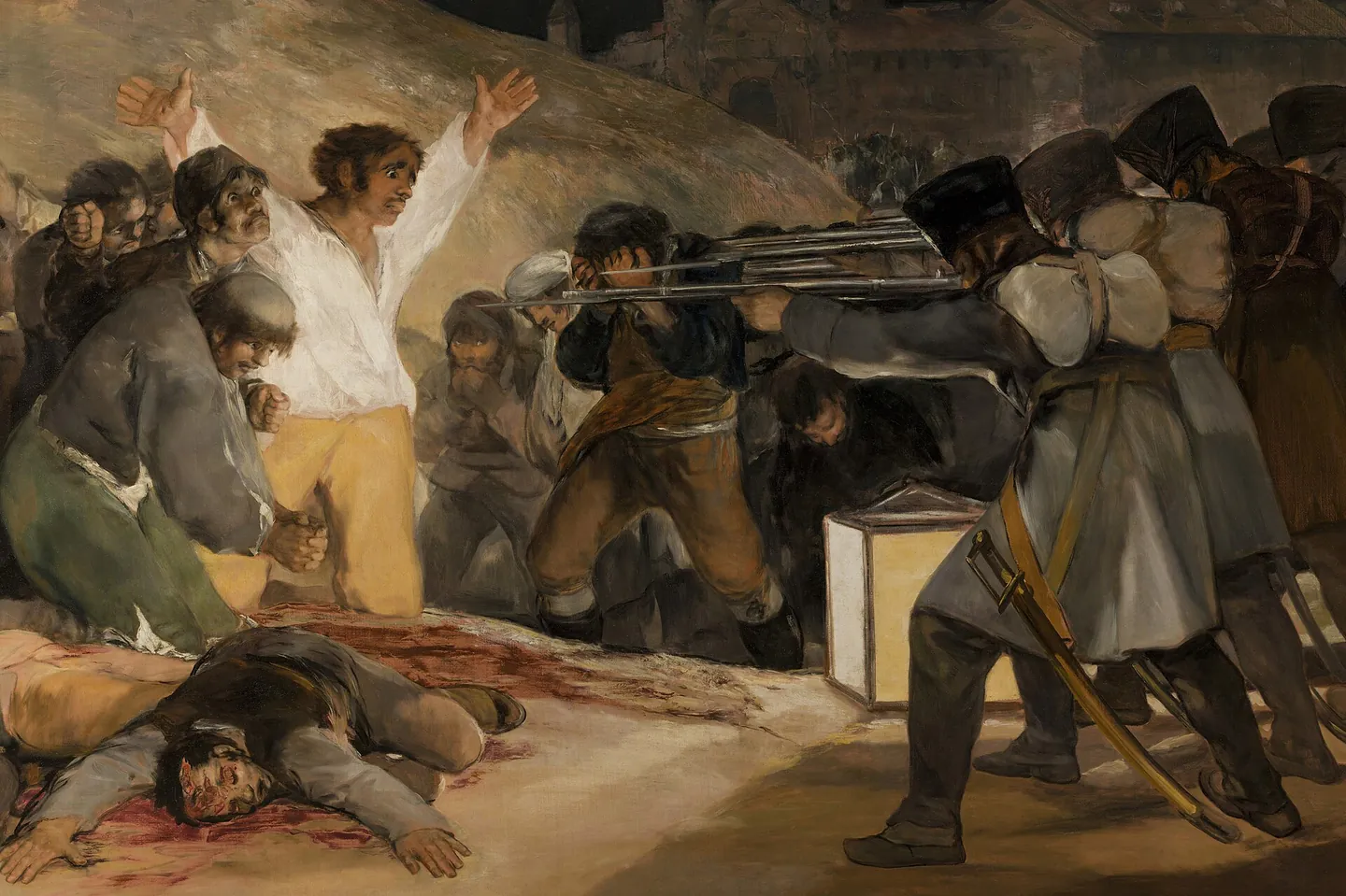
Francisco de Goya, The Third of May 1808, 1814, Museo del Prado. Public domain, via Wikimedia Commons.
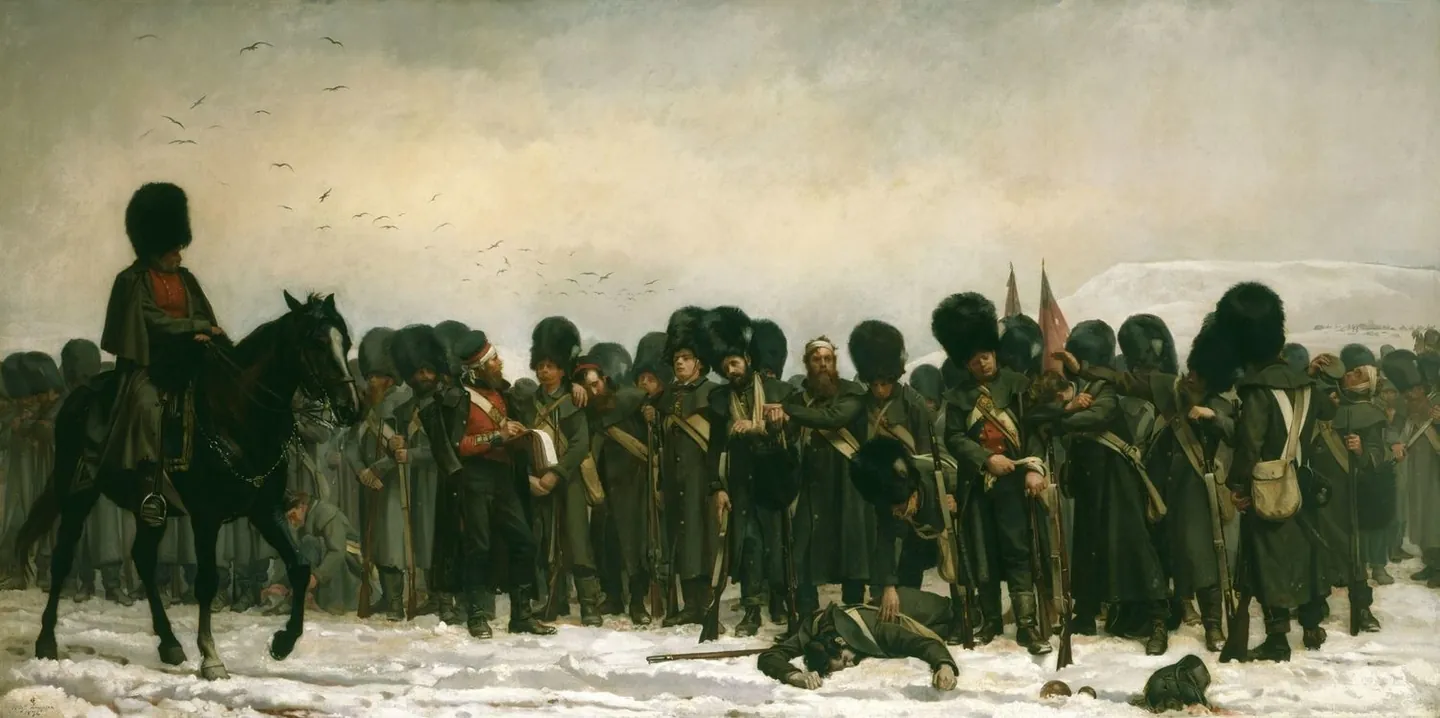
Elizabeth Thompson, Lady Butler, The Roll Call, 1874, Royal Collection. Public domain, via Wikimedia Commons.
Where to see war art
Imperial War Museums holds the largest collection, with galleries at IWM London. Tate holds Totes Meer and other works from the Second World War scheme. Sandham Memorial Chapel at Burghclere in Hampshire, run by the National Trust, has Stanley Spencer's murals based on his service in Salonika and in a military hospital in Bristol. Not every picture is on show at any one time, so check with the museum before you travel.
If you own a war picture
War pictures often stay in families for generations, and the first questions are who made it, whether it is a unique work or a print, and what it shows.
Many soldiers sketched at the front, so a drawing may be a family record by an amateur hand, and it is worth keeping any letters, names or regimental details that go with it. Prints need a closer look. In 1917 the government issued The Great War: Britain's Efforts and Ideals, a set of 66 lithographs by 18 artists including Nevinson, Bone, Kennington and Frank Brangwyn. Signed impressions were issued in small editions and unsigned ones also exist, so the signature and the paper both matter. Labels on the back from galleries such as the Leicester Galleries can show where a picture was first seen.
If you have a picture like this and would like to know what it is, send us photographs for a free valuation. There is no obligation to sell, and we act for you rather than for the saleroom.
Cover: Paul Nash, We Are Making a New World, 1918, Imperial War Museums. Public domain, via Wikimedia Commons.
Exhibitions