Art News ·
Art News: Modern British Artists, the Painters and Sculptors from Sickert to Hockney
By Whitebank Fine Art
Modern British artists are the painters and sculptors who brought new ideas into British art from the early twentieth century to the 1960s, from Walter Sickert in his north London lodgings to Henry Moore, Barbara Hepworth, Francis Bacon and David Hockney. This guide sets out who they were, the groups they formed and what to check if you own a work by one of them.
What is Modern British art?
Modern British is a label used by salerooms, dealers and museums more often than by the artists themselves. It usually covers British art from about 1900 to the 1960s, although some definitions start in the 1880s and others run on through the post-war years and pop. Christie's and Sotheby's both hold Modern British sales in London.
The label holds a wide range of styles. Artists in Britain took what they saw in Paris and elsewhere in Europe and mixed it with British subjects: the landscape, the coast, the city street and the people they knew.
Who are the most famous modern British artists?
The names most people know are Henry Moore, Barbara Hepworth, L. S. Lowry, Ben Nicholson, Paul Nash, Stanley Spencer, Francis Bacon, Lucian Freud, Bridget Riley and David Hockney. Dozens of other British painters and sculptors from the period are widely collected, and they are easiest to understand through the groups they belonged to.
The Camden Town Group
The Camden Town Group formed in London in 1911 around Walter Sickert, who had been painting the lodging houses and music halls of the city since his return from France in 1905. Its members included Spencer Gore, its first president, Harold Gilman, Charles Ginner, Robert Bevan and later Duncan Grant. They painted ordinary streets and rooms in thick, broken colour, and held three exhibitions at the Carfax Gallery in 1911 and 1912 before merging into the London Group in 1913.
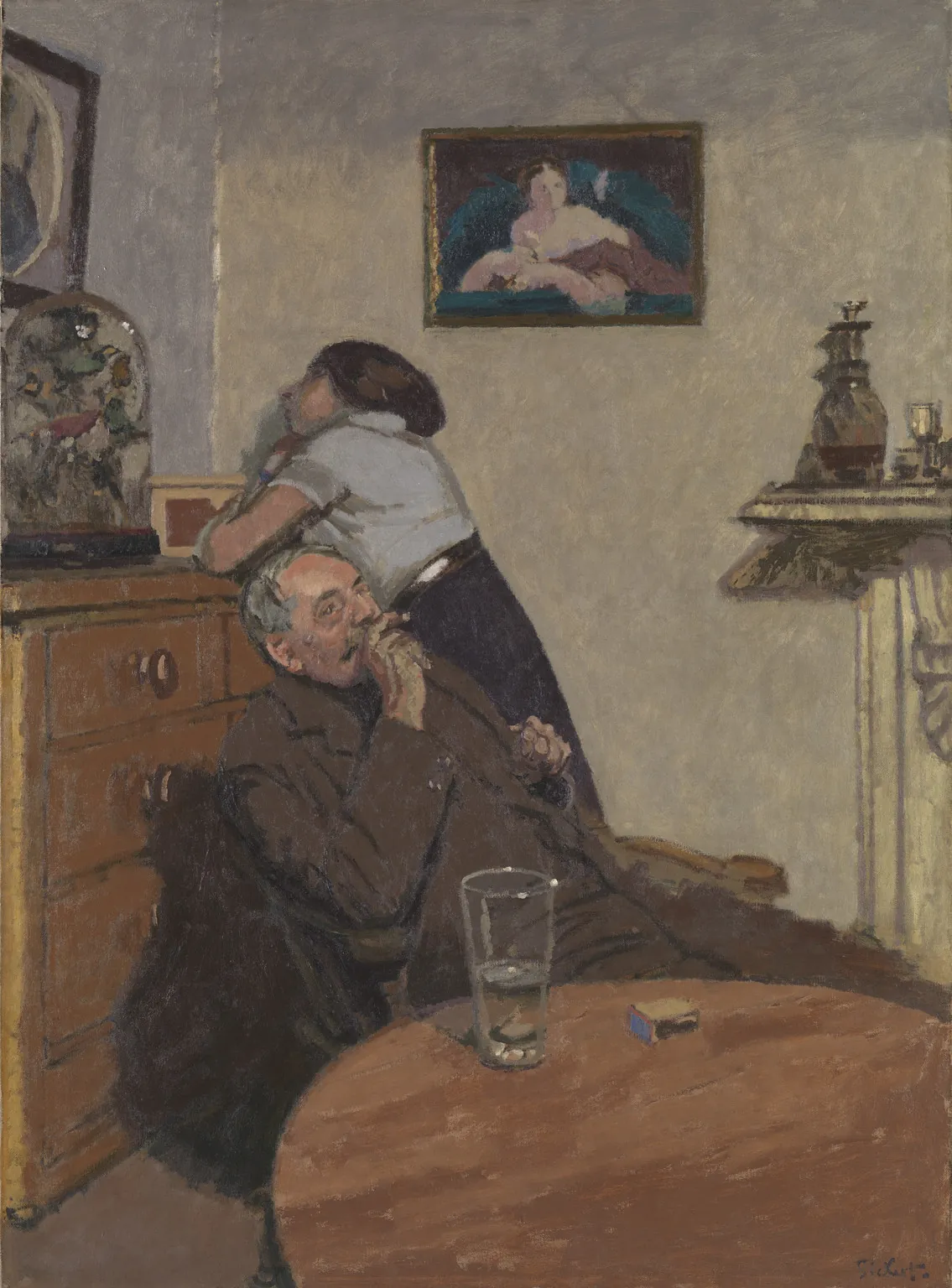
Walter Sickert, Ennui, about 1914. Public domain, via Wikimedia Commons.
Vorticism
Vorticism is often called Britain's first abstract art movement. Wyndham Lewis launched it in 1914 with the magazine BLAST, and the poet Ezra Pound gave it its name. Its hard, machine-like geometry drew on Cubism and Futurism, and the group included Edward Wadsworth, William Roberts, Helen Saunders, Jessica Dismorr and the sculptor Henri Gaudier-Brzeska. Jacob Epstein's Rock Drill is the best-known sculpture linked to it. C. R. W. Nevinson, a friend of the group, sided with the Italian Futurists and became better known for his war paintings.
The Vorticists held one exhibition of their own, in London in 1915, and the group did not outlast the First World War. The war did give Wadsworth a new subject. He supervised the dazzle camouflage of ships at Liverpool and Bristol, and painted them afterwards.
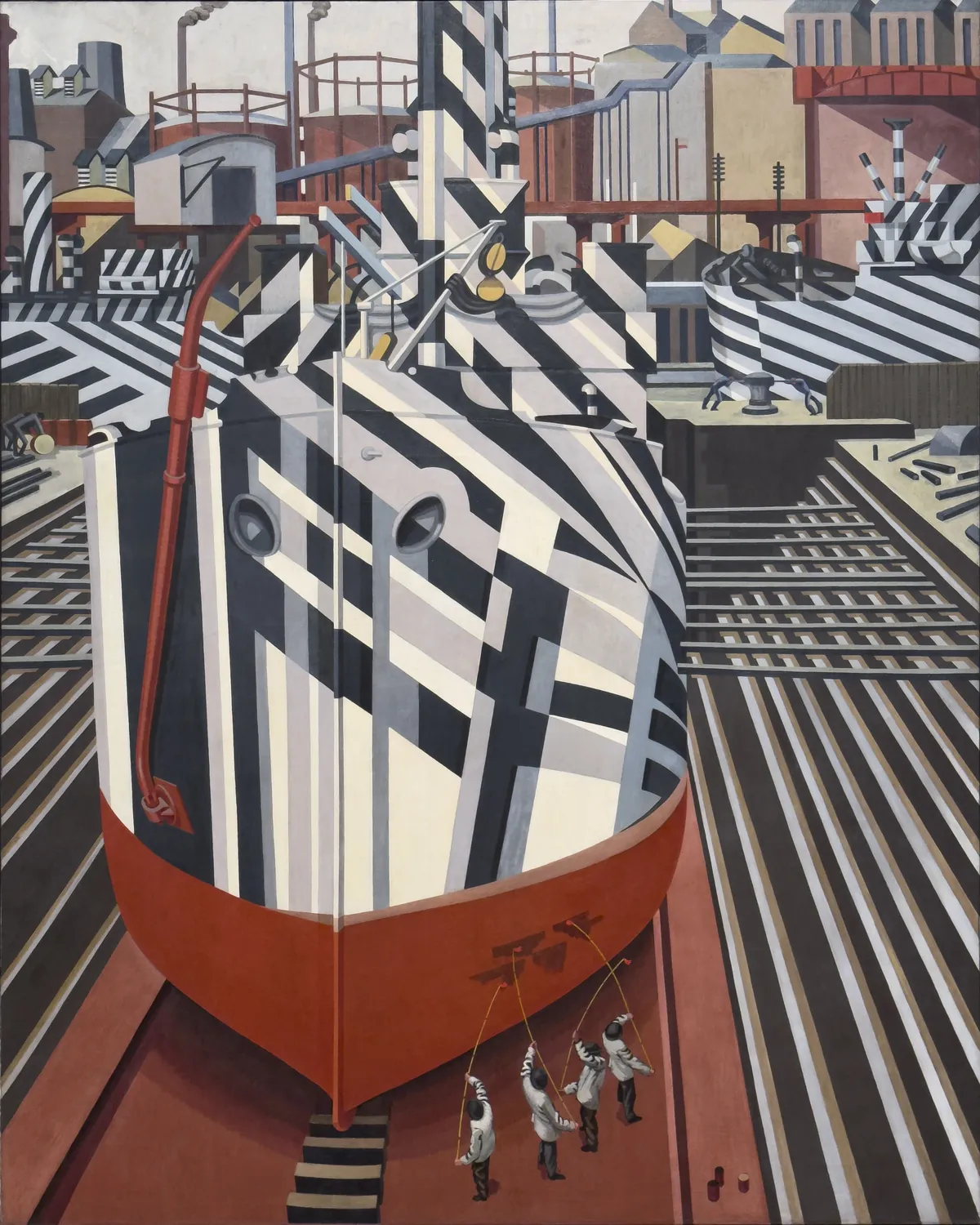
Edward Wadsworth, Dazzle-ships in Drydock at Liverpool, 1919, National Gallery of Canada. Public domain, via Wikimedia Commons.
The Bloomsbury Group artists
The painters of the Bloomsbury Group were Vanessa Bell, Duncan Grant and the critic and artist Roger Fry, whose exhibitions of Post-Impressionist painting in London in 1910 and 1912 introduced many British viewers to Cézanne, Gauguin, Van Gogh and Matisse. In 1913 Fry founded the Omega Workshops, which sold painted furniture, textiles and ceramics, and Bell and Grant decorated Charleston, their farmhouse in Sussex, in the same spirit. Omega work was sold unsigned, marked at most with the Greek letter, so a painted tray or table can be easy to miss.
Dora Carrington, who was close to the circle through the writer Lytton Strachey, painted landscapes and portraits that she rarely showed in her lifetime.
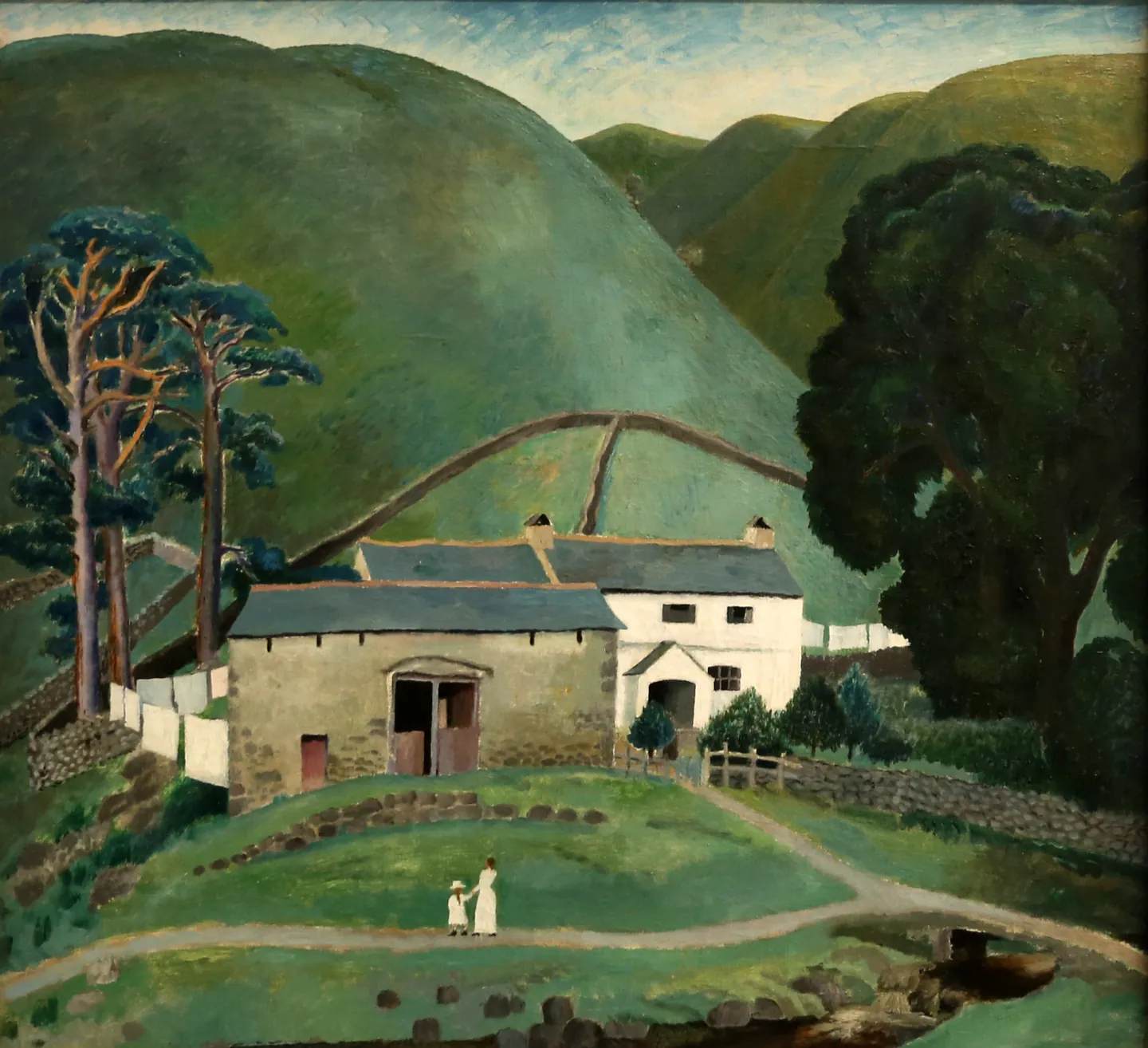
Dora Carrington, Farm at Watendlath, 1921, Tate. Photo: Sailko, CC BY 3.0, via Wikimedia Commons.
Unit One, Paul Nash and British surrealism
In 1933 Paul Nash founded Unit One, a short-lived group that brought together Henry Moore, Barbara Hepworth, Ben Nicholson, Edward Burra, Edward Wadsworth and others. The critic Herbert Read edited a book on them, and they showed at the Mayor Gallery in London in 1934. British surrealism arrived in force two years later with the International Surrealist Exhibition at the New Burlington Galleries, where Nash, Roland Penrose and Eileen Agar all showed.
Nash was an official war artist in both world wars. He based Totes Meer on a dump of wrecked aircraft near Oxford, and it is among the best-known British paintings of the Second World War.
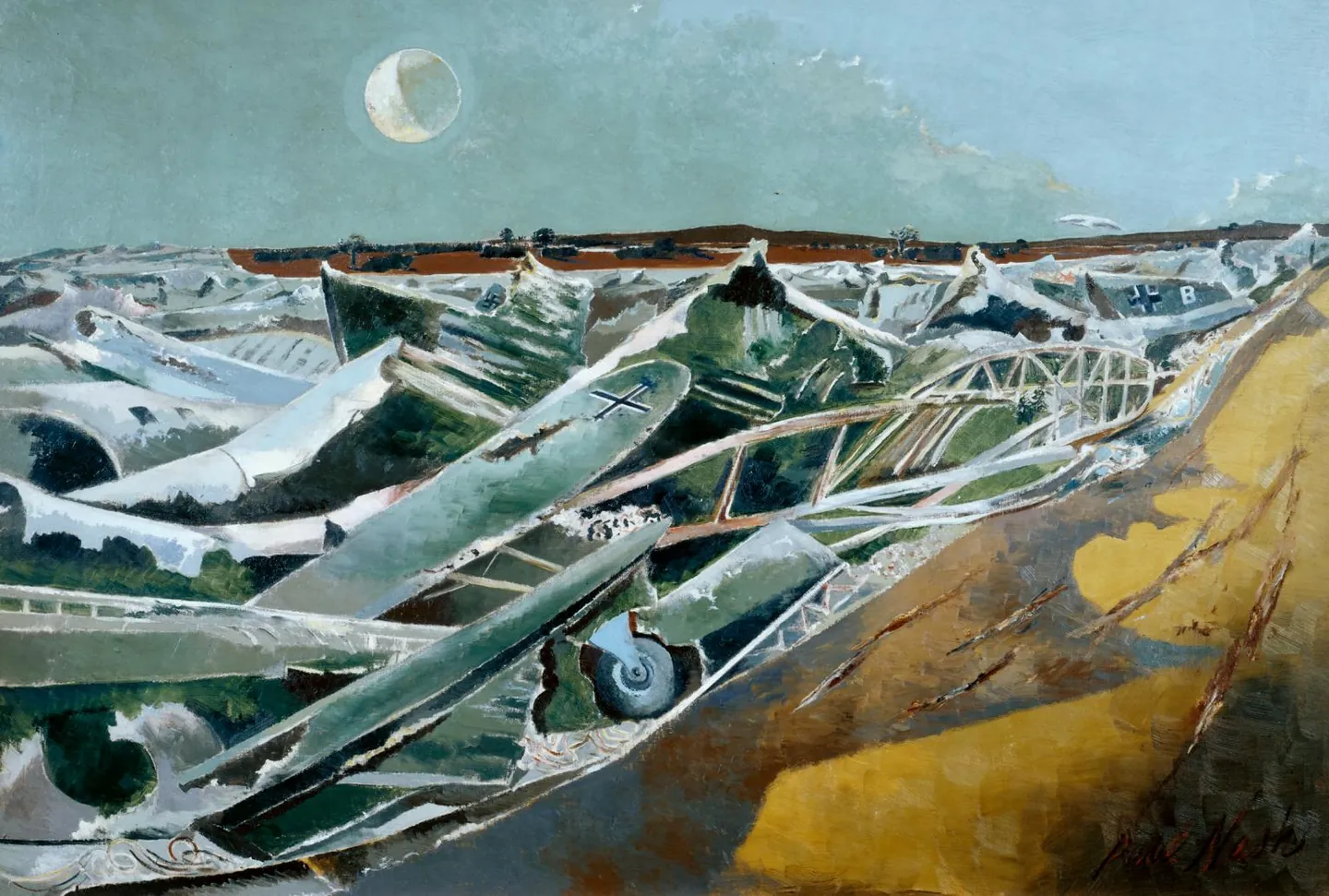
Paul Nash, Totes Meer (Dead Sea), 1940–41, Tate. Public domain, via Wikimedia Commons.
Ravilious, Bawden and the Neo-Romantics
Eric Ravilious and Edward Bawden met at the Royal College of Art in the 1920s and shared a house at Great Bardfield in Essex from 1932. Both worked in watercolour, wood engraving and design, Ravilious designed ceramics for Wedgwood, and both became official war artists.
Neo-Romantic painters such as Graham Sutherland, John Piper, John Minton, John Craxton and Keith Vaughan looked back to William Blake and Samuel Palmer for a darker, more personal view of the landscape in the 1930s and 1940s. Sutherland went on to design the great tapestry for Coventry Cathedral, and Piper its baptistery window.
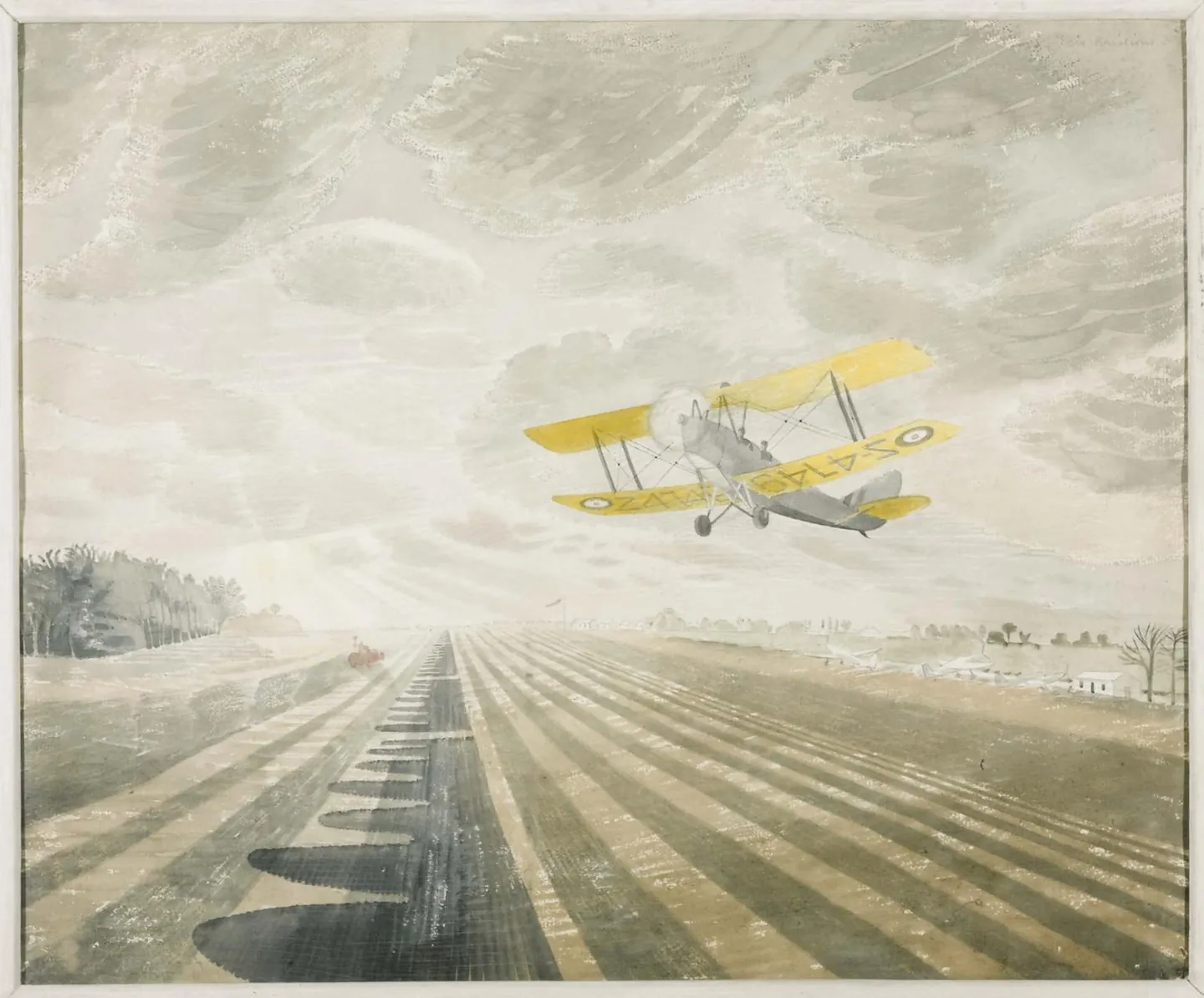
Eric Ravilious, Tiger Moth, 1942, Tate. Public domain, via Wikimedia Commons.
British sculptors: Moore, Hepworth and the geometry of fear
Henry Moore and Barbara Hepworth are the two best-known British sculptors of the century. Both grew up in West Yorkshire and studied at Leeds School of Art and the Royal College of Art, and Moore won the International Sculpture Prize at the 1948 Venice Biennale. We looked at Hepworth's year in 2026 in a separate post.
At the 1952 Biennale a younger group including Lynn Chadwick, Kenneth Armitage, Reg Butler, Eduardo Paolozzi and William Turnbull showed spiky, anxious figures in metal, which Herbert Read described as the geometry of fear. Elisabeth Frink went on to make her men, horses and birds in bronze, and Anthony Caro, once an assistant to Moore, welded painted steel and set it straight on the floor. Many of these sculptors worked in bronze editions, so the cast number and foundry mark are among the first things to check.
St Ives artists
When Ben Nicholson and Barbara Hepworth moved to Cornwall in 1939, St Ives was already home to Alfred Wallis, the self-taught former seaman whose paintings on card had caught Nicholson's eye in 1928. After the war the town became a centre for British abstract painting. Peter Lanyon, who was born there, Patrick Heron, Terry Frost, Roger Hilton, Wilhelmina Barns-Graham and Sandra Blow all lived or worked in the area for a time, and much of their work draws on its coast. Tate St Ives, which opened in 1993, shows the St Ives School today.
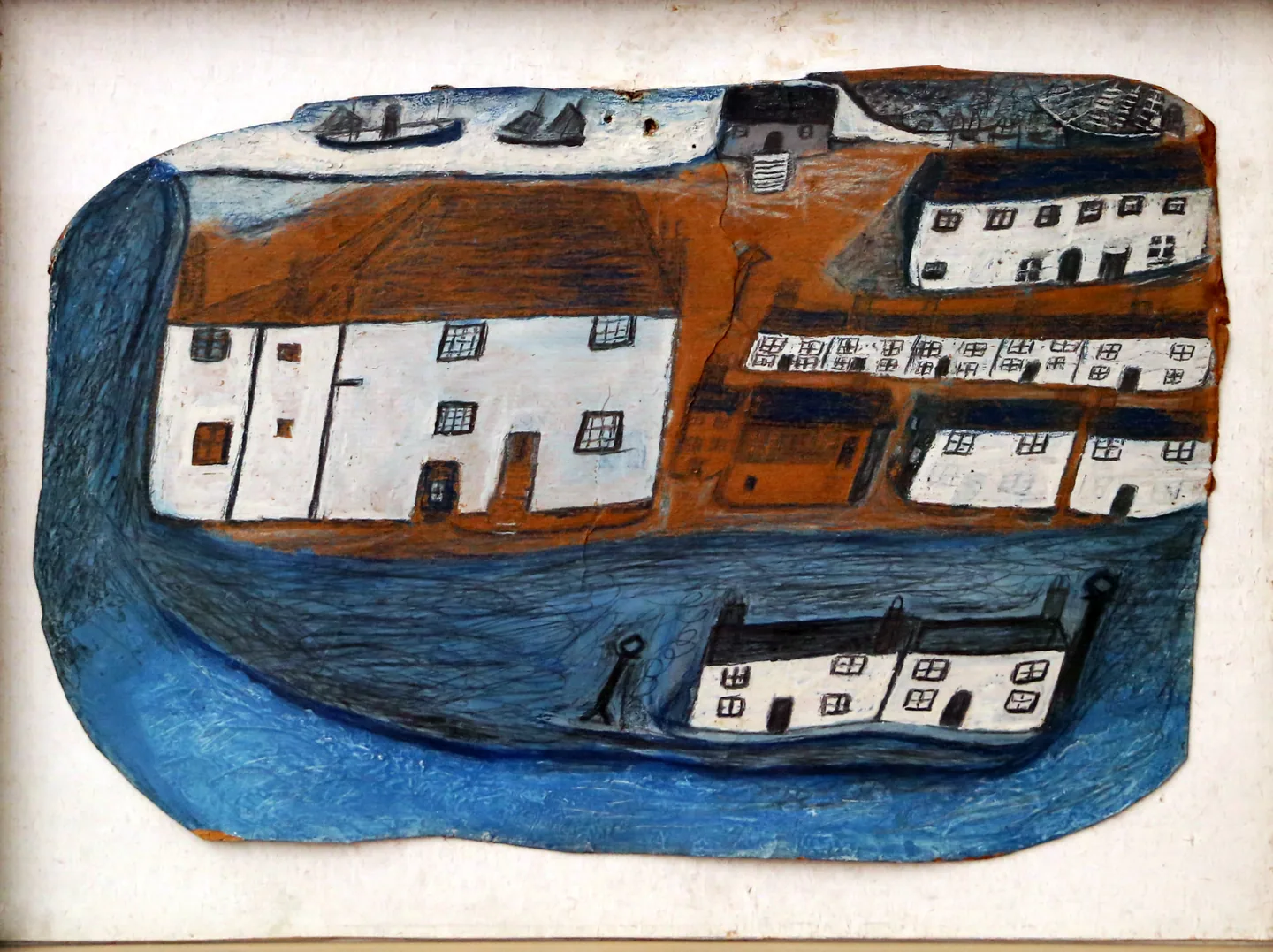
Alfred Wallis, St Ives, about 1928. Photo: Sailko, CC BY 3.0, via Wikimedia Commons.
The School of London
The School of London is the name R. B. Kitaj gave in 1976 to a loose circle of figurative painters in the capital, among them Francis Bacon, Lucian Freud, Frank Auerbach, Leon Kossoff and Michael Andrews. Auerbach and Kossoff studied under David Bomberg at Borough Polytechnic and built up their paint in thick, worked layers. Euan Uglow, who taught at the Slade, took a slower route, measuring each sitter over months or years and leaving the marks visible on the canvas.
British pop art
British pop art began in the 1950s at the Institute of Contemporary Arts in London, where the Independent Group, including Richard Hamilton and Paolozzi, studied advertising, film and American magazines. Hamilton's small collage Just what is it that makes today's homes so different, so appealing? was made for the exhibition This Is Tomorrow at the Whitechapel Art Gallery in 1956.
A second wave came out of the Royal College of Art around 1960, with David Hockney, Allen Jones, Patrick Caulfield and Derek Boshier. Peter Blake, who co-designed the cover of Sgt. Pepper's Lonely Hearts Club Band, and Joe Tilson had studied there a few years earlier. Many pop artists made screenprints in editions, so a print and a unique work by the same hand can be very different things.
British female artists
Some of these groups shut women out, including Camden Town, but women are central to the story. Gwen John (1876–1939), who spent most of her career in France, painted quiet interiors and portraits. Laura Knight became the first woman elected a full Royal Academician in 1936. Winifred Nicholson and Frances Hodgkins showed with the Seven and Five Society, Prunella Clough painted lorry drivers and industrial sites, and Pauline Boty was one of the founders of British pop. Bridget Riley became the first woman to win the International Painting Prize at the Venice Biennale, in 1968, and Lucie Rie changed British studio pottery from a mews in London.
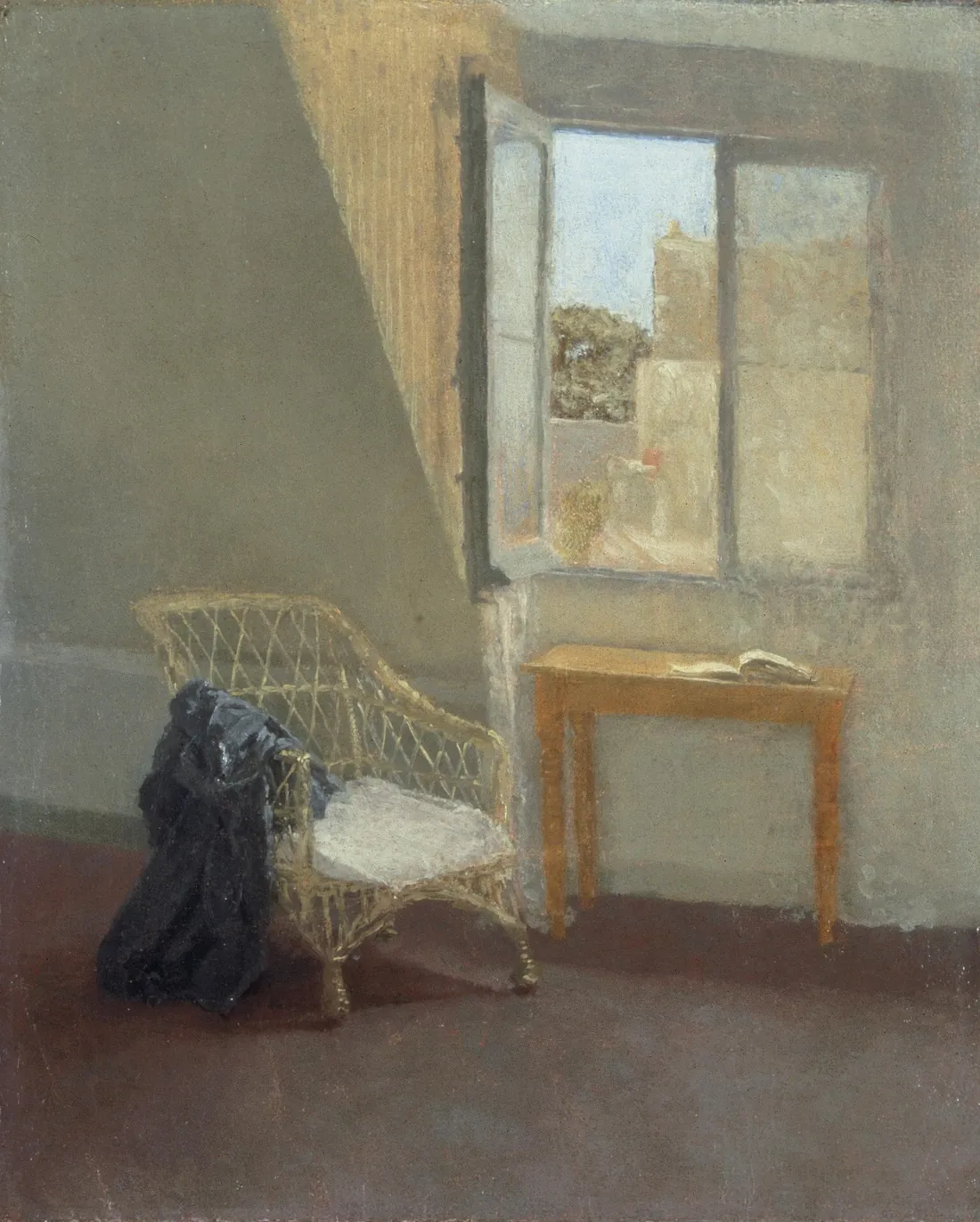
Gwen John, A Corner of the Artist's Room in Paris, about 1907–09, National Museum Wales. Public domain, via Wikimedia Commons.
British artists outside the groups
Some of the best-known names stood apart. L. S. Lowry painted the mill towns around Salford while working as a rent collector, and Stanley Spencer set biblical scenes in the village of Cookham. Frank Bowling, who arrived from British Guiana in 1953 and studied at the Royal College of Art, became the first Black artist elected a Royal Academician.
Modern British art at auction
Modern British art has its own sales in London. At Christie's Modern British and Irish Art Evening Sale on 21 October 2026, three sculptures by Barbara Hepworth made more than half of the £23.1 million total, led by Sculpture with Colour (Eos) at £6.19 million.
Prices across the field vary enormously, because one name can cover a major oil, a small drawing and a print in a large edition. The first checks on any work are the medium, the date, the signature and the back of the frame, where labels from dealers such as the Leicester Galleries, the Redfern Gallery, Gimpel Fils or Waddington can show where it has been.
Each artist linked above has a profile on our site, with their biography and what a buyer checks before bidding. If you own a work by a modern British artist, send us photographs for a free valuation. There is no obligation to sell, and we act for you rather than for the saleroom.
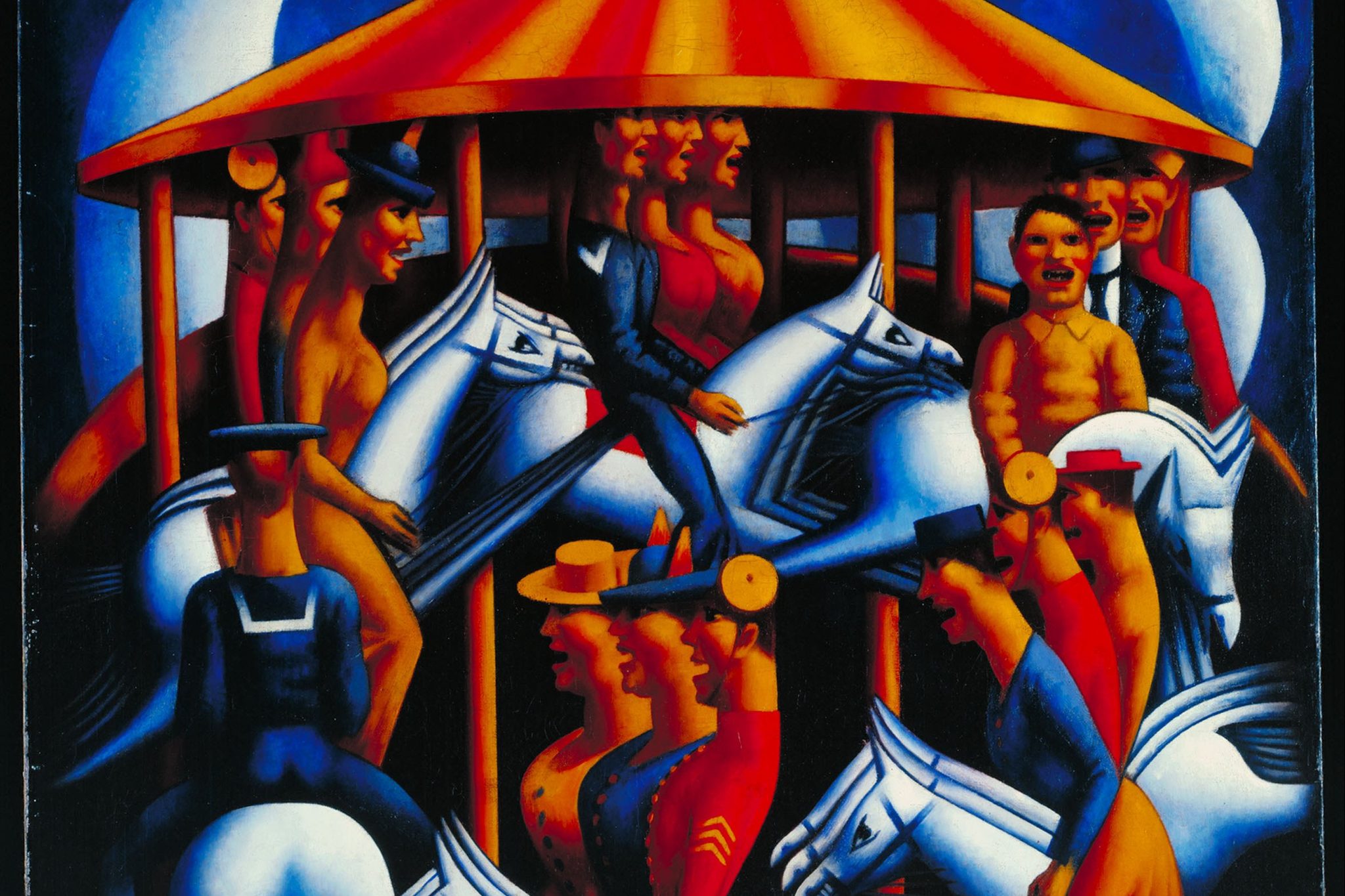
Cover: Mark Gertler, Merry-Go-Round, 1916, Tate. Public domain, via Wikimedia Commons.
Auction market