
Henry Moore valuation
Coal miner's son who put the hole through the figure and filled the world's plazas with reclining women.
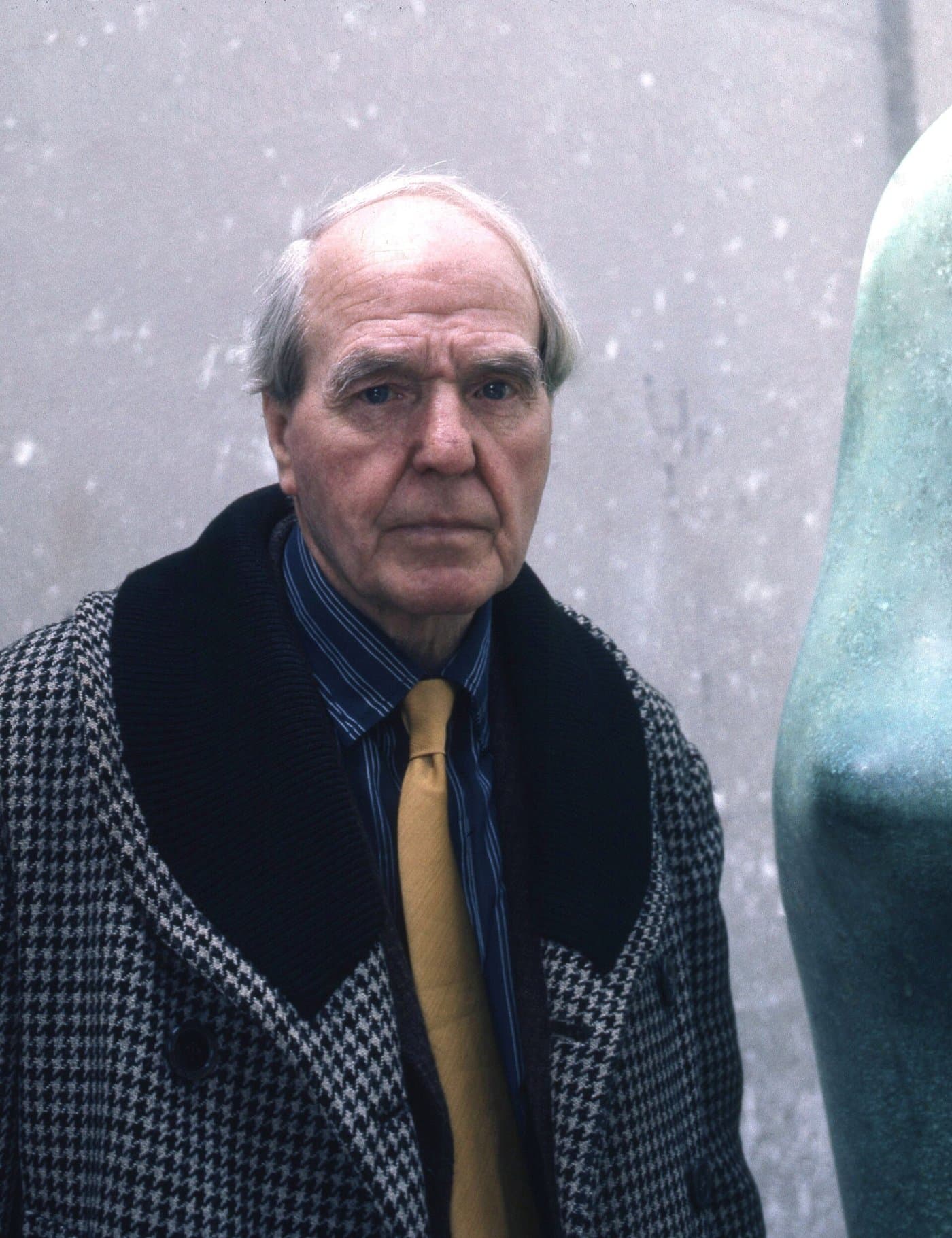
Henry Moore was born at Castleford in Yorkshire in 1898, the son of a coal miner, was gassed at Cambrai, and studied at Leeds alongside Barbara Hepworth before the Royal College.
What a work by Henry Moore is worth
Send photographs and whatever paperwork came with it. The first question is what the work actually is — edition or unique, when, and in what condition — because everything else follows from the answer. A valuation is free, made online from the photographs you send, and it commits you to nothing. We act for sellers across the United Kingdom, Europe and the United States.
Write to info@whitebankfineart.co.uk, or start below.
Bio
Henry Moore was born at Castleford in Yorkshire in 1898, the son of a coal miner, was gassed at Cambrai, and studied at Leeds alongside Barbara Hepworth before the Royal College. Pre-Columbian and Cycladic sculpture in the British Museum mattered more to him than the classical tradition. The reclining figure, the mother and child, and the pierced form are the three subjects of a sixty-year career. The Shelter Drawings, made in the London Underground during the Blitz, are the best-known works on paper. He gave away most of his fortune through the Henry Moore Foundation and died in 1986.
Bronzes are editioned, generally in numbers of seven or nine plus artist's copies, and cast number, foundry, patina and whether a cast was made in the artist's lifetime are the substance of a valuation; the Foundation holds the archive and unauthorised casts are a known problem. The carvings in wood and stone are unique and sit far above the bronzes. Maquettes are numerous. Drawings and the Shelter Drawings are a significant separate market, and Moore's lithographs and etchings from the 1970s onwards are plentiful and modestly valued.
At a glance
- Born
- 30 July 1898, Castleford
- Died
- 31 August 1986, Much Hadham
- Movements
- Contemporary art, Surrealism, Primitivism
More on Wikipedia.
Getting an opinion from the Foundation
The Henry Moore Foundation at Perry Green runs a research and review service for works whose attribution is uncertain. It works in two stages. The Foundation's researchers first check the work against the catalogue raisonné of sculpture, drawings and graphics, their own unpublished records and a database of recorded fakes and misattributions; only where the evidence warrants it does the work go before an expert panel in person. A bronze or drawing that has never been catalogued needs this before a sale.
The lithographs and etchings are the opposite case: plentiful, recorded and usually straightforward. What matters is whether a sheet is signed and numbered in pencil or comes from an unsigned book or portfolio edition, its condition, and whether it is an original print at all, since posters and reproductions after the sculpture are common. A small bronze with a plausible story and no catalogue number is where the care should go.
Leeds, the Chac Mool and Much Hadham
The Leeds School of Art set up a sculpture studio especially for Moore when he arrived in 1919, and there he could see the modern pictures collected by Sir Michael Sadler, the university's vice-chancellor. At the Royal College he was set to copy a marble relief with a pointing machine; he carved it directly instead and faked the machine's prick marks. A travelling scholarship in 1924 took him to Italy for Giotto, Giovanni Pisano and Michelangelo, and in Paris he saw a plaster cast of the Toltec-Maya Chac Mool, the figure behind his reclining women.
His first visit to America came in 1946, for a retrospective at the Museum of Modern Art. Family Group, made in 1950 for a school in Stevenage, was his first large public bronze, and in 1958 he carved a marble reclining figure for the UNESCO building in Paris. From the late 1940s he worked out his forms in clay or plaster and had them cast by the lost-wax process, with assistants at Much Hadham who included Anthony Caro and Richard Wentworth. The Foundation, set up in 1977, keeps his house and seventy acres of sculpture grounds at Perry Green open to visitors.
Best auction results
- Reclining Figure: Festival £19.1m
- Bronze, 1951 · London · February 2012
- Publicly reported
- An auction record for the artist.
Results as reported at the time of sale, inclusive of buyer's premium. They are a record of what specific works achieved on specific days, not a guide to what any other work is worth.
Whitebank Fine Art is an art advisory and gallery, not an auction house, and is not affiliated with any auction house or with the artist, their estate or their representatives. This page describes the range we advise on. Nothing here is investment advice.