

Alexej von Jawlensky valuation
Russian officer turned Munich Expressionist, who painted the same head for thirty years.
Alexej von Jawlensky was born near Torzhok in 1864, served as an officer in the Imperial Russian army, and resigned his commission to study painting in Munich, where he arrived in 1896 with Marianne von Werefkin.
What a work by Alexej von Jawlensky is worth
Send photographs and whatever paperwork came with it. The first question is what the work actually is — edition or unique, when, and in what condition — because everything else follows from the answer. A valuation is free, made online from the photographs you send, and it commits you to nothing. We act for sellers across the United Kingdom, Europe and the United States.
Write to info@whitebankfineart.co.uk, or start below.
Bio
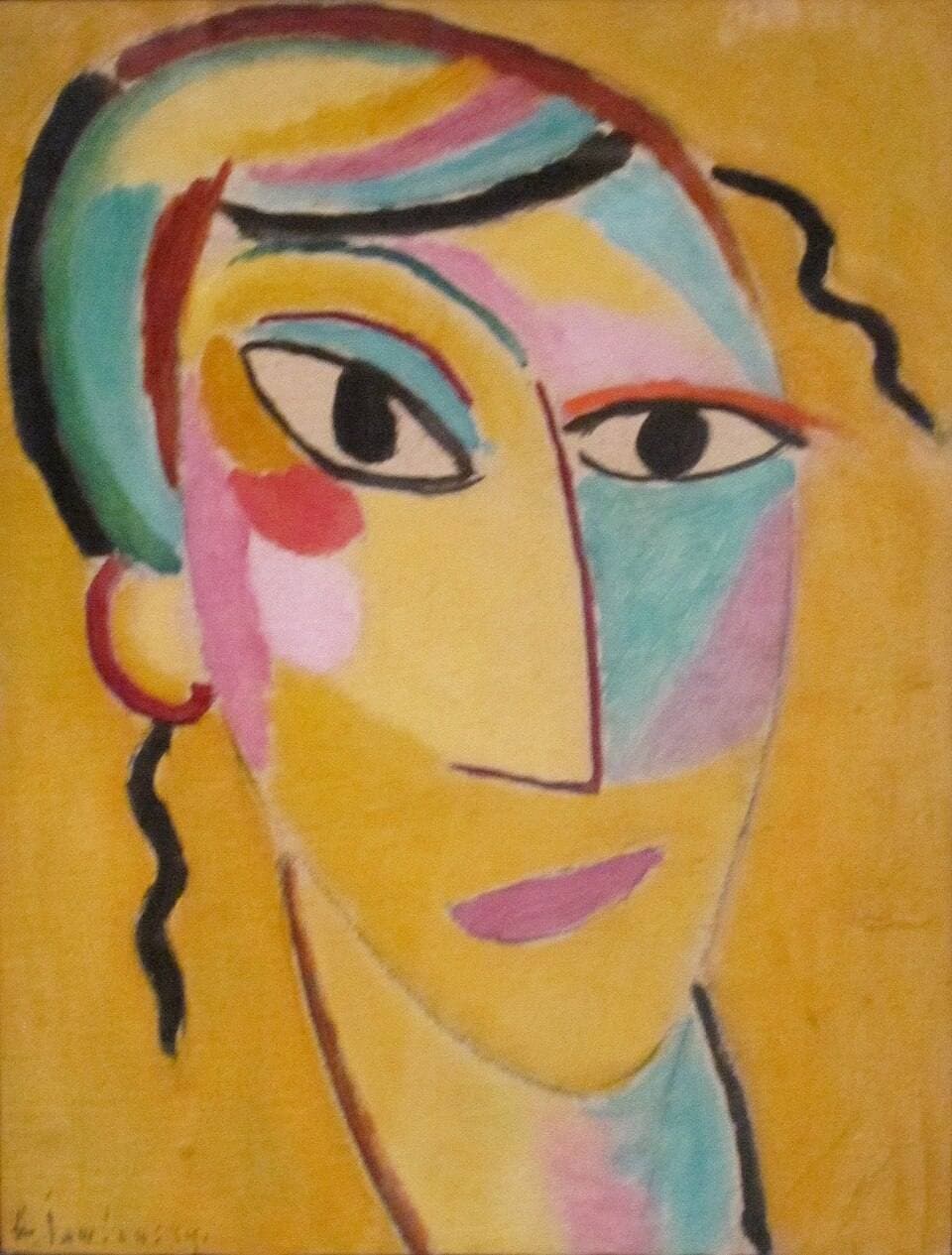
Alexej von Jawlensky was born near Torzhok in 1864, served as an officer in the Imperial Russian army, and resigned his commission to study painting in Munich, where he arrived in 1896 with Marianne von Werefkin. He was central to the Neue Kunstlervereinigung and close to Kandinsky and the Blaue Reiter circle, and by 1911 was making the heads that became his subject for life: frontal, symmetrical, in flat unmixed colour with heavy contours. Exile in Switzerland during the First World War narrowed the work further, into Variations, Abstract Heads and finally the Meditations, painted with crippled hands from arthritis until 1937. He died in 1941.
The pre-1914 Munich heads and landscapes lead by a considerable distance, with the Swiss Variations and the late Meditations forming distinct and much larger groups. Jawlensky was declared degenerate and works were confiscated, so provenance between 1933 and 1945 must be examined. He worked largely on board and paper rather than canvas, often in oil on card, and these supports warp, cockle and suffer at the edges. The catalogue raisonne prepared by Maria Jawlensky and the artist's descendants is the reference for attribution.
At a glance
- Born
- 13 March 1864, Torzhok
- Died
- 15 March 1941, Wiesbaden
- Movement
- Expressionism
More on Wikipedia.
Ažbe, Galka Scheyer and the Blue Four
In Munich Jawlensky studied at Anton Ažbe's private school, and through Jan Verkade and Paul Sérusier he took in the ideas of the Nabis. Between 1908 and 1910 he and Werefkin spent summers in the Bavarian Alps with Kandinsky and Gabriele Münter. Expelled from Germany in 1914, he moved to Switzerland, where in 1916 he met Emmy Scheyer, whom he called Galka, and who promoted his work in the United States.
In 1921 he settled in Wiesbaden, and in 1922 married Hélène Nesnakomoff, the mother of his son Andreas. In 1924 he formed the Blue Four with Kandinsky, Klee and Feininger, shown in Germany and America through Scheyer. The Museum Wiesbaden owns more than 90 of his works, the largest collection, and the Museum Ostwall in Dortmund also has a strong group.
Whitebank Fine Art is an art advisory and gallery, not an auction house, and is not affiliated with any auction house or with the artist, their estate or their representatives. This page describes the range we advise on. Nothing here is investment advice.
