

Ernst Ludwig Kirchner valuation
Founded Die Brucke, painted Berlin's streets on the edge of war, and never recovered from it.
Ernst Ludwig Kirchner was born in Aschaffenburg in 1880, trained as an architect, and founded Die Brucke in Dresden in 1905.
What a work by Ernst Ludwig Kirchner is worth
Send photographs and whatever paperwork came with it. The first question is what the work actually is — edition or unique, when, and in what condition — because everything else follows from the answer. A valuation is free, made online from the photographs you send, and it commits you to nothing. We act for sellers across the United Kingdom, Europe and the United States.
Write to info@whitebankfineart.co.uk, or start below.
Bio
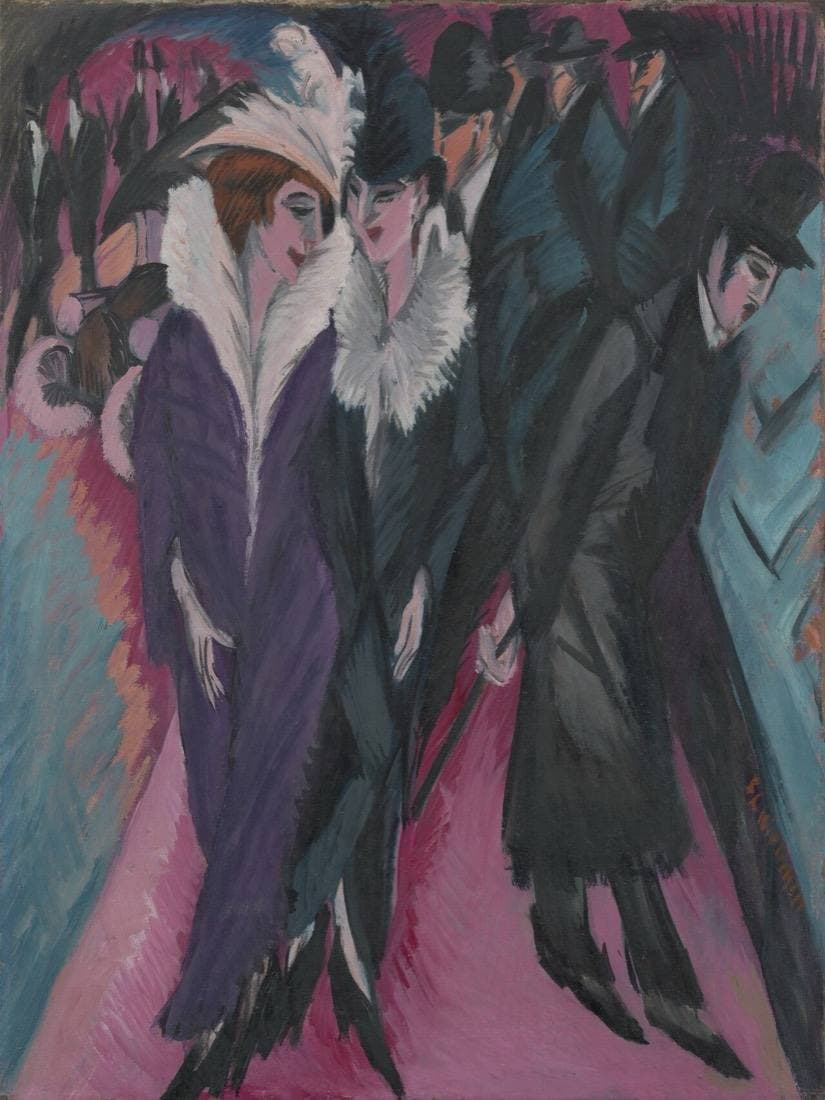
Ernst Ludwig Kirchner was born in Aschaffenburg in 1880, trained as an architect, and founded Die Brucke in Dresden in 1905. The group's paintings of bathers at the Moritzburg lakes and of studio life were the beginning of German Expressionism; the Berlin street scenes of 1913 and 1914, with their spiky cocotte figures and lurching perspective, are its high point. He broke down during military training in 1915, was discharged, and spent the rest of his life at Davos in Switzerland painting mountains and peasants. The Nazis declared him degenerate and confiscated more than six hundred works. He shot himself in 1938.
Provenance between 1933 and 1945 is unavoidable with Kirchner and remains an active area of restitution. The Berlin street paintings are among the most valuable German pictures of the century and almost all are institutional. He was one of the great printmakers of the movement — woodcut, etching and lithograph, often in tiny numbers of impressions, catalogued by Dube — and the graphic work is where the market principally operates. Kirchner also backdated and reworked his own pictures at Davos, which complicates dating and is well documented.
At a glance
- Born
- 6 May 1880, Aschaffenburg
- Died
- 15 June 1938, Davos Frauenkirch
- Movements
- Expressionism, Expressionism
More on Wikipedia.
Dresden, Fehmarn and the Chronik
Kirchner studied architecture at the Royal Saxon Polytechnic in Dresden from 1901, with a spell at the Debschitz school in Munich in 1903 and 1904, and founded Die Brücke in 1905 with Fritz Bleyl, Erich Heckel and Karl Schmidt-Rottluff. The group's first exhibition, of the female nude, was held in 1906 in the showroom of K.F.M. Seifert in Dresden, and from 1907 to 1911 he spent summers at the Moritzburg lakes and on the island of Fehmarn.
He moved to Berlin in 1911, and his Chronik der Brücke of 1913 brought the group to an end; his first solo exhibition was at the Folkwang Museum in Essen the same year. The Kirchner Museum at Davos holds a large collection of his work, and Dube's catalogues of the woodcuts, etchings and lithographs are the reference for any print.
Whitebank Fine Art is an art advisory and gallery, not an auction house, and is not affiliated with any auction house or with the artist, their estate or their representatives. This page describes the range we advise on. Nothing here is investment advice.
