
Abstract art
Abstract art is art that does not depict the visible world but uses colour, line, shape and texture for their own sake; it emerged in Europe between about 1910 and 1915, in the work of Wassily Kandinsky, František Kupka, Kazimir Malevich and Piet Mondrian, and became one of the main currents of twentieth-century art.
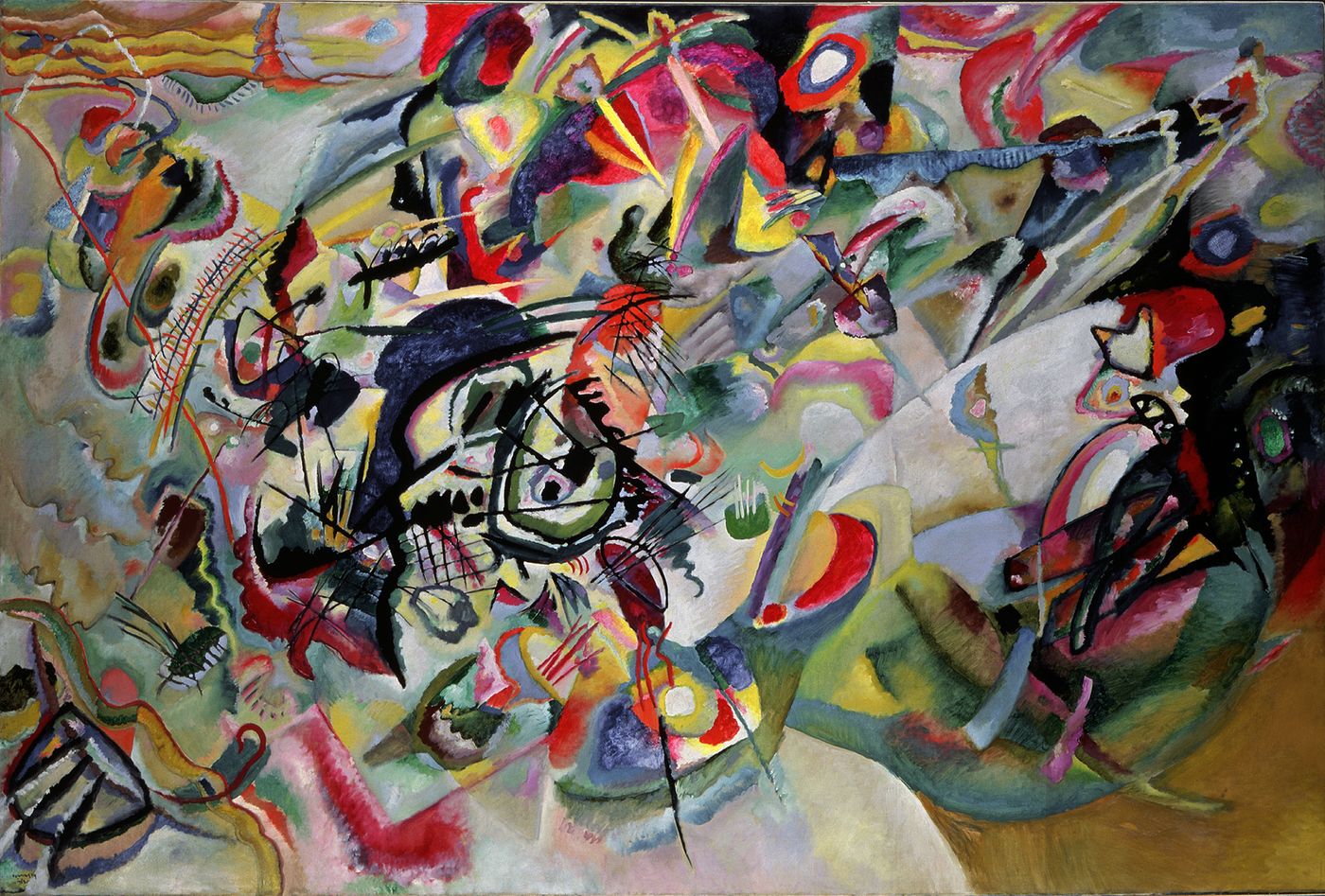
Several painters crossed the line at almost the same time, largely independently. In Munich Wassily Kandinsky dissolved landscapes and Biblical scenes into colour until, by 1911 to 1913, little or nothing recognisable remained, and in On the Spiritual in Art, published at the end of 1911, he argued that colour could act on the soul as music does. In Paris the Czech painter František Kupka showed wholly abstract canvases at the Salon d'Automne of 1912, and Robert and Sonia Delaunay painted discs of pure colour. In Petrograd in December 1915 Kazimir Malevich hung his Black Square high in the corner of the room at the 0,10 exhibition and called the new art Suprematism, and in the Netherlands Piet Mondrian, with Theo van Doesburg and De Stijl, reduced painting to straight lines and primary colours. The Swedish painter Hilma af Klint had made abstract paintings in private from 1906, but they were not shown publicly until the 1980s.
After 1945 abstraction moved to the centre. In New York Jackson Pollock, Willem de Kooning, Mark Rothko and Barnett Newman made Abstract Expressionism; in Paris there was Art Informel; in Britain the painters of St Ives, Patrick Heron, Terry Frost and Peter Lanyon among them. Colour field painting, Op art and Minimalism followed in the 1960s, and abstraction has remained one of the main ways painters work ever since, from Bridget Riley and Sean Scully to the present.
At a glance
- When
- 1910s to the present
- Where
- Munich, Paris and Russia, then worldwide
- Leading artists
- Wassily Kandinsky, František Kupka, Robert Delaunay, Sonia Delaunay
Characteristics of abstract art
- Geometric abstraction
- Straight lines, flat colour and regular shapes: Malevich, Mondrian, Albers, Riley.
- Gestural abstraction
- Free, expressive marks and visible brushwork: Kandinsky's early compositions, Pollock, de Kooning, Joan Mitchell.
- Colour as the subject
- Large fields of colour that carry the whole picture, as in Rothko, Newman and Frankenthaler.
- Abstracted, or wholly abstract
- Some works start from a landscape or a figure and simplify it; others refer to nothing outside themselves.
- Titles without subjects
- Compositions, Improvisations, numbers and 'Untitled' in place of a story or a place.
Abstract artists
Every artist below has a page on this site, with a short biography and what a valuation of their work turns on.
The pioneers
- Wassily KandinskyGave up a law professorship at thirty and painted his way out of the recognisable world.
- František KupkaCzech illustrator and one-time spiritualist medium who painted some of the first abstract pictures shown in Paris.
- Robert DelaunayPainted the Eiffel Tower breaking apart, then discs of pure colour; Apollinaire called the result Orphism.
- Sonia DelaunayTook abstraction off the canvas and onto dresses, cars, book covers and dance floors.
- Kazimir MalevichInvented Suprematism, painted the Black Square, and took painting to pure abstraction in 1915.
- Piet MondrianReduced painting to black lines, white ground and three primary colours, and got there step by step.
- Josef AlbersBauhaus master turned American teacher, and the painter who spent twenty-five years on one square inside another.
After 1945, in America
- Jackson PollockPut the canvas on the floor and poured, and made American painting the centre of the argument.
- Willem de KooningStowed away to America at twenty-two, and painted Woman until people shouted at him.
- Mark RothkoRectangles of colour that hover, painted by a man who insisted they were about tragedy, not decoration.
- Barnett NewmanA single vertical band down a field of colour, and forty years of argument about whether that is enough.
- Franz KlineBlack bars across white canvas, painted with a decorator's brush and a great deal of thought.
- Lee KrasnerAbstract Expressionist who cut up her own canvases to make better ones, and outlived the myth around her husband.
- Joan MitchellPainted remembered landscape in violent colour, from a house above the Seine at Vetheuil.
- Helen FrankenthalerPoured thinned paint into raw canvas in 1952 and changed what the next generation did with a brush.
- Agnes MartinDrew graphite grids on square canvases in the New Mexico desert, and asked for nothing else.
- Ellsworth KellyTook shapes from shadows, windows and bridges, and painted them flat with nothing else in the picture.
- Frank StellaSaid what you see is what you see, then spent fifty years making it more complicated.
In Britain
- Ben NicholsonCarved white reliefs in the 1930s and spent fifty years arranging jugs, hills and rectangles.
- Barbara HepworthPut the hole through the middle of the sculpture, and made St Ives a centre of European modernism.
- Patrick HeronSt Ives colourist who made the whole picture out of soft-edged shapes of pure hue.
- Terry FrostLearned to paint in a prisoner-of-war camp, and spent the rest of his life on boats, harbours and half-circles.
- Peter LanyonPainted the Cornish landscape from inside a glider, and died doing it.
- Roger HiltonCornish abstraction with a figure fighting its way back in, and gouaches made from a sickbed.
- John HoylandBritish abstraction at American scale, from stained colour fields to slabs of paint laid on with a knife.
- Bridget RileyThe screenprints are colour-critical to an unusual degree, and fading is the fault owners never see coming.
- Sean ScullyBands of colour in oil on linen, built out of joined panels rather than composed on one.
Famous Abstract works
- Composition VIIWassily Kandinsky, 1913, State Tretyakov Gallery, Moscow
- Black SquareKazimir Malevich, 1915, State Tretyakov Gallery, Moscow
- Composition with Red, Blue and YellowPiet Mondrian, 1930, Kunsthaus Zürich
- Autumn Rhythm (Number 30)Jackson Pollock, 1950, Metropolitan Museum of Art, New York
- Black on MaroonMark Rothko, 1958, Tate, London
- Movement in SquaresBridget Riley, 1961, Arts Council Collection, London
What a valuation turns on
Because abstract art spans more than a century, there is no single market for it: a work by one of the pioneers, a New York painting of the 1950s and a recent canvas are three different questions. What they share is that, without a recognisable subject, a work is judged on period, quality, scale and condition, and on its documentation. A painting from an artist's most admired years, of a good size and in its original state, can be worth many times a late or minor work by the same hand.
Abstract paintings are easy to imitate and have been forged often, the Russian avant-garde and the Abstract Expressionists among them, so provenance and the catalogue raisonné carry great weight, and several of these artists have foundations or committees that review works. Condition matters more than with most paintings: an unvarnished field of colour shows every scratch, stain and retouching, and cleaning it is specialist work.
Common questions
What is abstract art?
Abstract art is art that does not depict people, places or things, but uses colour, line, shape and texture for their own sake. It ranges from the precise geometry of Mondrian to the free, gestural painting of Pollock and the colour fields of Rothko.
Who invented abstract art?
No one person. Wassily Kandinsky is usually credited with the first abstract paintings, made between about 1910 and 1913, but František Kupka, Robert Delaunay, Kazimir Malevich and Piet Mondrian reached abstraction at about the same time, and the Swedish painter Hilma af Klint had made abstract paintings in private from 1906.
Who are the most famous abstract artists?
Wassily Kandinsky, Kazimir Malevich and Piet Mondrian among the pioneers; Jackson Pollock, Mark Rothko, Willem de Kooning, Barnett Newman, Joan Mitchell and Helen Frankenthaler after the Second World War; and Bridget Riley, Agnes Martin, Ellsworth Kelly and Sean Scully since.
What are the main types of abstract art?
Geometric abstraction, built from straight lines, flat colour and regular shapes, and gestural or lyrical abstraction, built from free, expressive marks. Colour field painting, in which large areas of colour carry the picture, sits between them.
How do I sell an abstract painting?
Send photographs of the front, the signature and the back, with any labels, certificates or invoices, for a free, confidential valuation. Whether the work is recorded in the artist's catalogue raisonné, and what its history is, usually decide the most; we check both, compare a confidential private sale with auction, and keep the paperwork in your name until you are paid.