

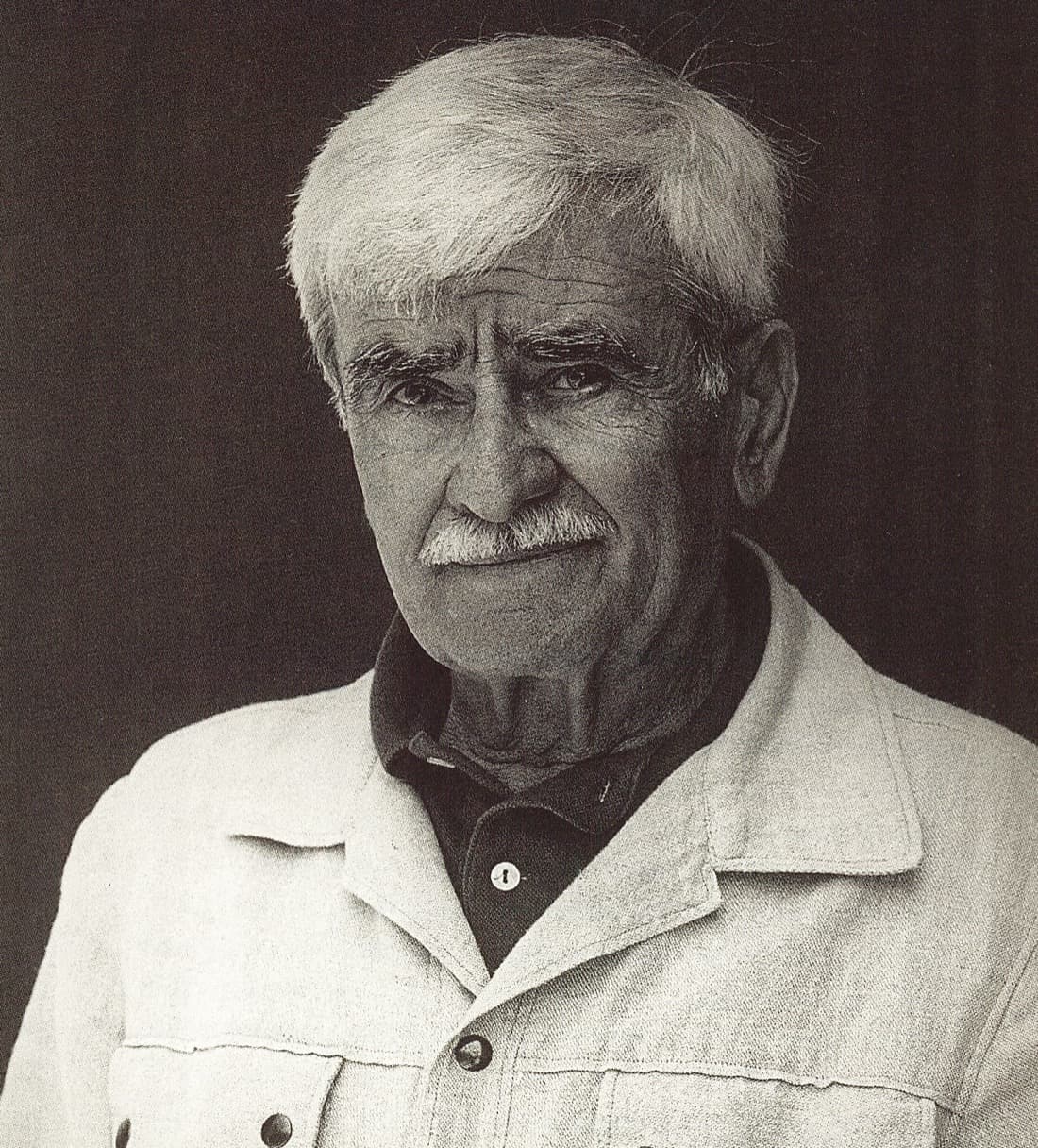
Alberto Burri valuation
A doctor who came out of a prisoner-of-war camp and began stitching, burning and cracking his materials.
Alberto Burri was born at Citta di Castello in Umbria in 1915 and qualified as a physician.
What a work by Alberto Burri is worth
Send photographs and whatever paperwork came with it. The first question is what the work actually is — edition or unique, when, and in what condition — because everything else follows from the answer. A valuation is free, made online from the photographs you send, and it commits you to nothing. We act for sellers across the United Kingdom, Europe and the United States.
Write to info@whitebankfineart.co.uk, or start below.
Bio
Alberto Burri was born at Citta di Castello in Umbria in 1915 and qualified as a physician. Captured in North Africa in 1943, he began to paint in a prisoner-of-war camp in Hereford, Texas, on the only support available, and never practised medicine again. The work that followed is organised by material rather than by image: the Sacchi of stitched and patched burlap sacking, the Combustioni made by burning plastic sheet with a blowtorch, the Legni of charred wood, the Ferri of welded steel, and finally the Cretti, great white surfaces of kaolin and resin cracked like dried mud. He died in 1995.
Because the materials were chosen for what they do rather than for permanence, condition is more central here than with almost any contemporary of his: plastic embrittles and discolours, burlap slackens and tears at the stitching, and cretti surfaces lose flakes that cannot be replaced. Original tears, burns and cracks are the work and are constantly misreported as damage, which cuts both ways. The Fondazione Palazzo Albizzini at Citta di Castello holds the archive and issues the archiviazione that the market treats as the reference. Editions and multiples exist and are separate.
At a glance
- Born
- 12 March 1915, Città di Castello
- Died
- 13 February 1995, Nice
- Movements
- Fluxus, Nouveau Réalisme, Arte Povera
More on Wikipedia.
Rome, the Guggenheim and the Grande Cretto
Burri's first solo exhibition, of figurative work, was at La Margherita in Rome in 1947, and by the end of that year he had turned to abstraction; he later treated Nero 1, of 1948, as the starting point of his work. James Johnson Sweeney, director of the Guggenheim, saw his paintings at the Obelisco gallery in Rome in 1953 and introduced them to the United States, and from 1963 Burri spent his winters in Los Angeles.
The Cretti began in 1973, prompted by the cracked ground of Death Valley. The largest is the Grande Cretto at Gibellina in Sicily, which covers the ruins of the town destroyed by the 1968 earthquake in white concrete. The Guggenheim in New York gave him a retrospective in 2015, and the foundation shows his work at Città di Castello in the Palazzo Albizzini and the former tobacco-drying sheds outside the town.
Tar, mould, the Gobbi and Rauschenberg's visits
Between 1948 and 1950 Burri worked with tar, sand, zinc, pumice, aluminium powder and PVA glue, giving the glue the standing of oil paint. In the Catrami the tar is a colour rather than a collage material; in the Muffe the materials drip and crust like mould; in the Gobbi, branches fixed behind the canvas push the surface out into the room. SZ1, of 1949, a sugar sack carrying part of an American flag, comes before the Sacchi proper, which began in 1952 with the jute the Marshall Plan had spread across Italy.
Italy was slow to accept them. At his first Venice Biennale, in 1952, Lo Strappo and Rattoppo were turned down, and in 1959 a question in Parliament asked for one of his works to be taken out of the Galleria Nazionale d'Arte Moderna in Rome. James Johnson Sweeney wrote the first monograph on him in 1955. Robert Rauschenberg came to his studio twice in 1953, and the visits fed the Combines although the two men had no language in common. On 15 May 1955 Burri married Minsa Craig, an American dancer and choreographer who had trained with Martha Graham, at Westport, Connecticut.
Best auction results
- Sacco e Rosso £9.1m
- Sacking and paint on canvas, 1959 · London · 10 February 2016
- Publicly reported
- The largest of the fifteen works titled Sacco e Rosso.
Results as reported at the time of sale, inclusive of buyer's premium. They are a record of what specific works achieved on specific days, not a guide to what any other work is worth.
Whitebank Fine Art is an art advisory and gallery, not an auction house, and is not affiliated with any auction house or with the artist, their estate or their representatives. This page describes the range we advise on. Nothing here is investment advice.
