

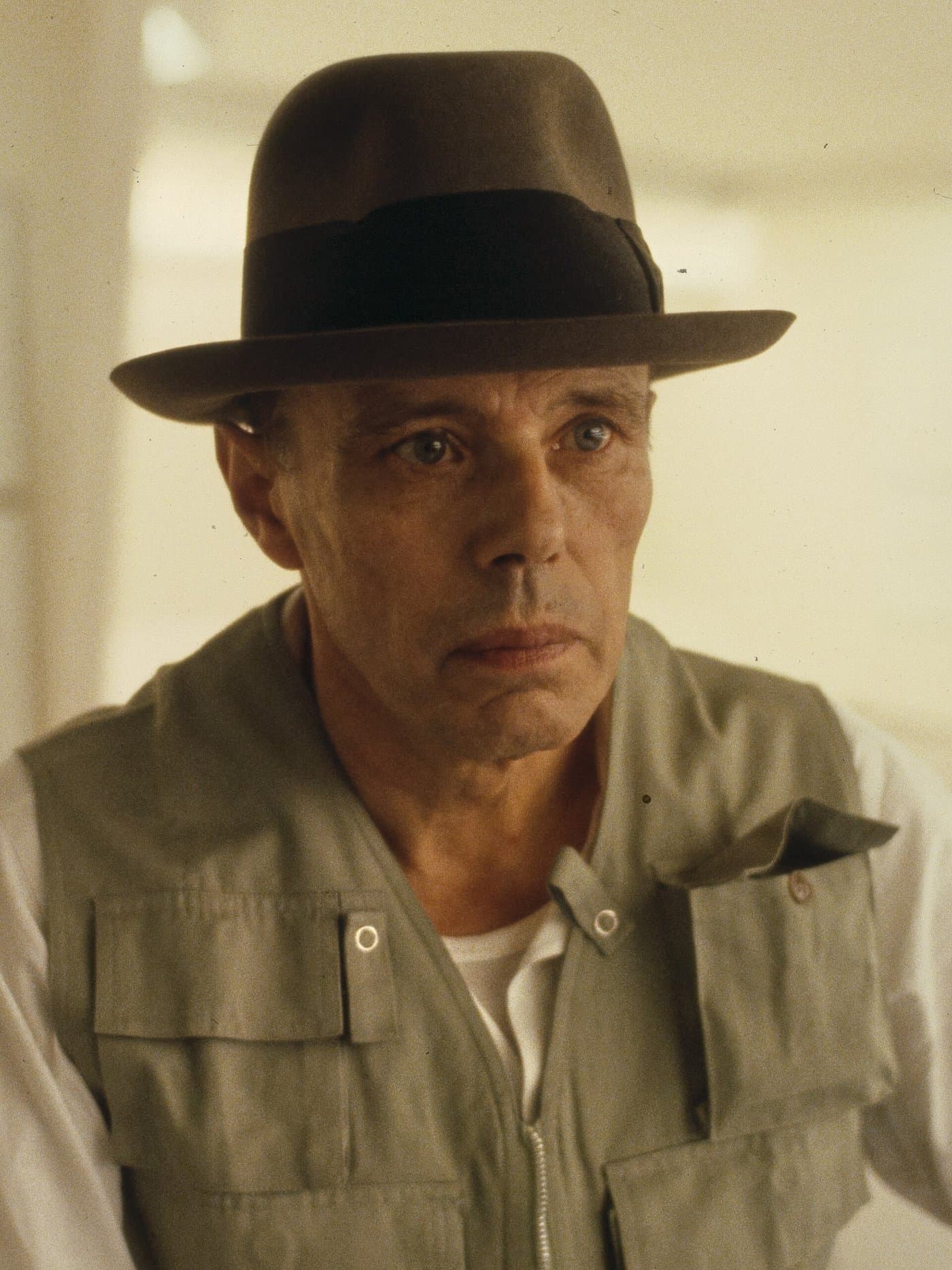
Joseph Beuys valuation
Felt, fat, a Luftwaffe crash he may have invented, and the claim that everyone is an artist.
Joseph Beuys was born in Krefeld in 1921, served as a Luftwaffe radio operator, and built his public persona around a wartime crash in Crimea after which, he said, Tatars wrapped him in fat and felt to keep him alive.
What a work by Joseph Beuys is worth
Send photographs and whatever paperwork came with it. The first question is what the work actually is — edition or unique, when, and in what condition — because everything else follows from the answer. A valuation is free, made online from the photographs you send, and it commits you to nothing. We act for sellers across the United Kingdom, Europe and the United States.
Write to info@whitebankfineart.co.uk, or start below.
Bio
Joseph Beuys was born in Krefeld in 1921, served as a Luftwaffe radio operator, and built his public persona around a wartime crash in Crimea after which, he said, Tatars wrapped him in fat and felt to keep him alive. Historians have found little to support the story and it hardly matters: felt and fat became the materials of a body of work that treated sculpture as something closer to social process. He taught at Dusseldorf until he was dismissed in 1972 for admitting every applicant, co-founded the German Green Party, and planted the first of 7,000 Oaks at Kassel in 1982. He died in 1986.
Beuys made multiples on a scale almost no other artist of his stature attempted — over five hundred editions, catalogued by Schellmann, from postcards and felt suits to sledges and vitrined objects, often in editions of a hundred or more. These are the bulk of the market and are entirely legitimate works, but they must be identified precisely by Schellmann number, and the printed or stamped documentation is part of the piece. Organic materials in the unique work degrade, and condition reports on fat, felt and food-based elements need to be read closely.
7000 Oaks, Edinburgh and the actions
For documenta 7 at Kassel in 1982 Beuys piled 7,000 basalt stones in front of the Fridericianum; each could be adopted for a fee, and the money paid for an oak to be planted beside it, a project that officially ended in 1987, the year after his death. He had a long connection with Scotland through Richard Demarco, who brought him to Edinburgh in 1970, when he performed Celtic (Kinloch Rannoch) The Scottish Symphony.
Many of the multiples relate to particular actions, lectures and campaigns, and knowing the action behind one, alongside its Schellmann number, helps place it.
Kleve, Mataré and the coyote
Beuys grew up in Kleve on the Lower Rhine and, by his own account, pulled Linnaeus's Systema Naturae from the Nazi book burning in his school courtyard in 1933. He enrolled in monumental sculpture at the Düsseldorf academy in 1946 and moved the next year into the class of Ewald Mataré, and Rudolf Steiner's anthroposophy became the basis of his thinking. Appointed professor of monumental sculpture in 1961, he taught Jörg Immendorff, Blinky Palermo, Sigmar Polke and Katharina Sieverding, and through Nam June Paik he took part in Fluxus events from 1962.
In The Chief, first performed in Copenhagen in 1963, he lay wrapped in felt for nine hours. How to Explain Pictures to a Dead Hare opened his first solo exhibition at a private gallery on 26 November 1965, his head covered in honey and gold leaf, and Infiltration Homogen for Piano of 1966 is a piano covered in felt. In May 1974 he flew to New York and spent three days in the René Block Gallery with a coyote for I Like America and America Likes Me. With Heinrich Böll he founded the Free International University, and from 1972 to 1985 he ran Operation Defence of Nature at Bolognano in Italy.
Whitebank Fine Art is an art advisory and gallery, not an auction house, and is not affiliated with any auction house or with the artist, their estate or their representatives. This page describes the range we advise on. Nothing here is investment advice.
