

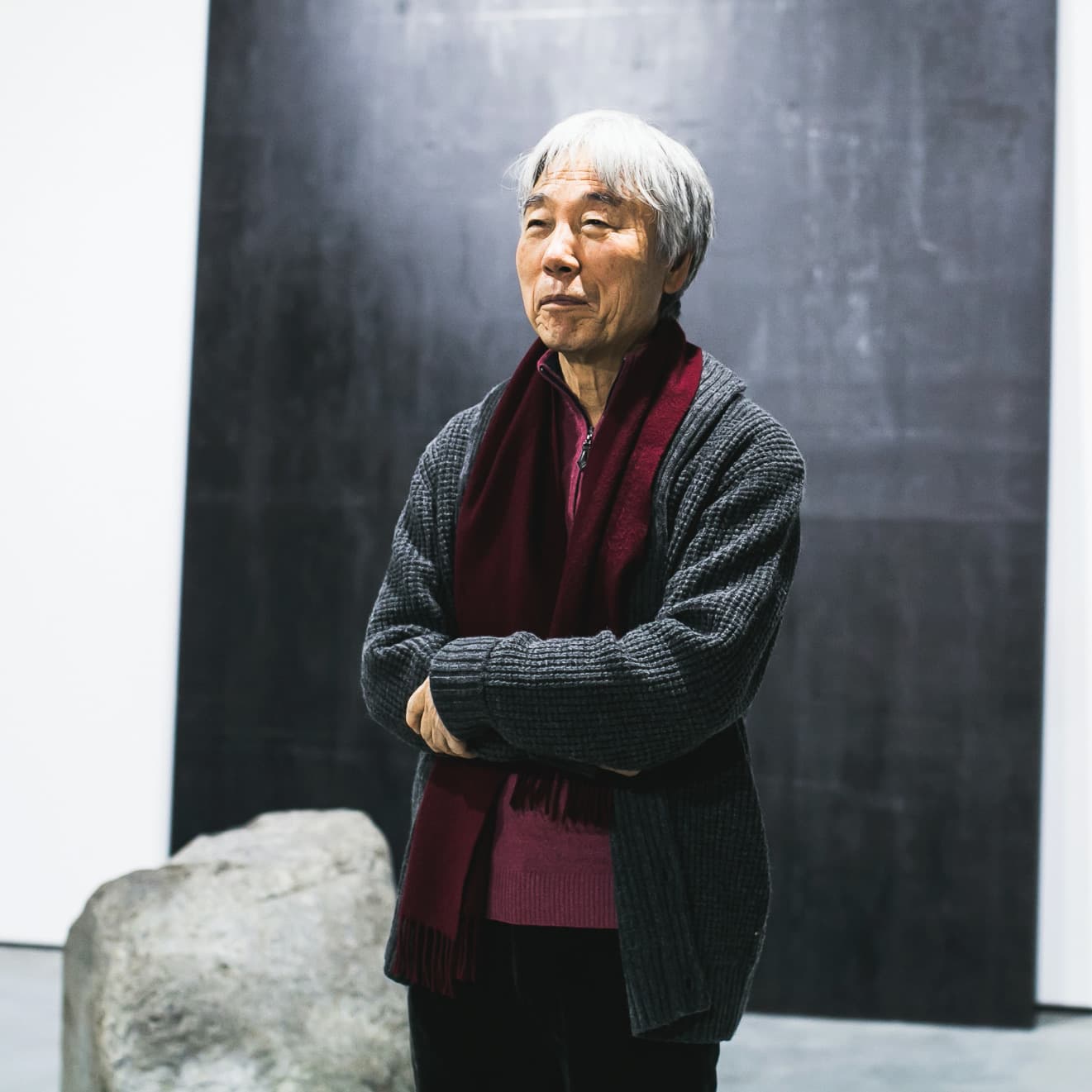
Lee Ufan valuation
Mono-ha philosopher-painter of a single brushstroke and a stone beside a steel plate.
Lee Ufan was born in Korea in 1936, moved to Japan in 1956 and studied philosophy at Nihon University, and became the principal theorist of Mono-ha — the School of Things — which argued in the late 1960s for placing materials in relation to one another rather than making objects out of them.
What a work by Lee Ufan is worth
Send photographs and whatever paperwork came with it. The first question is what the work actually is — edition or unique, when, and in what condition — because everything else follows from the answer. A valuation is free, made online from the photographs you send, and it commits you to nothing. We act for sellers across the United Kingdom, Europe and the United States.
Write to info@whitebankfineart.co.uk, or start below.
Bio
Lee Ufan was born in Korea in 1936, moved to Japan in 1956 and studied philosophy at Nihon University, and became the principal theorist of Mono-ha — the School of Things — which argued in the late 1960s for placing materials in relation to one another rather than making objects out of them. Relatum, the ongoing sculpture series, is typically a natural stone set against an industrial steel plate. The paintings run through From Point and From Line, in which a loaded brush is drawn until the pigment runs out, to the Dialogue series, in which a single grey-blue stroke sits on a large empty canvas. Museums devoted to him stand at Naoshima and Busan.
The From Point and From Line paintings of the 1970s lead the market, with the recent Dialogue works forming a large and strong second group; prices are set principally in Seoul, Hong Kong and New York. The pigment is mineral-based, mixed with glue, matt and extremely vulnerable — it cannot be cleaned and marks permanently, so condition is exceptionally determinative. Lee is significantly forged and a criminal case in Korea concerned exactly that, so provenance and studio confirmation matter. There is a modest print output.
Naoshima, the Guggenheim and Arles
The Lee Ufan Museum on the island of Naoshima in Japan, designed by Tadao Ando, opened in 2010, and the Guggenheim in New York gave him a retrospective, Marking Infinity, in 2011. He showed at the Palace of Versailles in 2014, and Lee Ufan Arles, a space for his work in a sixteenth-century house in the south of France, opened in 2022.
Titles name the series, From Point, From Line, With Winds, Correspondance and Dialogue, with a number and year, and that full title with the gallery's documentation is what identifies a painting.
Yokohama, Words and Things and Tama
Lee was born in Haman county in South Gyeongsang province and learned ink-brush painting as a boy, raised partly by a Confucian grandfather. He spent two months at Seoul National University's College of Fine Arts in 1956 before a journey to Japan, to take medicine to an uncle, became a move: he stayed, and took his philosophy degree at Nihon University in 1961, with a particular interest in Heidegger. His first solo exhibition was at the Sato Gallery in Tokyo in March 1967. In 1969 he won the Bijutsu Shuppansha prize for new critics, and a prize at the Contemporary Art Exhibition of Japan for Words and Things, three huge sheets of paper laid flat, its title taken from Foucault.
His essay on Sekine Nobuo, Beyond Being and Nothingness, and the texts From Object to Being, of 1969, and In Search of Encounter, of 1970, are counted among the founding writings of Mono-ha, and in 1970 he chaired the round table Mono Opens a New World. He taught at Tama Art University from 1973 to 2007. As a painter he also belongs to Korean monochrome painting, the first Korean movement of the century to be promoted in Japan. He divides his time between Kamakura and Paris.
Whitebank Fine Art is an art advisory and gallery, not an auction house, and is not affiliated with any auction house or with the artist, their estate or their representatives. This page describes the range we advise on. Nothing here is investment advice.
