

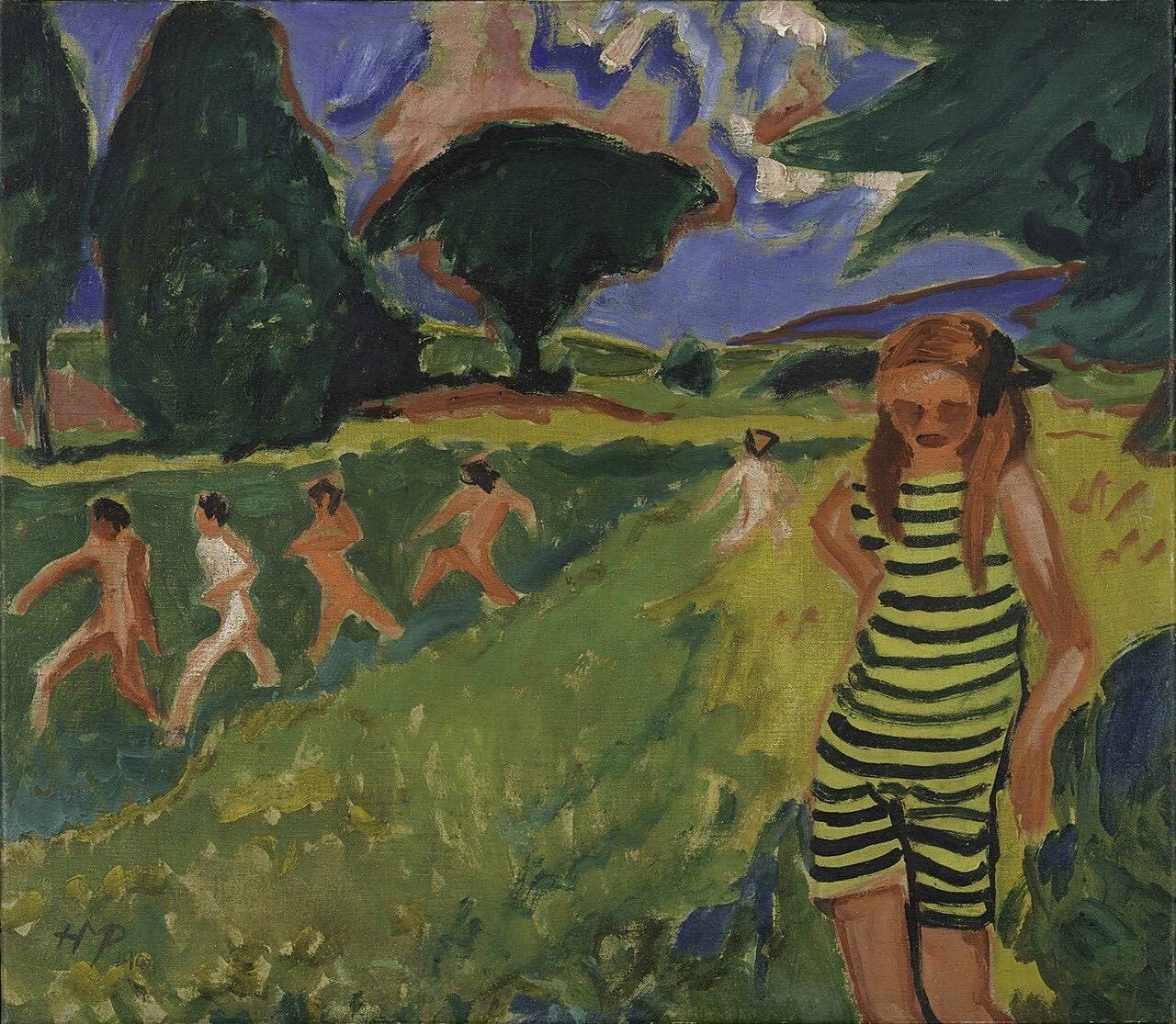
Max Pechstein valuation
The Brücke painter the public took to first, expelled by the group and later declared degenerate by the state.
Max Pechstein was born at Zwickau in 1881, served a decorator's apprenticeship and trained in Dresden, and joined Die Brücke in 1906.
What a work by Max Pechstein is worth
Send photographs and whatever paperwork came with it. The first question is what the work actually is — edition or unique, when, and in what condition — because everything else follows from the answer. A valuation is free, made online from the photographs you send, and it commits you to nothing. We act for sellers across the United Kingdom, Europe and the United States.
Write to info@whitebankfineart.co.uk, or start below.
Bio
Max Pechstein was born at Zwickau in 1881, served a decorator's apprenticeship and trained in Dresden, and joined Die Brücke in 1906. He was the one of them the public took to earliest, which was part of the trouble: in 1912 the group expelled him for exhibiting with the Berlin Secession against their agreement. In 1914 he made the voyage to Palau in the South Seas he had been planning for years, painting and drawing there until the Japanese seizure of the islands ended it and the work he had sent home was lost. He served in the war, taught and was elected to the Prussian Academy afterwards, was dismissed and declared degenerate in 1933 with hundreds of works removed from German museums, and returned to a professorship in Berlin after 1945. He died in 1955.
Oils, watercolours and drawings all appear, and so does a large graphic output — woodcuts, lithographs and etchings, many printed in very small numbers and some by the artist himself, so impressions of one subject vary in inking and in paper. Krüger is the reference for the prints and Soika for the paintings. Provenance between 1933 and 1945 has to be established because of the confiscations, and the loss of the Palau work makes anything surviving from that voyage a matter for documentation rather than assumption.
At a glance
- Born
- 31 December 1881, Zwickau
- Died
- 29 June 1955, Berlin
- Movement
- Expressionism
More on Wikipedia.
Italy, van Dongen and the confiscations
In 1907 Pechstein went to Italy to receive an award, and in Paris in 1908 he met Kees van Dongen and persuaded him to join Die Brücke; later that year he moved to Berlin, ahead of the others.
In 1933 the Nazis banned him from painting and exhibiting and dismissed him from teaching, and 326 of his paintings were removed from German museums. Many of his collectors were Jewish, and in 2013 the Bavarian State Painting Collections agreed to return White House, of 1910, and Meadow Valley, of 1911, to the heirs of Curt Glaser. He died in West Berlin in 1955.
Whitebank Fine Art is an art advisory and gallery, not an auction house, and is not affiliated with any auction house or with the artist, their estate or their representatives. This page describes the range we advise on. Nothing here is investment advice.
