

Samuel Peploe valuation
Scottish Colourist who painted the same roses, fan and Chinese bowl until he had them exactly right.
Samuel John Peploe was born in Edinburgh in 1871, trained there and in Paris, and is generally taken as the most rigorous of the four Scottish Colourists.
What a work by Samuel Peploe is worth
Send photographs and whatever paperwork came with it. The first question is what the work actually is — edition or unique, when, and in what condition — because everything else follows from the answer. A valuation is free, made online from the photographs you send, and it commits you to nothing. We act for sellers across the United Kingdom, Europe and the United States.
Write to info@whitebankfineart.co.uk, or start below.
Bio
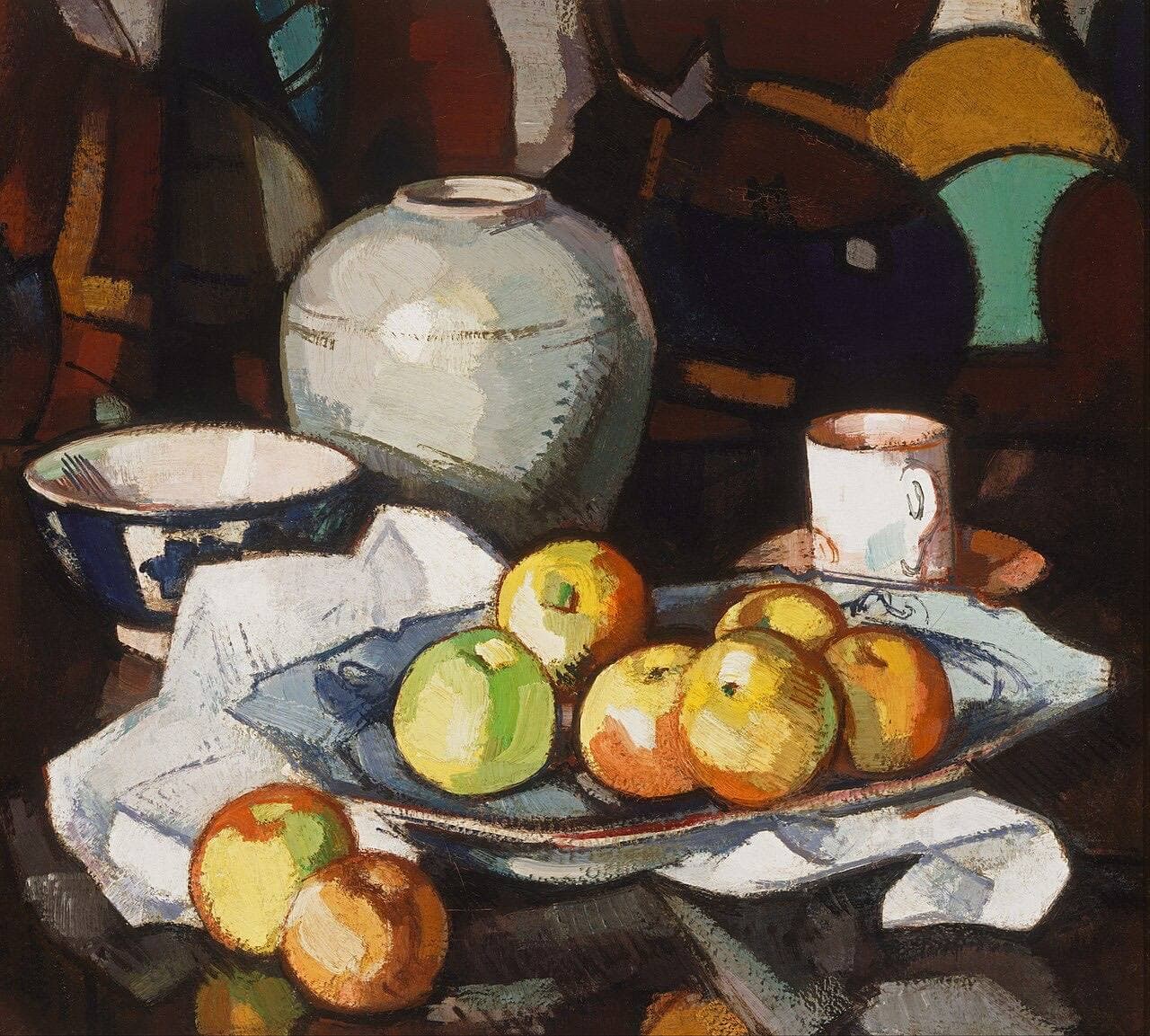
Samuel John Peploe was born in Edinburgh in 1871, trained there and in Paris, and is generally taken as the most rigorous of the four Scottish Colourists. The early work is dark and fluent, painted with a loaded brush on a light ground in the manner of Manet and Hals. After a period in Paris from 1910 the palette lifts and the handling hardens under the influence of Cezanne, and the pictures that followed are the ones he is known for: still lifes of tulips or roses in a Chinese bowl, with a black fan, a book and a piece of drapery, arranged and rearranged over years. He also painted at Iona and Cassis. He died in 1935.
Still lifes are the subject most asked for, ahead of the Iona and French landscapes. The paintings are unique oils, often on panel or board. The Colourists as a group attract imitation, and Peploe in particular has been copied since his lifetime, so provenance, exhibition history and the standing literature matter more here than the appearance of the picture. The signature is generally a plain Peploe, lower left or right, and is not evidence in itself. Watercolours and drawings appear, and his son Denis was also a painter.
Aitken Dott, Reid and the early collectors
Peploe was the first of the Colourists to have a solo exhibition, at Aitken Dott in Edinburgh in 1903, where he sold nineteen paintings, and the Glasgow dealer Alexander Reid placed his work with collectors, including the first sold to America in 1905. William Burrell bought from McNeill Reid, Alexander Reid's son, in 1926, and the Kirkcaldy collector Robert Wemyss Honeyman began buying the same year; Kirkcaldy Galleries now hold a large group.
Labels from Aitken Dott, which became The Scottish Gallery, and from Alexander Reid and its successors are some of the most useful evidence on the back of a Peploe, and should never be removed.
Whitebank Fine Art is an art advisory and gallery, not an auction house, and is not affiliated with any auction house or with the artist, their estate or their representatives. This page describes the range we advise on. Nothing here is investment advice.
