

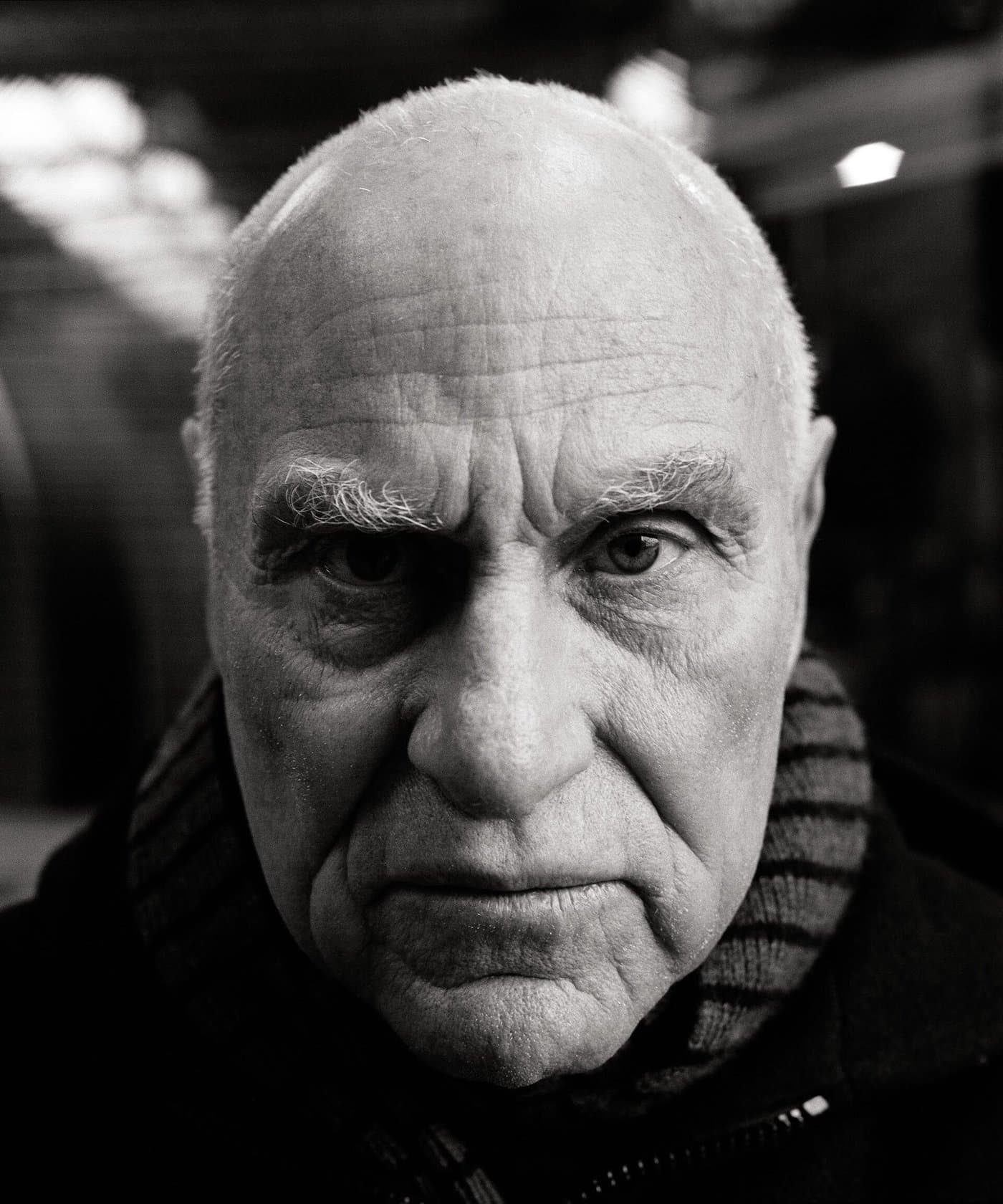
Richard Serra valuation
Made sculpture out of shipyard steel at a weight that changes the room and sometimes the street.
Richard Serra was born in San Francisco in 1938 and worked in steel mills to pay for his education, which is where the material came from.
What a work by Richard Serra is worth
Send photographs and whatever paperwork came with it. The first question is what the work actually is — edition or unique, when, and in what condition — because everything else follows from the answer. A valuation is free, made online from the photographs you send, and it commits you to nothing. We act for sellers across the United Kingdom, Europe and the United States.
Write to info@whitebankfineart.co.uk, or start below.
Bio
Richard Serra was born in San Francisco in 1938 and worked in steel mills to pay for his education, which is where the material came from. Early works threw molten lead against a wall or propped enormous plates against each other by weight alone. Tilted Arc, installed in a Manhattan plaza in 1981, was so unpopular with the people who worked there that it was cut up and removed in 1989 after a public hearing, and he regarded the removal as its destruction. The later Torqued Ellipses and spirals in weatherproof steel are walk-through works of enormous mass. He died in 2024.
The major sculpture is architectural, weighs many tonnes, requires engineering assessment and often a crane and a permanent site, so the practical market is narrow and institutional. Weatherproof steel is intended to develop an oxide surface, so rust is correct and cleaning it is damage. Serra's works on paper are the accessible body of work and are substantial in their own right: dense black paintstick drawings, oil-stick on heavy paper, and a very large printed output in etching and screenprint, catalogued and published in editions of twenty-five to a hundred.
At a glance
- Born
- 2 November 1938, San Francisco
- Died
- 26 March 2024, Orient
- Movements
- Process art, Minimalism
More on Wikipedia.
The Matter of Time, the drawings and the Gemini prints
The Matter of Time, eight large steel sculptures made between 1994 and 2005, has been installed at the Guggenheim Museum Bilbao since 2005. The drawings, always black and usually in paintstick, lithographic crayon or charcoal, had a retrospective at the Metropolitan Museum of Art in New York in 2011.
Serra began making prints in 1972 and made more than two hundred, many of them with Gemini G.E.L. in Los Angeles, where he developed his own methods, including screenprints with paintstick forced through a second screen for a thick, matt black surface. A Serra print should match the publisher's record of title, date, size and edition.
Yale, the Verb List and Kyoto
Serra's father, a pipe fitter at a shipyard near San Francisco, came from Mallorca, and his mother's parents were Russian Jewish immigrants from Odessa. He remembered watching a ship launched when he was four, and said the memory held all the raw material he needed. He studied English literature at Berkeley and then Santa Barbara, graduating in 1961, and went on to Yale, where he took an MFA in 1964. A Yale fellowship took him to Paris, where he befriended Philip Glass and studied Brâncuși's studio, and in Europe he turned from painting to sculpture.
In New York from 1966 he worked with rubber, latex, fibreglass, neon and lead, and in 1967 he wrote the Verb List, transitive verbs such as roll, tear and prop that set the actions behind To Lift and Thirty-Five Feet of Lead Rolled Up. A Guggenheim Fellowship took him to Japan in 1970, where the Zen gardens of Myoshin-ji in Kyoto changed how he saw space, and his first outdoor sculptures were shown in Ueno Park for the Tokyo Biennale. Fulcrum, of 1986 and 1987, stands at Broadgate in London. He made films and videos from 1968 to 1979, some with Joan Jonas and Nancy Holt, and married the art historian Clara Weyergraf in 1981.
Whitebank Fine Art is an art advisory and gallery, not an auction house, and is not affiliated with any auction house or with the artist, their estate or their representatives. This page describes the range we advise on. Nothing here is investment advice.
