
De Stijl
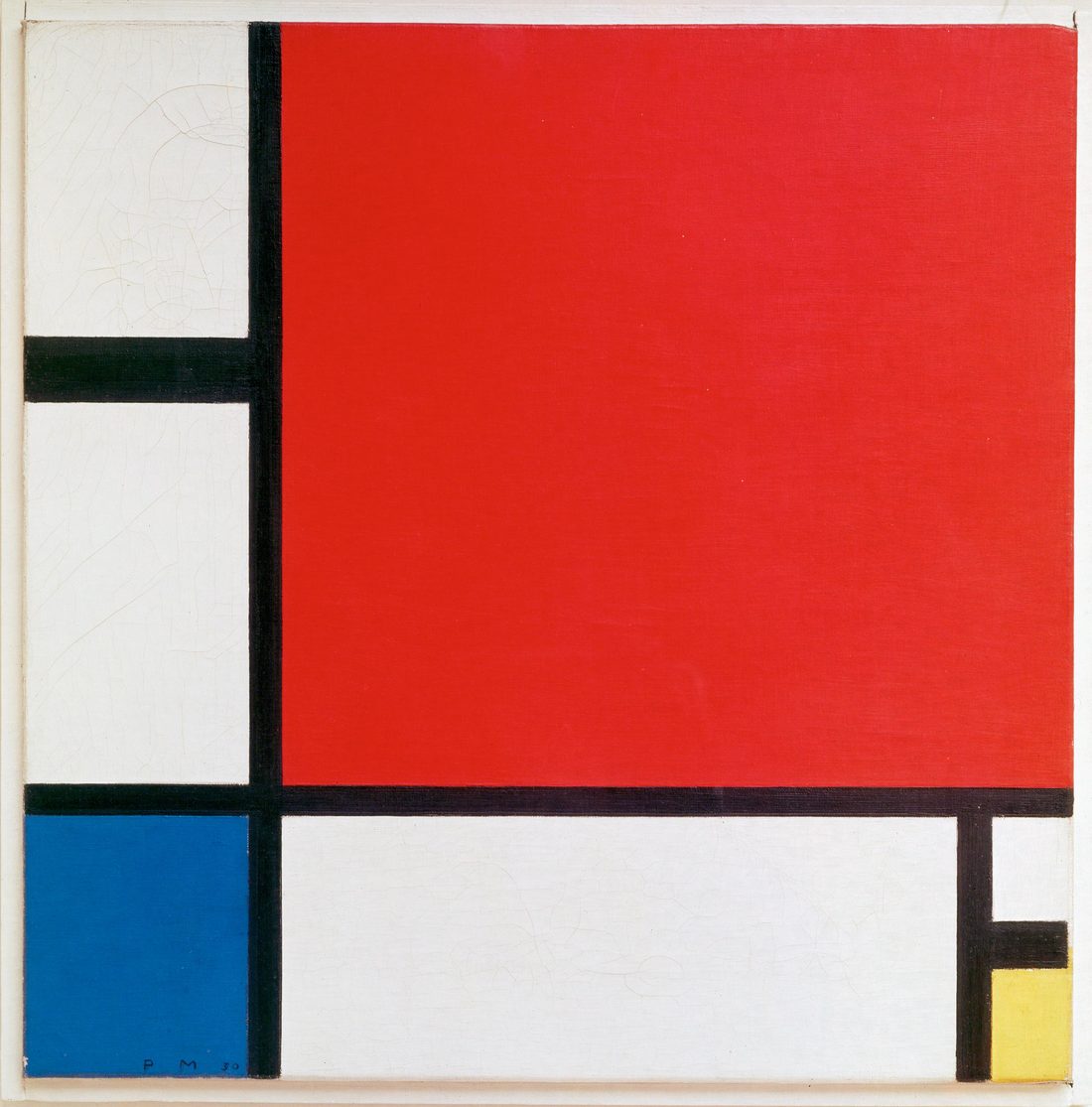
De Stijl, Dutch for 'the style', was a movement founded in the Netherlands in 1917 by Theo van Doesburg and Piet Mondrian, which reduced painting, architecture and design to horizontal and vertical lines, rectangles, and the three primary colours with black, white and grey.
It began as a magazine. Theo van Doesburg, painter, critic and tireless organiser, launched De Stijl in Leiden in October 1917, and a group gathered round it: Piet Mondrian, the painters Bart van der Leck and Vilmos Huszár, the sculptor Georges Vantongerloo, and the architects J. J. P. Oud and Robert van 't Hoff. The furniture maker and architect Gerrit Rietveld joined soon after. The Netherlands stayed neutral in the First World War, and the group set out to make a universal, harmonious art from the simplest elements: the straight line, the right angle and pure colour.
Mondrian called his version Neo-Plasticism and kept to it for the rest of his career, in the grids of black lines and blocks of red, yellow and blue he painted in Paris, London and New York. Van Doesburg brought diagonals in during the mid-1920s, which he called Elementarism, and Mondrian broke with him over it. Rietveld's Red and Blue Chair and his Schröder House in Utrecht, of 1924, now a World Heritage Site, carried the ideas into three dimensions, and Van Doesburg's teaching in Weimar in 1921 and 1922 fed them into the Bauhaus. The group had largely dispersed by the end of the 1920s, and the magazine's last issue appeared in 1932.
At a glance
- When
- 1917 to about 1931
- Where
- The Netherlands
- Leading artists
- Piet Mondrian
Characteristics of De Stijl
- Straight lines and right angles
- Horizontals and verticals only, even when the canvas is turned on its corner, as in Mondrian's lozenge paintings.
- Primary colours
- Red, yellow and blue, with black, white and grey, and nothing else.
- Asymmetric balance
- Unequal areas of colour and white held in tension rather than mirrored.
- Art and life as one
- Painting, architecture, furniture and typography designed on the same principles.
- Universal, not personal
- No visible brushwork and no subject: an art meant to be impersonal and universal.
De Stijl artists
Every artist below has a page on this site, with a short biography and what a valuation of their work turns on.
Famous De Stijl works
- Composition with Large Red Plane, Yellow, Black, Grey and BluePiet Mondrian, 1921, Kunstmuseum Den Haag
- Red and Blue ChairGerrit Rietveld, about 1918–23
- Rietveld Schröder House, UtrechtGerrit Rietveld, 1924
- Café Aubette interiors, StrasbourgTheo van Doesburg, Sophie Taeuber-Arp and Jean Arp, 1926–28
- Broadway Boogie WoogiePiet Mondrian, 1942–43, Museum of Modern Art, New York
What a valuation turns on
Works by the De Stijl artists are scarce. Mondrian painted relatively few Neo-Plastic canvases, most are in museums, and those that come to market are among the most valuable abstract paintings of their time; works by Van Doesburg, Van der Leck and Huszár are rarer still. Mondrian's earlier, figurative work, the landscapes, farmhouses, flowers and windmills he painted in the Netherlands before 1912, is offered more often and is a separate market.
Because the style looks simple, it has been imitated and forged, and Mondrian's catalogue raisonné is the essential reference; the paint surface, the canvas and stretcher, and any later restoration of the flat white grounds all matter. Rietveld furniture is another field again, full of later licensed reproductions and copies, so the maker, the date and the construction need establishing first.
Common questions
What is De Stijl?
De Stijl was a Dutch art and design movement founded in 1917 by Theo van Doesburg and Piet Mondrian. It used only straight horizontal and vertical lines, rectangles and the primary colours with black, white and grey, and applied the same principles to painting, architecture and furniture.
What does De Stijl mean?
'The style' in Dutch. It was the title of the magazine Theo van Doesburg founded in 1917, and it came to name the group of artists and architects around it.
Who were the De Stijl artists?
Theo van Doesburg and Piet Mondrian, with the painters Bart van der Leck and Vilmos Huszár, the sculptor Georges Vantongerloo, the architects J. J. P. Oud and Robert van 't Hoff, and the designer and architect Gerrit Rietveld.
What is the difference between De Stijl and the Bauhaus?
De Stijl was a Dutch movement and magazine built on a strict vocabulary of straight lines and primary colours; the Bauhaus was a German school of art and design. They overlapped: Van Doesburg taught informally in Weimar in 1921 and 1922, and De Stijl's ideas shaped Bauhaus design.
How do I sell a work by Mondrian or the De Stijl artists?
Send photographs of the front, the signature and the back, with any labels, certificates or invoices, for a free, confidential valuation. Whether the work is in the artist's catalogue raisonné is usually the first question; we check it, compare a confidential private sale with auction, and keep the paperwork in your name until you are paid.