
Laszlo Moholy-Nagy valuation
Bauhaus master who made pictures without a camera and ordered a painting over the telephone.
Laszlo Moholy-Nagy was born in Hungary in 1895, was wounded in the First World War, and joined the Bauhaus in 1923, where he ran the preliminary course and pushed the school decisively towards industry and technology.
What a work by Laszlo Moholy-Nagy is worth
Send photographs and whatever paperwork came with it. The first question is what the work actually is — edition or unique, when, and in what condition — because everything else follows from the answer. A valuation is free, made online from the photographs you send, and it commits you to nothing. We act for sellers across the United Kingdom, Europe and the United States.
Write to info@whitebankfineart.co.uk, or start below.
Bio
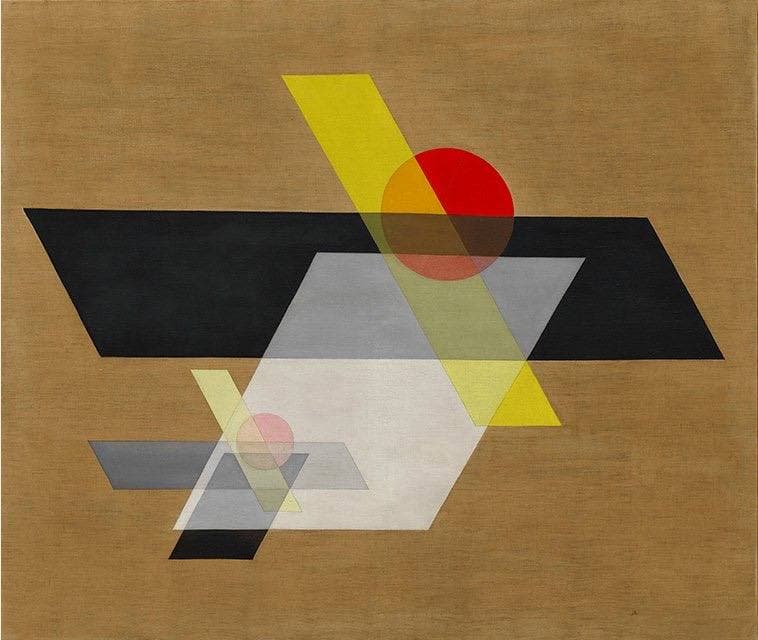
Laszlo Moholy-Nagy was born in Hungary in 1895, was wounded in the First World War, and joined the Bauhaus in 1923, where he ran the preliminary course and pushed the school decisively towards industry and technology. He made photograms — camera-less images produced by laying objects on light-sensitive paper — and in 1922 ordered five paintings from a sign factory by telephone, dictating them on a colour chart and a grid, in order to prove that a work could be made without the artist's hand. He fled to London, then Chicago, where he founded the New Bauhaus. He died in 1946.
The photograms are the most important part of the output and are unique, since a photogram has no negative; they are also silver gelatin prints from the 1920s and 1930s and are physically fragile, light-sensitive and prone to silvering. Vintage prints are worth a great deal more than the later prints made by his widow Sibyl and by the estate, and distinguishing them is essential. The paintings on Trolit and other early plastics have serious stability problems. Provenance across the 1933 to 1945 period should be examined.
At a glance
- Born
- 20 July 1895, Bácsborsód
- Died
- 24 November 1946, Chicago
- Movement
- Constructivism
More on Wikipedia.
London, Chicago and the Light-Space Modulator
After leaving Germany Moholy-Nagy spent 1935 to 1937 in London, where he worked on design and photography commissions and on special effects for the film Things to Come, before moving to Chicago to found the New Bauhaus, which became the Institute of Design, now part of the Illinois Institute of Technology. He died in Chicago in 1946.
The Light-Space Modulator, the kinetic sculpture he first sketched in 1922 and completed in 1930, is at the Harvard Art Museums. The Guggenheim gave him a retrospective, Future Present, in 2016. For a photograph, the print date and who made the print are the first things to establish.
Whitebank Fine Art is an art advisory and gallery, not an auction house, and is not affiliated with any auction house or with the artist, their estate or their representatives. This page describes the range we advise on. Nothing here is investment advice.