
Kazimir Malevich valuation
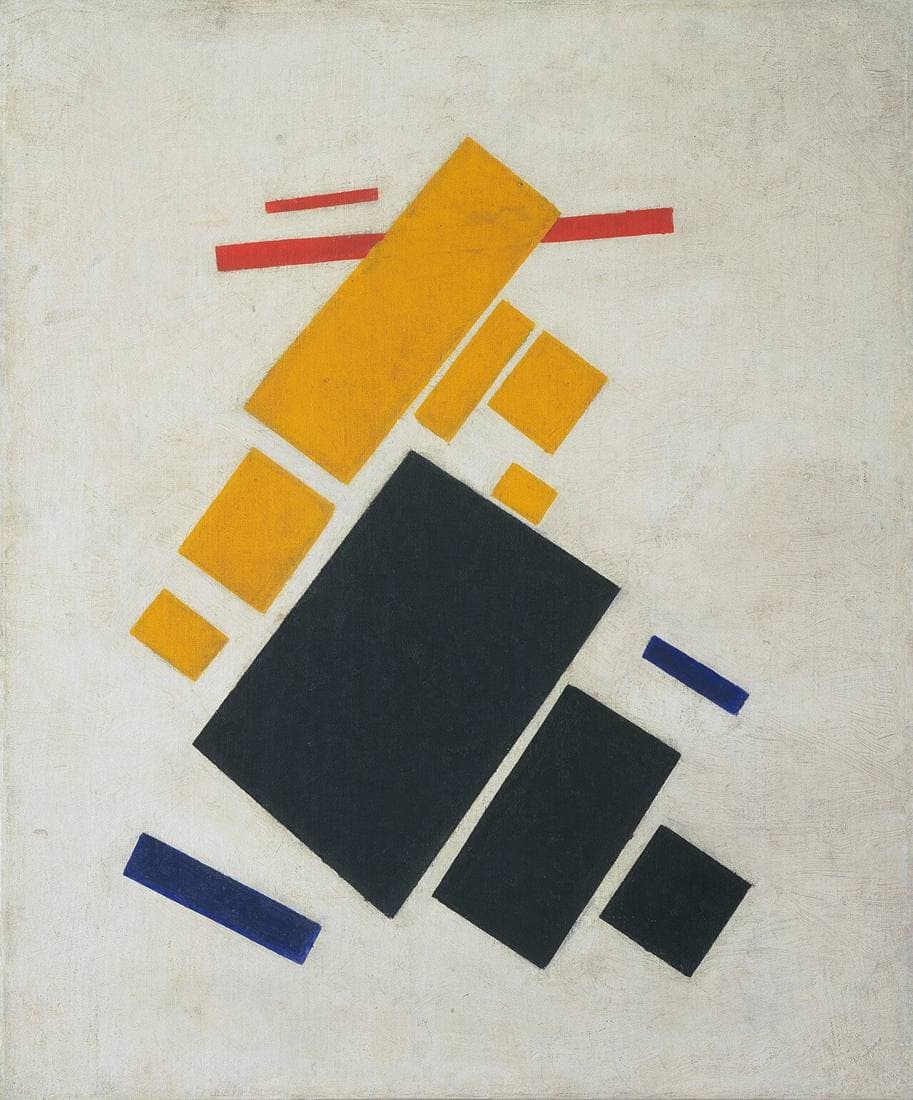
Invented Suprematism, painted the Black Square, and took painting to pure abstraction in 1915.
Kazimir Malevich was born near Kyiv in 1879 to a Polish family and was largely self-taught, with brief classes in Kyiv and Moscow; he was never admitted to the Moscow School of Painting.
What a work by Kazimir Malevich is worth
Send photographs and whatever paperwork came with it. The first question is what the work actually is — edition or unique, when, and in what condition — because everything else follows from the answer. A valuation is free, made online from the photographs you send, and it commits you to nothing. We act for sellers across the United Kingdom, Europe and the United States.
Write to info@whitebankfineart.co.uk, or start below.
Bio
Kazimir Malevich was born near Kyiv in 1879 to a Polish family and was largely self-taught, with brief classes in Kyiv and Moscow; he was never admitted to the Moscow School of Painting. He passed through Impressionism, Symbolism, Fauvism and Cubo-Futurism before launching Suprematism, a painting of flat geometric forms on white grounds, at the Last Futurist Exhibition 0,10 in Petrograd in 1915, where his Black Square hung high in the corner of the room. After the Revolution he taught at Vitebsk alongside Marc Chagall, founded the UNOVIS group, and later taught in Leningrad and Kyiv. His only journey abroad was in 1927, to exhibitions in Warsaw and Berlin. Under Stalin's cultural policy he returned to figurative painting, and he died in Leningrad in 1935.
Very little Malevich comes to market. Most of his work is in museums in Russia and at the Stedelijk Museum in Amsterdam, and in 2008 the Stedelijk returned five paintings to his heirs after a long dispute. The Russian avant-garde is one of the most forged areas of the art market, and any work needs a documented history and specialist scrutiny before it can be offered.
0,10, Vitebsk and the works left in Berlin
His essay From Cubism and Futurism to Suprematism was published to accompany 0,10. Black Square of 1915 is in the State Tretyakov Gallery in Moscow.
When he returned from Berlin in 1927 he left a large group of paintings and papers with the architect Hugo Häring, and most of them reached the Stedelijk in 1958.
Whitebank Fine Art is an art advisory and gallery, not an auction house, and is not affiliated with any auction house or with the artist, their estate or their representatives. This page describes the range we advise on. Nothing here is investment advice.