
Piet Mondrian valuation
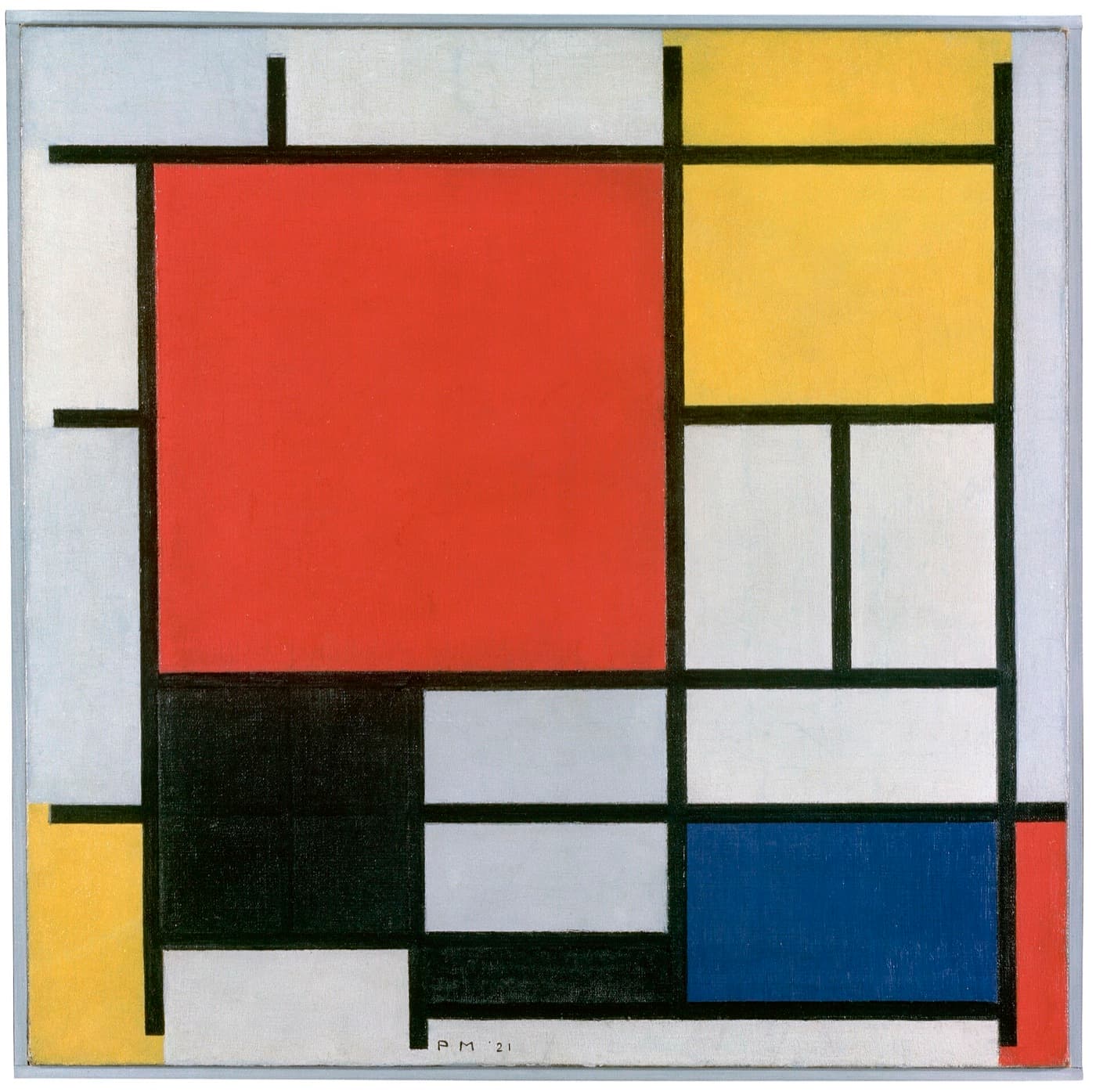
Reduced painting to black lines, white ground and three primary colours, and got there step by step.
Piet Mondrian was born at Amersfoort in 1872 and painted Dutch windmills, dunes and trees in a naturalistic manner for twenty years before anything changed.
What a work by Piet Mondrian is worth
Send photographs and whatever paperwork came with it. The first question is what the work actually is — edition or unique, when, and in what condition — because everything else follows from the answer. A valuation is free, made online from the photographs you send, and it commits you to nothing. We act for sellers across the United Kingdom, Europe and the United States.
Write to info@whitebankfineart.co.uk, or start below.
Bio
Piet Mondrian was born at Amersfoort in 1872 and painted Dutch windmills, dunes and trees in a naturalistic manner for twenty years before anything changed. Paris and Cubism began the reduction around 1912; the tree paintings show it happening. Stranded in the Netherlands by the First World War, he founded De Stijl with Theo van Doesburg in 1917 and arrived at Neoplasticism: horizontals, verticals, black lines, white ground, and red, blue and yellow only. He left Paris for London in 1938 and New York in 1940, where Broadway Boogie Woogie broke the black line into colour. He died in 1944.
The classical grid paintings are almost entirely institutional and rarely trade, and the naturalistic early work is a distinct market in its own right that is regularly underestimated because it does not look like a Mondrian. Both are unique. He reworked pictures over years and re-dated them, so an inscribed date can post-date the canvas beneath it. The white grounds have yellowed unevenly and past restoration has sometimes been heavy-handed. The RKD and the standing catalogue raisonne are the references, and reproductions of the grids are everywhere.
At a glance
- Born
- 7 March 1872, Amersfoort
- Died
- 1 February 1944, New York City
- Movements
- Post-Impressionism, De Stijl, Symbolism
More on Wikipedia.
The 1920 paintings
1920 is the year Mondrian settled the language of black lines and flat planes of primary colour he called Neo-Plasticism, and he finished only eight paintings in it. Five are in museums: Tate, the Museum of Modern Art, the Stedelijk in Amsterdam, the Galleria Nazionale d'Arte Moderna in Rome and the Wilhelm-Hack-Museum in Ludwigshafen. Three remain in private hands.
That scarcity is typical of the classical work as a whole, which is why paintings from the grid years appear at auction so rarely and draw such attention when they do. The early naturalistic landscapes, drawings and flower studies are far more numerous, and the Joosten and Welsh catalogue raisonné and the archive at the RKD in The Hague are the references for every period.
Best auction results
- Composition No. II $51m
- Oil on canvas, 1930 · New York · 14 November 2022
- Publicly reported
- The record for the artist. The same painting had last sold at auction in 1983.
- Composition with Large Red Plane, Bluish Gray, Yellow, Black and Blue $47.6m
- Oil on canvas, 1922 · New York · 12 May 2025
- Publicly reported
Results as reported at the time of sale, inclusive of buyer's premium. They are a record of what specific works achieved on specific days, not a guide to what any other work is worth.
Whitebank Fine Art is an art advisory and gallery, not an auction house, and is not affiliated with any auction house or with the artist, their estate or their representatives. This page describes the range we advise on. Nothing here is investment advice.