

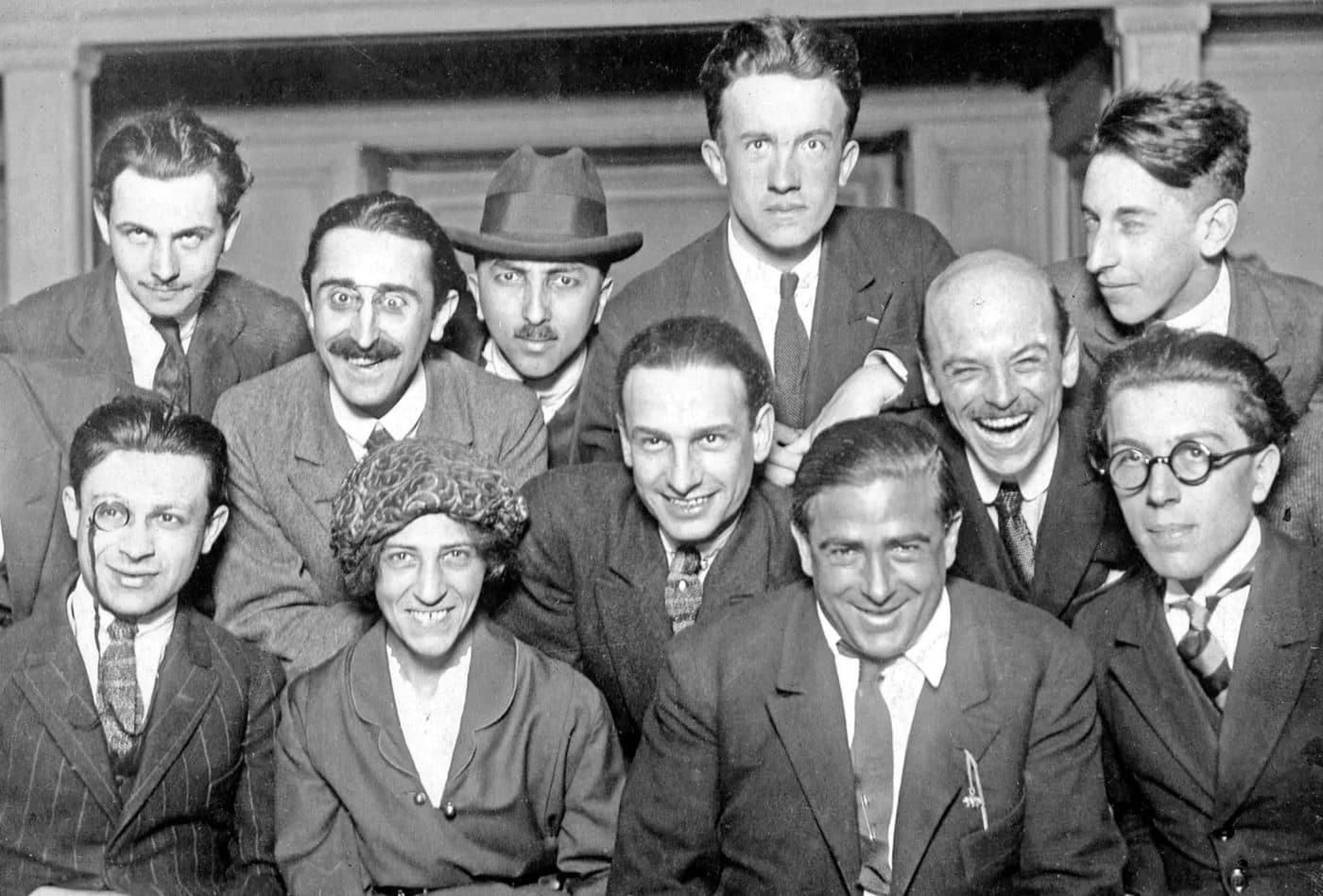
Dada
Dada, or Dadaism, was an anti-art movement founded in Zurich in 1916 by artists and writers in revolt against the First World War and the culture that had produced it, using nonsense, chance, collage, performance and the readymade to mock art itself.
It began at the Cabaret Voltaire, a nightclub opened in Zurich in February 1916 by the poet Hugo Ball and the performer Emmy Hennings. Neutral Switzerland was full of exiles from the war, and the evenings there, with Tristan Tzara, Marcel Janco, Richard Huelsenbeck and Jean Arp, were a mixture of sound poetry, costume, masks, manifestos and noise. The name, by most accounts found at random in a dictionary, is French for a child's hobby horse; that it meant nothing in particular was the point.
Dada spread wherever the war had scattered its people. In New York, Marcel Duchamp, Francis Picabia and Man Ray were doing much the same independently, and Duchamp's Fountain, a porcelain urinal signed 'R. Mutt' and submitted to an exhibition in 1917, became the most discussed object of the century. In Berlin, Hannah Höch, Raoul Hausmann, George Grosz and John Heartfield made photomontage a political weapon, and Otto Dix showed at the First International Dada Fair in 1920; in Hanover Kurt Schwitters made collages from tram tickets and rubbish; in Cologne Max Ernst worked with Arp. Paris Dada, around Tzara, André Breton and Picabia, ended in quarrels in the early 1920s, and Breton's circle became Surrealism.
At a glance
- When
- 1916 to about 1924
- Where
- Zurich, New York, Berlin, Cologne, Hanover and Paris
- Leading artists
- Jean Arp, Francis Picabia, Man Ray, Max Ernst
Characteristics of Dada
- Anti-art
- Mockery of the museum, of good taste and of the idea of the masterpiece.
- Chance
- Arp's collages arranged 'according to the laws of chance'; poems drawn from a hat.
- The readymade
- Ordinary manufactured objects chosen, signed and shown as art, after Duchamp.
- Collage and photomontage
- Images cut from newspapers and magazines, sharply political in Berlin.
- Performance
- Sound poetry, costume and provocation at the Cabaret Voltaire and the Dada soirées.
Dada artists
Every artist below has a page on this site, with a short biography and what a valuation of their work turns on.
Dada
- Jean ArpDada in Zurich, Surrealism in Paris, and then fifty years of forms that look grown rather than carved.
- Francis PicabiaImpressionist, Cubist, Dadaist and painter of pin-up nudes, who changed course on purpose and often.
- Man RayDada and Surrealist photographer who made pictures without a camera and called them rayographs.
- Max ErnstDada in Cologne, Surrealism in Paris, and the inventor of frottage, grattage and decalcomania.
- Otto DixWent to the trenches as a machine gunner and drew what he saw for the rest of his life.
Famous Dada works
- Untitled (Collage with Squares Arranged according to the Laws of Chance)Jean Arp, 1916–17, Museum of Modern Art, New York
- FountainMarcel Duchamp, 1917, replica of 1964, Tate, London
- Cut with the Kitchen KnifeHannah Höch, 1919–20, Nationalgalerie, Berlin
- The Art CriticRaoul Hausmann, 1919–20, Tate, London
- GiftMan Ray, 1921
What a valuation turns on
Dada made little that was meant to last or to sell, and its works are scarce: collages, drawings, photomontages, small reliefs, and periodicals and printed ephemera that have a strong market of their own among collectors of the avant-garde. Most of what comes up under the names on this page is from later in the artists' careers: Arp's sculptures and reliefs, Man Ray's photographs, Ernst's paintings and prints, Picabia's later paintings. Man Ray's photographs show the difficulty: a print made in the 1920s and a later print from the same negative are entirely different things, and dating the paper is part of the valuation.
Duchamp's readymades are mostly known through editions made in the 1960s, and authorised replicas and multiples are a recurring question. Arp's bronzes were cast in editions, some of them late, and the foundry, the cast number and the date of casting all need establishing.
Common questions
What is Dada?
Dada was an anti-art movement founded in Zurich in 1916 by artists and writers in revolt against the First World War. It used nonsense, chance, collage, performance and ready-made objects to attack the values of art and society, and spread to New York, Berlin, Hanover, Cologne and Paris.
What does Dada mean?
Dada is French for a child's hobby horse, and in other languages it sounds like baby talk. By most accounts the name was chosen at random from a dictionary, and its lack of meaning was the point.
Who were the Dada artists?
Hugo Ball, Tristan Tzara, Jean Arp and Marcel Janco in Zurich; Marcel Duchamp, Francis Picabia and Man Ray in New York; Hannah Höch, Raoul Hausmann, George Grosz and John Heartfield in Berlin; Kurt Schwitters in Hanover; Max Ernst in Cologne.
What is the difference between Dada and Surrealism?
Dada, from 1916, was destructive and anti-art: it set out to mock and dismantle. Surrealism, founded by André Breton in 1924 out of Paris Dada, was constructive, with a programme drawn from Freud to explore the unconscious through dream and automatism.
What is Neo-Dada?
A name for the work of American artists in the late 1950s, Robert Rauschenberg and Jasper Johns above all, who brought everyday objects and images back into art in the spirit of Duchamp, and opened the way for Pop art.
