

Pointillism
Pointillism is a technique of painting in small, separate dots of pure colour that the eye mixes at a distance, developed in Paris by Georges Seurat and Paul Signac from 1884 and known at the time as Neo-Impressionism.
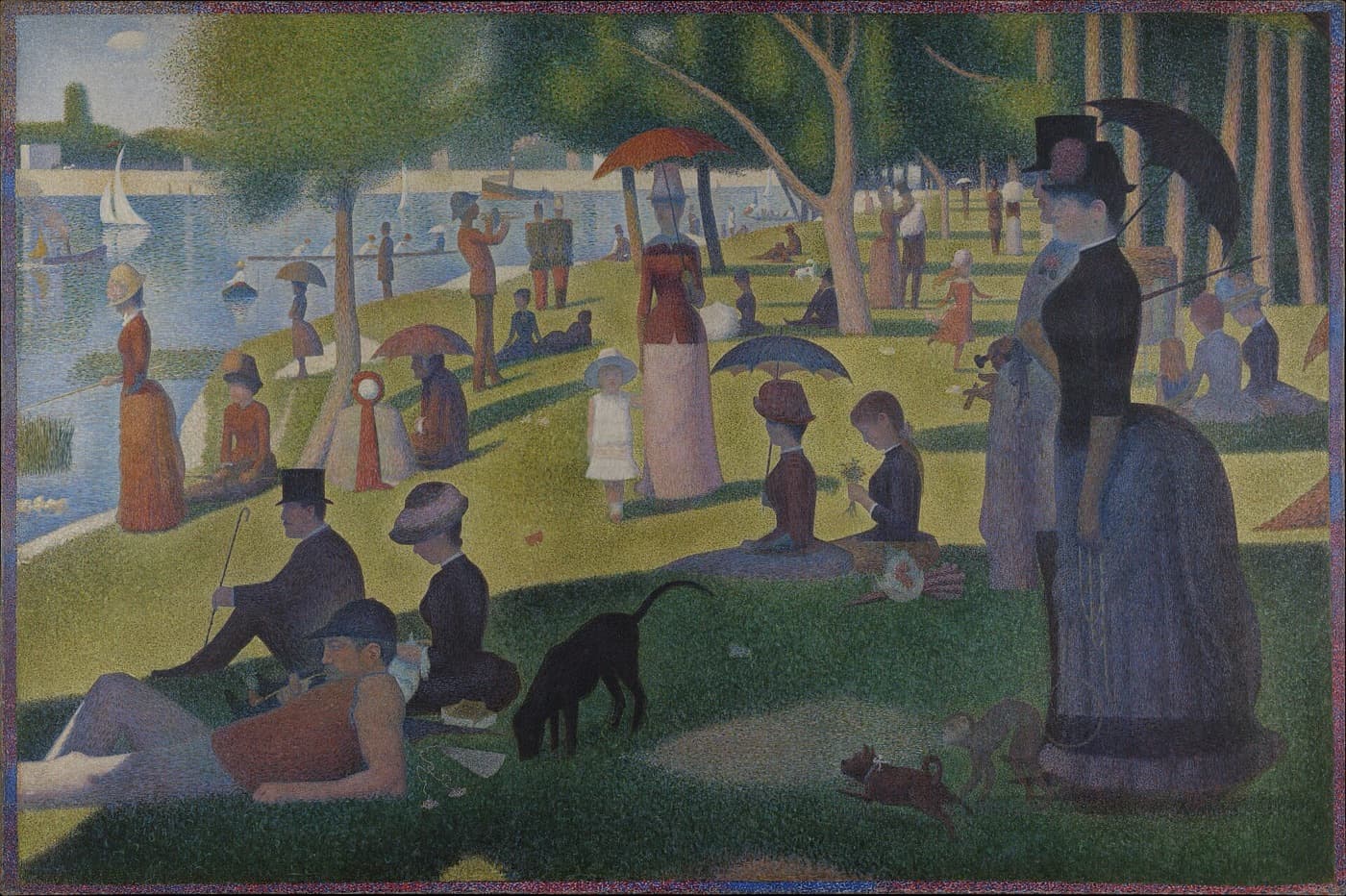
Seurat called it chromo-luminarism, the critic Félix Fénéon called the movement Neo-Impressionism in 1886, and 'pointillism' was the mocking word that stuck. It began with A Sunday on La Grande Jatte, which Seurat worked on from 1884 and showed at the eighth and last Impressionist exhibition in 1886. In place of Impressionism's quick, instinctive touch, Seurat laid down dots of unmixed colour according to the colour theories of Michel-Eugène Chevreul and Ogden Rood, setting complementary colours side by side so that each would intensify the other.
Seurat finished only a handful of large canvases, and the movement passed to Signac, its organiser and theorist, whose book From Eugène Delacroix to Neo-Impressionism appeared in 1899 and whose own touch grew into larger, mosaic-like blocks of colour. Camille Pissarro adopted the method for a few years in the late 1880s; Maximilien Luce and Henri-Edmond Cross took it up; in Belgium Théo van Rysselberghe, and the Dutch painter Jan Toorop, painted in dots. Henri Matisse spent the summer of 1904 with Signac at Saint-Tropez and painted Luxe, calme et volupté in the technique, and from that came Fauvism.
At a glance
- When
- 1884 to about 1905
- Where
- Paris
- Leading artists
- Georges Seurat, Paul Signac, Maximilien Luce, Camille Pissarro
Characteristics of pointillism
- Dots of pure colour
- Small, regular touches of unmixed pigment rather than brushstrokes.
- Optical mixing
- Colours mixed in the eye, not on the palette, which Seurat believed gave greater luminosity.
- Complementary contrast
- Orange set beside blue, red beside green, so that each makes the other more vivid.
- Order and stillness
- Calm, carefully planned compositions with a clear geometry, the opposite of Impressionist spontaneity.
- Painted borders
- Seurat sometimes painted a border of dots around the canvas, and even on the frame.
Pointillist artists
Every artist below has a page on this site, with a short biography and what a valuation of their work turns on.
The Neo-Impressionists
- Georges SeuratPainted in small, separate touches of colour, and died at thirty-one leaving a handful of large canvases.
- Paul SignacSeurat's partner in Neo-Impressionism, its theorist after Seurat died, and a sailor who painted harbours.
- Maximilien LuceNeo-Impressionist of building sites and steelworks, and an anarchist who was jailed for it.
- Camille PissarroThe only painter in all eight Impressionist exhibitions, and the teacher the others went to.
Painters who passed through it
- Henri MatisseTrained for the law, discovered painting in a sickbed, and ended cutting colour with scissors.
- Jan TooropJavanese-born Dutch Symbolist of linear, wraith-like figures, who later turned to Catholic subjects.
- Robert DelaunayPainted the Eiffel Tower breaking apart, then discs of pure colour; Apollinaire called the result Orphism.
Famous Pointillist works
- A Sunday on La Grande JatteGeorges Seurat, 1884–86, Art Institute of Chicago
- Le ChahutGeorges Seurat, 1889–90, Kröller-Müller Museum, Otterlo
- Portrait of Félix FénéonPaul Signac, 1890, Museum of Modern Art, New York
- The CircusGeorges Seurat, 1891, Musée d'Orsay, Paris
- Luxe, calme et voluptéHenri Matisse, 1904, Musée d'Orsay, Paris
What a valuation turns on
Seurat's paintings are very rare outside museums; his conté crayon drawings, which he treated as finished works, are what the market sees. Signac painted a good deal, but more often comes up in watercolour, harbours and coasts made in great numbers, and in the colour lithographs of the 1890s. Luce, Cross, Van Rysselberghe and the later Neo-Impressionists appear more often, and the catalogue raisonné for each is the first reference.
Condition is a particular question with dot-painted pictures. The effect depends on unmixed colour sitting side by side, and discoloured varnish, retouching or fading changes it more than it would a conventionally painted canvas. A conservator's report, and photographs taken in good daylight, help a valuation more than usual.
Common questions
What is pointillism?
Pointillism is a way of painting in small, separate dots of pure colour that blend in the viewer's eye rather than on the palette. Georges Seurat and Paul Signac developed it in Paris in the mid-1880s.
Who invented pointillism?
Georges Seurat, working with Paul Signac. His A Sunday on La Grande Jatte, painted from 1884 and shown in 1886, is the founding work.
What is the difference between pointillism and Neo-Impressionism?
Neo-Impressionism is the movement, named by the critic Félix Fénéon in 1886. Pointillism is its technique of painting in dots, and divisionism the colour theory behind it, of separating colours rather than mixing them.
Who are the most famous pointillist artists?
Georges Seurat and Paul Signac, followed by Camille Pissarro, Maximilien Luce, Henri-Edmond Cross and Théo van Rysselberghe. Henri Matisse, Jan Toorop and Robert Delaunay all painted in the technique for a time.
How do I sell a pointillist painting or a Signac watercolour?
Send photographs of the front, the signature and the back for a free, confidential valuation, with any labels or documents. We check the work against the artist's catalogue raisonné, look at condition, and compare a confidential private sale with auction.
