

Jan Toorop valuation
Javanese-born Dutch Symbolist of linear, wraith-like figures, who later turned to Catholic subjects.
Jan Toorop was born in Java in 1858 to a Dutch colonial official and a mother of mixed descent, and was sent to the Netherlands at eleven.
What a work by Jan Toorop is worth
Send photographs and whatever paperwork came with it. The first question is what the work actually is — edition or unique, when, and in what condition — because everything else follows from the answer. A valuation is free, made online from the photographs you send, and it commits you to nothing. We act for sellers across the United Kingdom, Europe and the United States.
Write to info@whitebankfineart.co.uk, or start below.
Bio
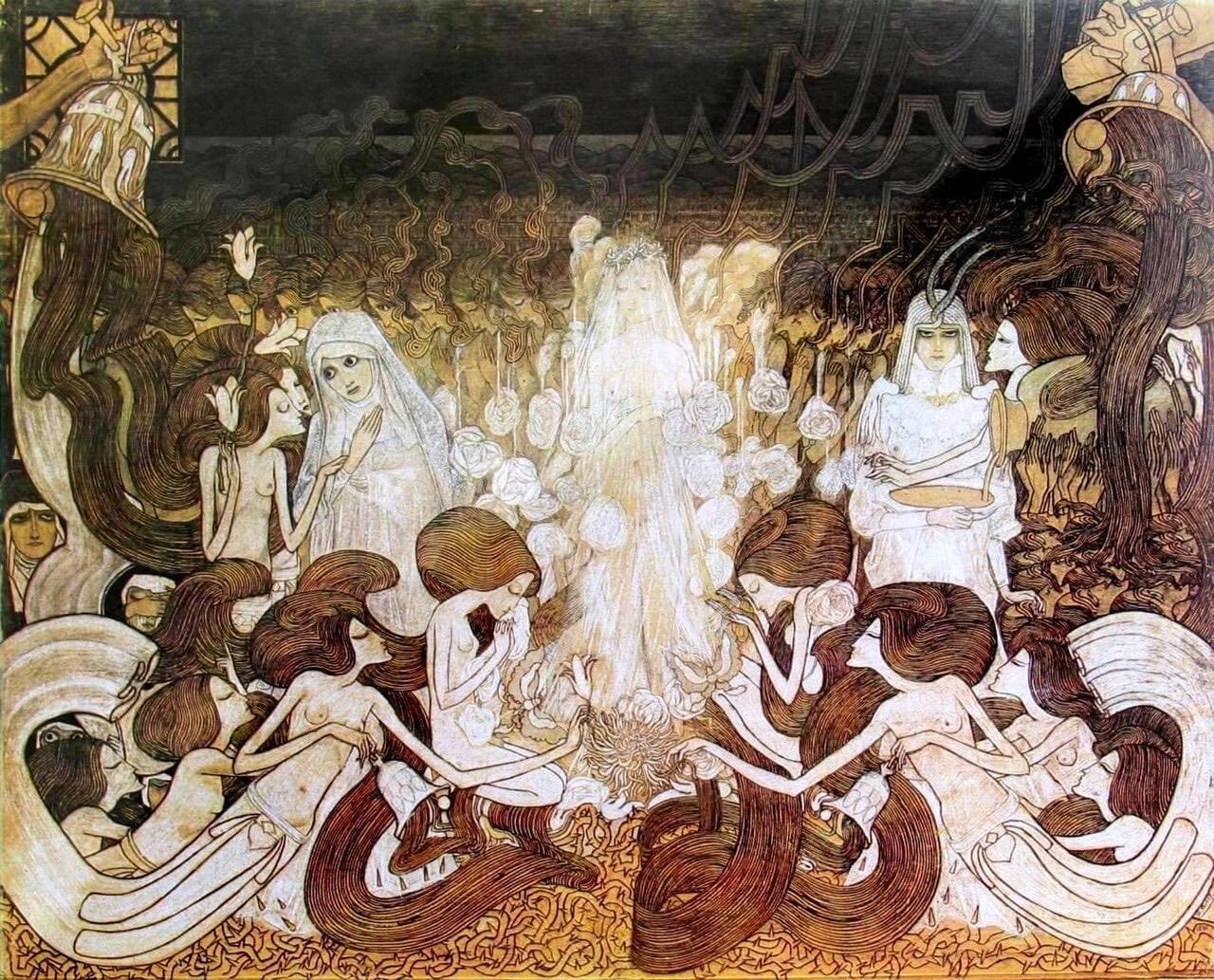
Jan Toorop was born in Java in 1858 to a Dutch colonial official and a mother of mixed descent, and was sent to the Netherlands at eleven. He worked through Impressionism and Pointillism before arriving in the 1890s at the Symbolist manner that made him: elongated, wraith-like female figures with streaming hair drawn in a linear rhythm that draws directly on the Javanese wayang shadow puppets of his childhood. He designed the famous Delftsche Slaolie poster, converted to Catholicism in 1905, and spent his later career on religious subjects and portraits. He died in 1928.
A market principally in the Netherlands and Belgium. The Symbolist works of roughly 1890 to 1900 lead by a considerable margin over both the earlier and the later output. Most of the significant work is on paper in chalk, pencil and mixed media, so light damage, foxing and mount-burn are the main condition determinants. The lithographic posters are collected in their own right and turn on impression quality and whether a sheet has been folded or backed. His daughter Charley Toorop was also a significant painter, and the two are sometimes confused.
At a glance
- Born
- 20 December 1858, Purworejo
- Died
- 3 March 1928, The Hague
- Movements
- Expressionism, Symbolism, Pointillism
More on Wikipedia.
Brussels, Katwijk and Domburg
Toorop studied at the Rijksakademie in Amsterdam from 1880 and lived in Brussels from 1882 to 1886, where he joined the avant-garde circle of Les XX. In 1886 he married Annie Hall, an Englishwoman, and divided his time between The Hague, England and Brussels, and from 1890 the seaside town of Katwijk, where the Symbolist manner took shape.
From 1897 he spent long periods at Domburg on Walcheren, painting alongside Piet Mondrian among others. He also designed book illustrations, posters and stained glass, and his grandson Edgar Fernhout was a painter too. The Kröller-Müller Museum at Otterlo holds a large group of his work, including The Three Brides of 1893.
Whitebank Fine Art is an art advisory and gallery, not an auction house, and is not affiliated with any auction house or with the artist, their estate or their representatives. This page describes the range we advise on. Nothing here is investment advice.
