

Maximilien Luce valuation
Neo-Impressionist of building sites and steelworks, and an anarchist who was jailed for it.
Maximilien Luce was born in Paris in 1858, trained as a wood engraver, and took up divisionism after meeting Seurat, Signac and Pissarro in the 1880s.
What a work by Maximilien Luce is worth
Send photographs and whatever paperwork came with it. The first question is what the work actually is — edition or unique, when, and in what condition — because everything else follows from the answer. A valuation is free, made online from the photographs you send, and it commits you to nothing. We act for sellers across the United Kingdom, Europe and the United States.
Write to info@whitebankfineart.co.uk, or start below.
Bio
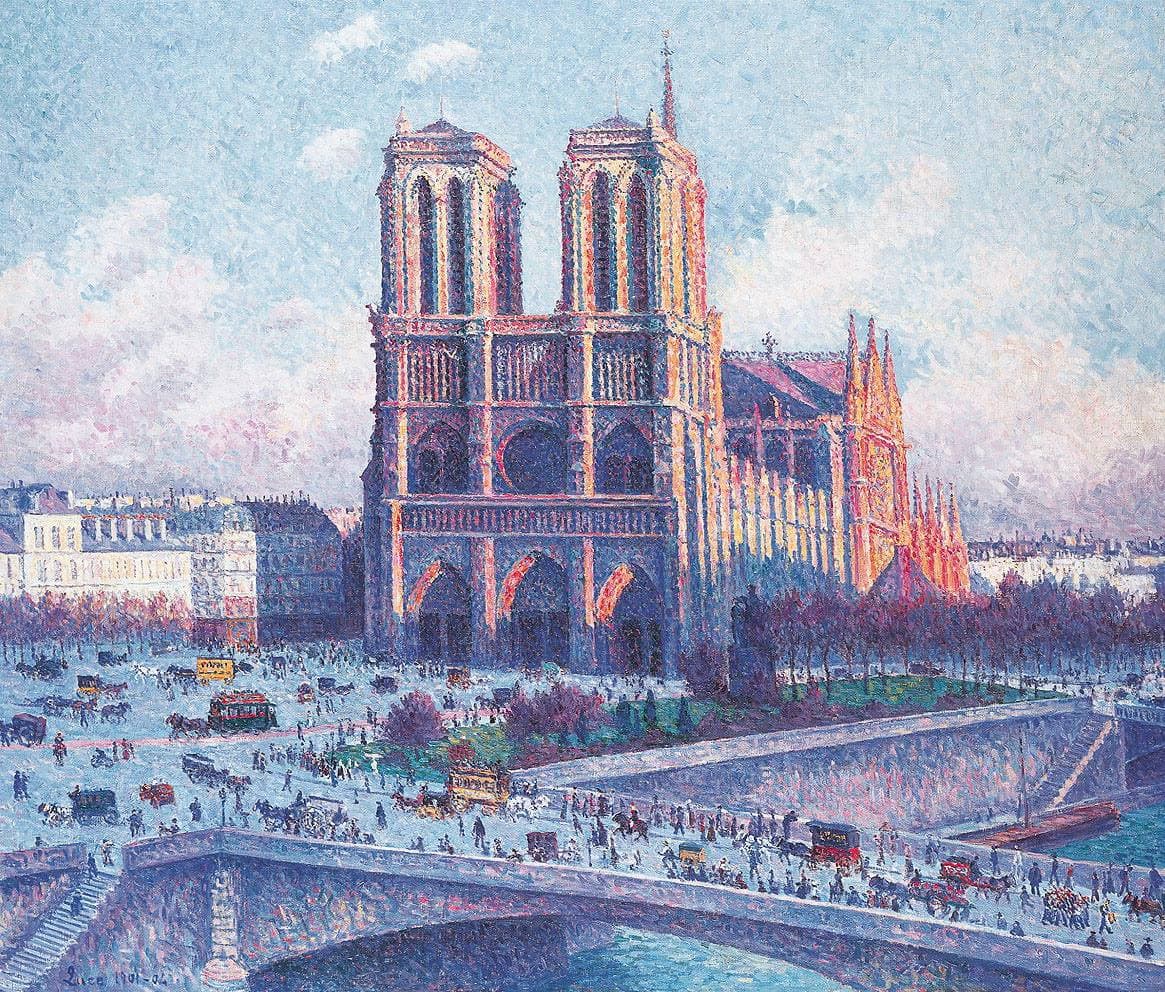
Maximilien Luce was born in Paris in 1858, trained as a wood engraver, and took up divisionism after meeting Seurat, Signac and Pissarro in the 1880s. What separates him from the rest of the Neo-Impressionists is the subject matter: labourers, foundries, pile-drivers, the steelworks of Charleroi and the building sites of Paris, painted with the same systematic dots used elsewhere for bathers and harbours. He was a committed anarchist, contributed to Le Pere Peinard and other papers, and was imprisoned at Mazas in 1894 during the trial of the thirty. He later loosened the technique considerably, and died in 1941.
The divisionist works of roughly 1887 to 1900 lead the market by a wide margin; the much larger later output in a freer Impressionist manner is a different and more modest field, and the two are frequently conflated. Luce was extremely prolific across sixty years and the supply of later work is substantial. The catalogue raisonne by Bouin-Luce and Bazetoux is the reference. He also produced lithographs and a large body of drawings and watercolours, including the anarchist illustrations.
Engraving, the Indépendants and Rolleboise
Luce was apprenticed to a wood engraver at fourteen and later engraved for L'Illustration and The Graphic in the studio of Eugène Froment, while taking classes with Carolus-Duran. When zincography made engraving nearly obsolete he turned to painting full time, in about 1883, and Léo Gausson and Cavallo-Péduzzi introduced him to divisionism the following year.
In 1892 he travelled to London with Pissarro and to Saint-Tropez with Signac. He showed at every Salon des Indépendants from 1887 until his death except those of 1915 to 1919, and in 1935 succeeded Signac as president of the Société des Artistes Indépendants. His companion and later wife, Ambroisine Bouin, appears in many of his paintings. He died in Paris in February 1941 and is buried at Rolleboise.
Whitebank Fine Art is an art advisory and gallery, not an auction house, and is not affiliated with any auction house or with the artist, their estate or their representatives. This page describes the range we advise on. Nothing here is investment advice.
