
Andre Derain valuation
Painted Collioure with Matisse in one summer and invented Fauvism, then spent forty years retreating from it.
Andre Derain was born at Chatou in 1880 and spent the summer of 1905 at Collioure with Matisse; the pictures the two brought back were shown that autumn in the room a critic called a cage of wild beasts, and Fauvism existed.
What a work by Andre Derain is worth
Send photographs and whatever paperwork came with it. The first question is what the work actually is — edition or unique, when, and in what condition — because everything else follows from the answer. A valuation is free, made online from the photographs you send, and it commits you to nothing. We act for sellers across the United Kingdom, Europe and the United States.
Write to info@whitebankfineart.co.uk, or start below.
Bio
Andre Derain was born at Chatou in 1880 and spent the summer of 1905 at Collioure with Matisse; the pictures the two brought back were shown that autumn in the room a critic called a cage of wild beasts, and Fauvism existed. Derain painted London for the dealer Vollard, was among the first Europeans to take African sculpture seriously, and then turned away from all of it — towards Cezanne, towards the museum, and finally towards a sober classicism that his admirers regarded as a betrayal. His agreement to join a Nazi-organised artists' tour of Germany in 1941 damaged his reputation permanently. He died in 1954.
The Fauve pictures of 1905 to 1907 are a very small group and are among the most valuable French paintings of the period; everything afterwards is a different and much broader market. That gap is the central fact of a Derain valuation. Provenance across 1940 to 1945 requires proper examination, as it does for any French painter of the period. He also made sculpture, ceramics, book illustration and a body of woodcuts, and produced many drawings, of which a considerable number of doubtful attributions circulate.
At a glance
- Born
- 10 June 1880, Chatou
- Died
- 8 September 1954, Garches
- Movements
- Fauvism, Cubism
More on Wikipedia.
The London paintings
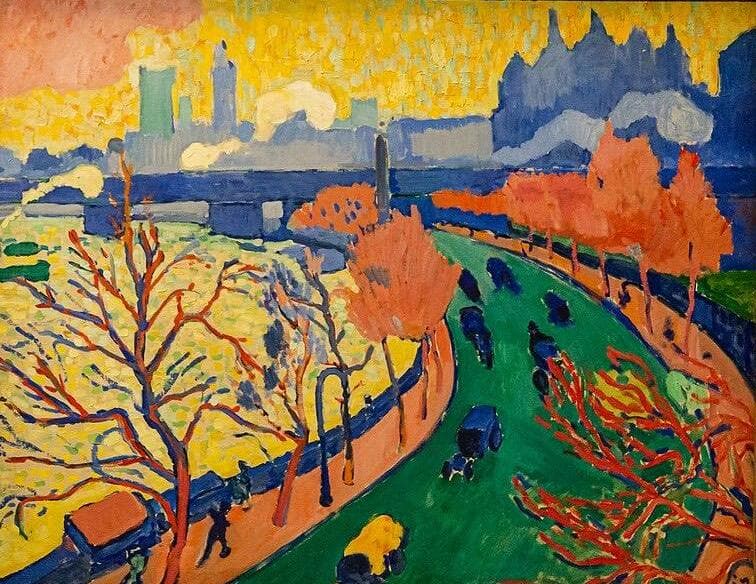
In March 1906 the dealer Ambroise Vollard sent Derain to London to paint the city, and he made thirty pictures of the Thames and its bridges, of which twenty-nine survive. They were the subject of an exhibition at the Courtauld from October 2005 to January 2006, and they remain his best-known work.
For anything outside that small group, the date is what matters most, since the Fauve years and the later classical work are valued so differently, and a work's entry in the catalogue raisonné of the paintings, with its provenance, is what an attribution rests on.
Whitebank Fine Art is an art advisory and gallery, not an auction house, and is not affiliated with any auction house or with the artist, their estate or their representatives. This page describes the range we advise on. Nothing here is investment advice.