

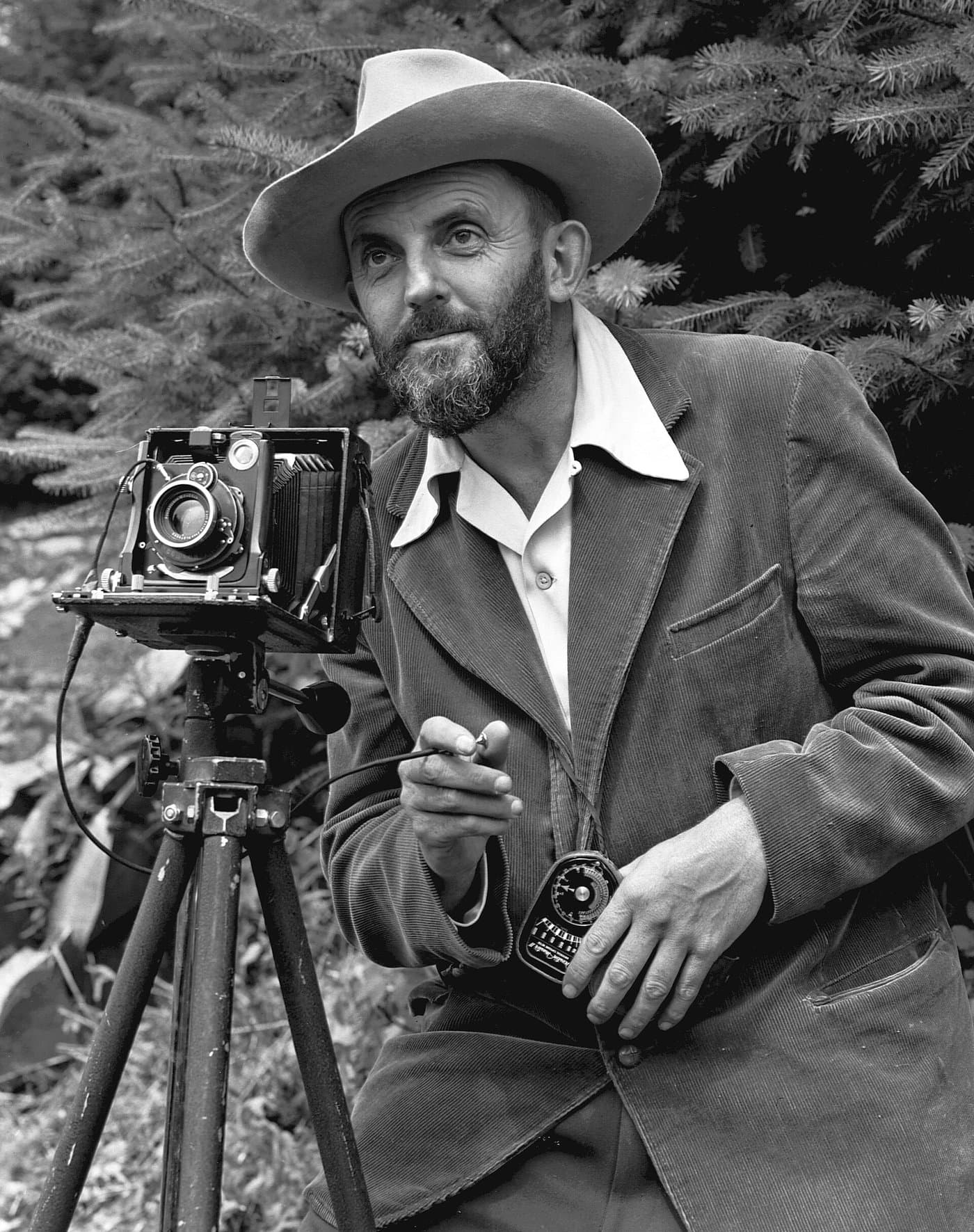
Ansel Adams valuation
Made the American West a subject, and made printing a discipline as exacting as the exposure.
Ansel Adams was born in San Francisco in 1902 and trained as a concert pianist before photography took the career.
What a work by Ansel Adams is worth
Send photographs and whatever paperwork came with it. The first question is what the work actually is — edition or unique, when, and in what condition — because everything else follows from the answer. A valuation is free, made online from the photographs you send, and it commits you to nothing. We act for sellers across the United Kingdom, Europe and the United States.
Write to info@whitebankfineart.co.uk, or start below.
Bio
Ansel Adams was born in San Francisco in 1902 and trained as a concert pianist before photography took the career. In 1932 he founded Group f/64 with Edward Weston and Imogen Cunningham, arguing for sharp focus and the full tonal range against the soft-focus pictorialism of the day, and with Fred Archer he set out the Zone System — a method of visualising the finished print first and then exposing and developing to arrive at it. Yosemite and the Sierra Nevada are the subjects attached to his name, and Moonrise, Hernandez, New Mexico of 1941 is the single most reproduced frame. He worked commercially for decades, taught widely, and helped establish the photography department at the Museum of Modern Art. He died in 1984.
Adams printed his own negatives across fifty years, and the same image exists in prints of very different character: the later ones are generally darker and more dramatic than those made in the 1940s. The date of the print rather than the date of the negative is therefore the first thing to establish, along with the mount, the pencil signature that usually sits on it, and whether the sheet is one of the Special Edition prints made by assistants from his negatives for sale in Yosemite, which is a separate category again. Portfolios should be complete.
At a glance
- Born
- 20 February 1902, San Francisco
- Died
- 22 April 1984, Carmel-by-the-Sea
More on Wikipedia.
The seven portfolios
Between 1948 and 1976 Adams issued seven portfolios, each a limited edition of between ten and fifteen signed prints in a box with a title page and text, ninety images in all. He printed them himself as definitive versions of the pictures, and a complete portfolio in its original box sits apart from loose prints of the same images.
Single prints from broken portfolios turn up regularly, and the mount, any edition information and the stamps on the reverse help to identify them. The opposite case is the very large number of posters, calendars and book plates printed from his photographs, which are mechanical reproductions and not photographic prints at all. A magnifying glass usually settles it: a gelatin silver print has continuous tone, while a reproduction shows a pattern of dots.
Monolith, the Mural Project and the Moonrise prints
Adams first saw Yosemite in 1916, when his father gave him a Box Brownie, and at seventeen he joined the Sierra Club, later serving 37 years on its board. Best's Studio in Yosemite began selling his prints in 1922. In 1927 the San Francisco patron Albert Bender backed his first portfolio, Parmelian Prints of the High Sierras, which included Monolith, the Face of Half Dome, made with a dark red filter on the last glass plate he had with him. Paul Strand persuaded him to print on glossy paper, and the Smithsonian gave him his first solo museum exhibition in 1931.
Moonrise, Hernandez, New Mexico was made in 1941, while he was photographing for the National Park Service's Mural Project. The negative was hard to print, and over nearly forty years he made more than 1,300 prints of it, mostly 16 by 20 inches and many of them in the 1970s. He co-founded the magazine Aperture in 1952, ran annual workshops in Yosemite from 1955 to 1981, and from 1965 lived at Carmel Highlands, printing the backlog of forty years of negatives. He thought little of his colour work, most of it made on assignment.
Whitebank Fine Art is an art advisory and gallery, not an auction house, and is not affiliated with any auction house or with the artist, their estate or their representatives. This page describes the range we advise on. Nothing here is investment advice.
