

Symbolism
Symbolism was a movement in literature and art, named in Paris in 1886, whose painters turned away from the visible world to paint ideas, dreams, myth, desire and mortality in images meant to suggest rather than describe.
The word came from poetry. In September 1886 the poet Jean Moréas published a Symbolist manifesto in Le Figaro, arguing for an art that would 'clothe the idea in a form perceptible to the senses'. Painters had been working that way already: Gustave Moreau with his jewelled biblical and mythological scenes, Pierre Puvis de Chavannes with his pale, still allegories, Odilon Redon with charcoal drawings of floating eyes and strange creatures. Against Realism and Impressionism, which painted what was in front of them, the Symbolists painted what was not.
It spread quickly. In Brussels the group Les XX showed Symbolist work beside the avant-garde, and Fernand Khnopff, Félicien Rops and Jan Toorop made it their own. In Norway Edvard Munch painted love, jealousy and anxiety as a cycle he called The Frieze of Life. In Vienna, Gustav Klimt and the artists of the Secession, founded in 1897, turned Symbolism into gold and ornament, and the young Egon Schiele grew out of it. Symbolism fed directly into Art Nouveau and, through Munch and Gauguin, into Expressionism.
At a glance
- When
- about 1886 to 1910
- Where
- France, Belgium, Scandinavia and Vienna
- Leading artists
- Jan Toorop, Edvard Munch, Paul Gauguin
Characteristics of Symbolism
- Ideas over appearances
- Subjects from myth, the Bible, legend and dream, used to stand for states of mind.
- The femme fatale
- Salome, the Sphinx and Medusa: a recurring and much-debated figure.
- Decorative line
- Flowing, rhythmic contour that leads straight into Art Nouveau.
- Mood
- Twilight, silence and melancholy; a heightened, unreal atmosphere.
- Private symbols
- Imagery whose meaning is personal to the artist, meant to be felt rather than decoded.
Symbolist artists
Every artist below has a page on this site, with a short biography and what a valuation of their work turns on.
The Symbolists
- Jan TooropJavanese-born Dutch Symbolist of linear, wraith-like figures, who later turned to Catholic subjects.
- Edvard MunchPainted The Scream four times, and printed the rest of his life's anxieties in editions.
- Paul GauguinLeft a stockbroking career and a family for Brittany, Martinique and finally Polynesia.
Vienna
- Gustav KlimtVienna Secession, gold leaf, and several thousand drawings that are the practical market.
- Egon SchieleDrew the body without flattery for ten years and was dead at twenty-eight.
- Ludwig Heinrich JungnickelViennese animal painter of the Wiener Werkstatte circle, who drew at the zoo for sixty years.
Famous Symbolist works
- Isle of the DeadArnold Böcklin, 1880, Kunstmuseum Basel
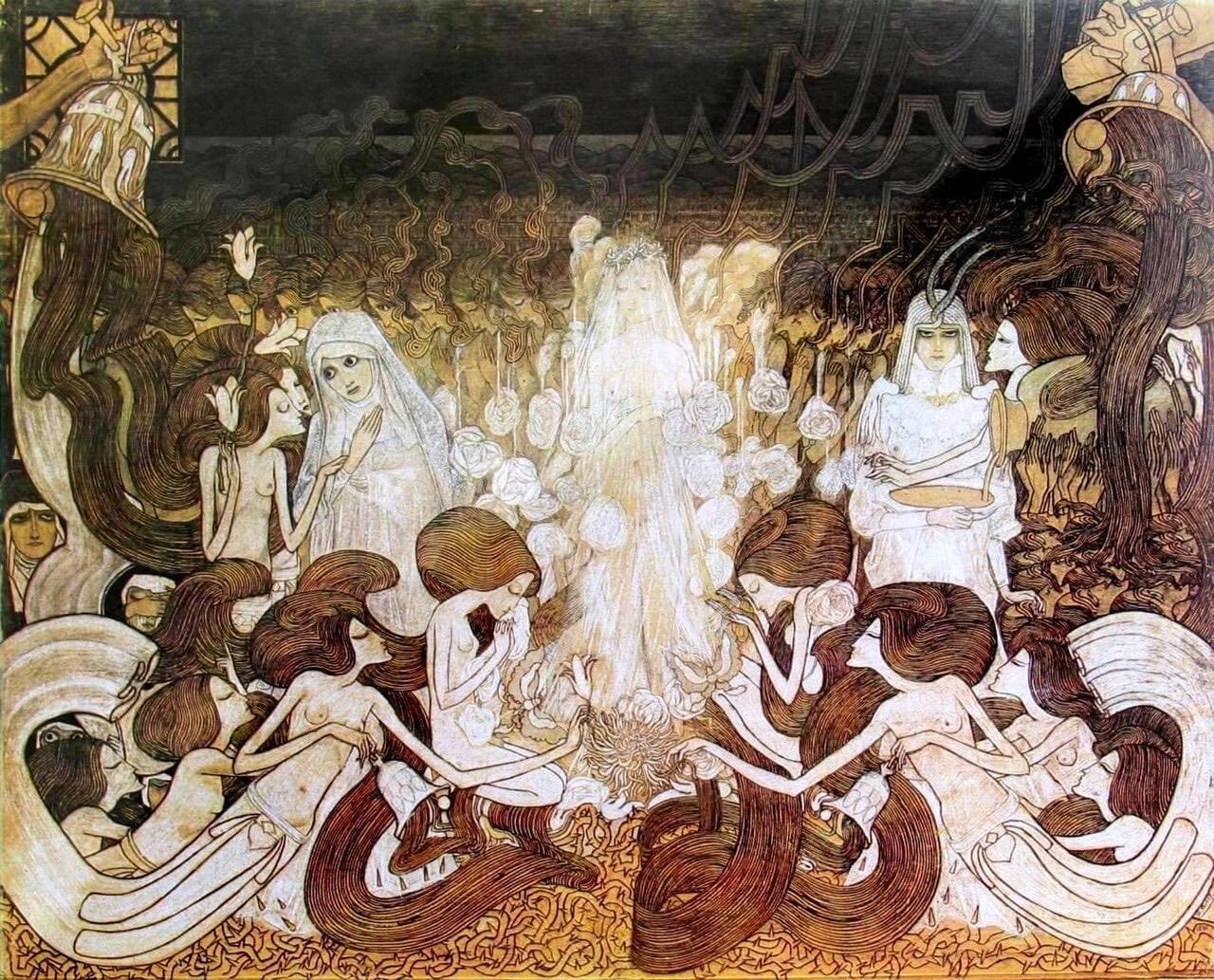
- The Three BridesJan Toorop, 1893, Kröller-Müller Museum, Otterlo
- The ScreamEdvard Munch, 1893, National Museum, Oslo
- CaressesFernand Khnopff, 1896, Royal Museums of Fine Arts of Belgium, Brussels
- The KissGustav Klimt, 1907–08, Belvedere, Vienna
- The CyclopsOdilon Redon, about 1914, Kröller-Müller Museum, Otterlo
What a valuation turns on
Much Symbolist art is on paper: Redon's charcoals and lithographs, Munch's woodcuts and lithographs, Klimt's drawings, Toorop's drawings. With Munch and Redon the prints are the larger market, and the impression, the colour, the paper and the edition all count; Munch printed and reworked his own blocks over many years, so two impressions of the same image can differ greatly. Klimt's drawings are many, and catalogued, so the catalogue is checked first; Schiele's work is catalogued by Jane Kallir.
Restitution is a real question for Viennese art of this period. Many works by Klimt and Schiele were in Jewish collections in Vienna before 1938, and a work with a gap in its provenance between the 1930s and 1945 has to be researched before it can be sold.
Common questions
What is Symbolism in art?
Symbolism was a late nineteenth-century movement whose artists painted ideas, dreams, myth and emotion rather than the visible world, using images meant to suggest rather than describe. It was named in Paris in 1886 and spread across Europe until about 1910.
Who were the Symbolist painters?
In France, Gustave Moreau, Pierre Puvis de Chavannes and Odilon Redon; in Belgium, Fernand Khnopff and Félicien Rops; Jan Toorop in the Netherlands, Arnold Böcklin in Switzerland, Edvard Munch in Norway and Gustav Klimt in Vienna. Gauguin and the Nabis came close to it too.
When was the Symbolist movement?
From the mid-1880s to about 1910. Jean Moréas's manifesto in Le Figaro in September 1886 gave it its name, and by the First World War it had passed into Art Nouveau, Expressionism and, later, Surrealism.
What is the difference between Symbolism and Surrealism?
Both deal in dream and the irrational. Symbolism, in the 1880s and 1890s, used myth and allegory to suggest states of mind; Surrealism, from 1924, drew on Freud and set out to release the unconscious directly, through automatism and the unexpected meeting of things.
How do I sell a Symbolist work or print?
Send photographs of the front, the signature and the back, with any labels, for a free, confidential valuation. For prints we check the impression and edition against the catalogue; for paintings and drawings, the catalogue raisonné and the provenance, including the years between 1933 and 1945.
