
Jean Dubuffet valuation
Wine merchant until forty-one, then the inventor of Art Brut and the Hourloupe.
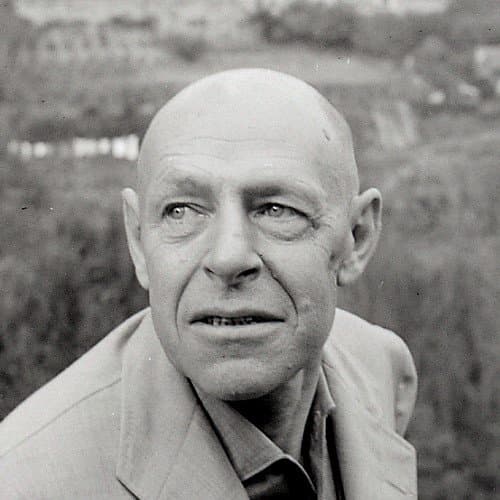
Jean Dubuffet was born at Le Havre in 1901, ran the family wine business for most of two decades, and committed to painting for good only in 1942.
What a work by Jean Dubuffet is worth
Send photographs and whatever paperwork came with it. The first question is what the work actually is — edition or unique, when, and in what condition — because everything else follows from the answer. A valuation is free, made online from the photographs you send, and it commits you to nothing. We act for sellers across the United Kingdom, Europe and the United States.
Write to info@whitebankfineart.co.uk, or start below.
Bio
Jean Dubuffet was born at Le Havre in 1901, ran the family wine business for most of two decades, and committed to painting for good only in 1942. He coined Art Brut for the work of psychiatric patients, prisoners and outsiders, assembled a vast collection of it now in Lausanne, and made his own paintings from tar, sand, gravel, asphalt and butterfly wings in a deliberate assault on good taste. In 1962 a ballpoint doodle taken during a telephone call produced the Hourloupe — jigsawed cells of red, white, blue and black outlined in heavy line — which occupied him for twelve years and grew into painted polyurethane architecture. He died in 1985.
The materials are the condition problem. The Texturologies, Materiologies and haute pate works of the 1940s and 1950s incorporate genuinely unstable substances and many have suffered structural loss; a proper condition report is not optional. Hourloupe works exist as paintings, as painted polyester sculpture in editions, and as prints. The Fondation Dubuffet in Paris maintains the catalogue raisonne begun by Max Loreau and issues certificates, and it is the necessary reference for anything of significance.
At a glance
- Born
- 31 July 1901, Le Havre
- Died
- 12 May 1985, 6th arrondissement of Paris
- Movements
- Art Brut, Informalism
More on Wikipedia.
Jardin d'émail, Falbala and the fascicules
Dubuffet's Hourloupe cycle grew into architecture: the Jardin d'émail, a large walk-on painted sculpture, was made for the Kröller-Müller Museum in the Netherlands in 1974, and the Closerie Falbala at Périgny-sur-Yerres, outside Paris, is looked after by the Fondation Dubuffet. He died in Paris in 1985.
His catalogue raisonné was issued in a long series of fascicules, begun by Max Loreau and continued by the Fondation, and a work's fascicule number is how it is identified. For an Hourloupe sculpture or print, the edition and the material should be checked against that record.
Paulhan, Pierre Matisse and the Compagnie de l'art brut
Dubuffet grew up in Le Havre, where the writers Raymond Queneau and Georges Limbour were childhood friends. He spent six months at the Académie Julian in Paris in 1918, came to know Juan Gris, André Masson and Fernand Léger, and then left to work alone. In 1943 Limbour brought Jean Paulhan to his studio, and the visit led to his first solo exhibition, at the Galerie René Drouin in October 1944. A show of Jean Fautrier's paintings in 1945 set him mixing oil paint with mud, sand, coal dust, glass and tar.
Pierre Matisse included him in a group exhibition in New York in 1946 and gave him his first American solo show the next year, followed by regular exhibitions at the gallery. After three trips to Algeria between 1947 and 1949, he founded the Compagnie de l'art brut in Paris in June 1948 with Paulhan, André Breton and others, and his own collection took in work by Aloïse Corbaz and Adolf Wölfli. In 1960 and 1961 he made sound recordings with Asger Jorn of COBRA, and from the late 1960s he modelled sculpture in polystyrene and painted it with vinyl.
Best auction results
- Cérémonie £8.72m
- Painting · London · 25 June 2019
- Publicly reported
- The artist's auction record.
- La féconde journée £4.38m
- Painting, 1976 · London · 15 April 2021
- Publicly reported
Results as reported at the time of sale, inclusive of buyer's premium. They are a record of what specific works achieved on specific days, not a guide to what any other work is worth.
Whitebank Fine Art is an art advisory and gallery, not an auction house, and is not affiliated with any auction house or with the artist, their estate or their representatives. This page describes the range we advise on. Nothing here is investment advice.