
Raoul Dufy valuation
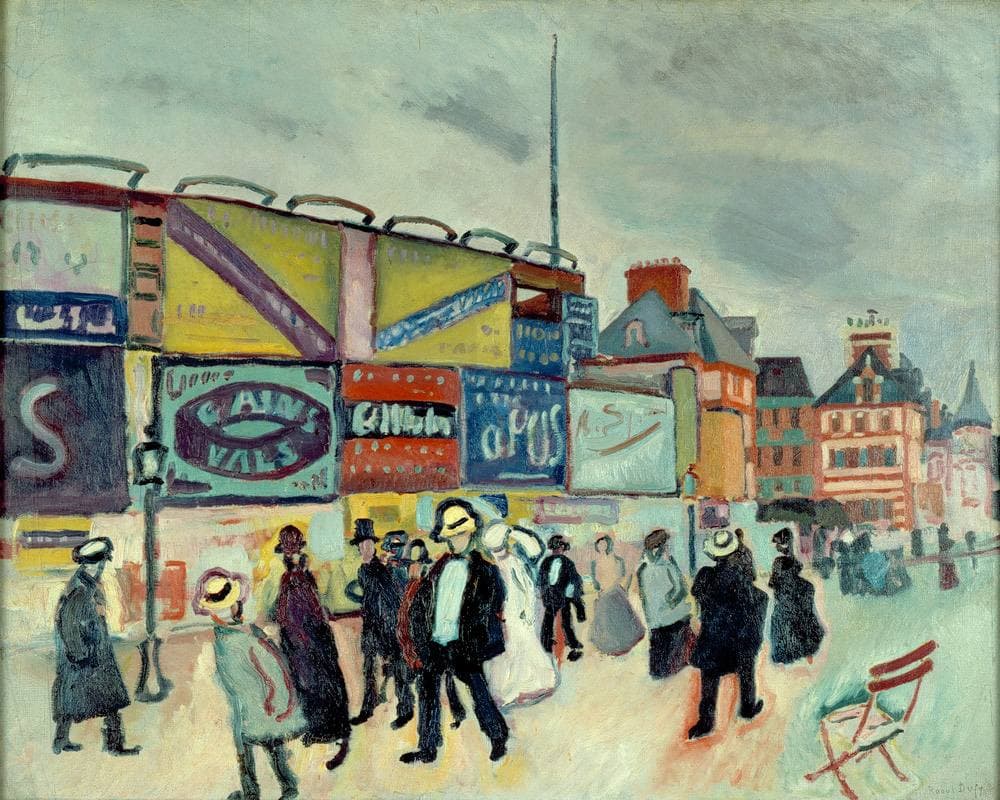
Regattas, racecourses and the Promenade des Anglais, drawn in ink and flooded with colour.
Raoul Dufy was born at Le Havre in 1877, passed through Impressionism and then Fauvism after seeing Matisse's Luxe, calme et volupte in 1905, and arrived in the 1920s at the manner everyone knows: a rapid calligraphic drawing in black over broad washes of colour that deliberately do not stay inside it.
What a work by Raoul Dufy is worth
Send photographs and whatever paperwork came with it. The first question is what the work actually is — edition or unique, when, and in what condition — because everything else follows from the answer. A valuation is free, made online from the photographs you send, and it commits you to nothing. We act for sellers across the United Kingdom, Europe and the United States.
Write to info@whitebankfineart.co.uk, or start below.
Bio
Raoul Dufy was born at Le Havre in 1877, passed through Impressionism and then Fauvism after seeing Matisse's Luxe, calme et volupte in 1905, and arrived in the 1920s at the manner everyone knows: a rapid calligraphic drawing in black over broad washes of colour that deliberately do not stay inside it. The subjects are regattas at Cowes and Deauville, racecourses, orchestras, harbours and open windows on the Riviera. He spent years designing textiles for Bianchini-Ferier and ceramics with Artigas, and painted La Fee Electricite, one of the largest pictures of the century, for the 1937 Paris exposition. He died in 1953.
Dufy is very widely forged, particularly the watercolours and gouaches, which are quick by nature and therefore easy to imitate badly; expert opinion is normally required and the Fanny Guillon-Laffaille catalogues are the reference. The oils, watercolours, textile designs, ceramics and prints are five distinct markets. Watercolour and gouache on paper are acutely light-sensitive and faded examples are common, which bears heavily on value. Signature is almost always present on the face, and the drawing beneath the colour is the surest indicator of quality.
Poiret, Bianchini-Férier and La Fée Électricité
Dufy's commercial work began in 1909, when the couturier Paul Poiret commissioned him to design stationery for his house, and from 1912 he designed textile patterns for the Lyon silk firm Bianchini-Férier. He illustrated books by Apollinaire, Mallarmé and Gide. La Fée Électricité, the enormous mural he painted for the 1937 Paris exhibition, is now at the Musée d'Art Moderne de Paris.
Fabrics printed from his designs, and the designs themselves, are collected as a field of their own and should be described as such, with the manufacturer and date where known, rather than as paintings.
Whitebank Fine Art is an art advisory and gallery, not an auction house, and is not affiliated with any auction house or with the artist, their estate or their representatives. This page describes the range we advise on. Nothing here is investment advice.