
Paul Gauguin valuation
Left a stockbroking career and a family for Brittany, Martinique and finally Polynesia.
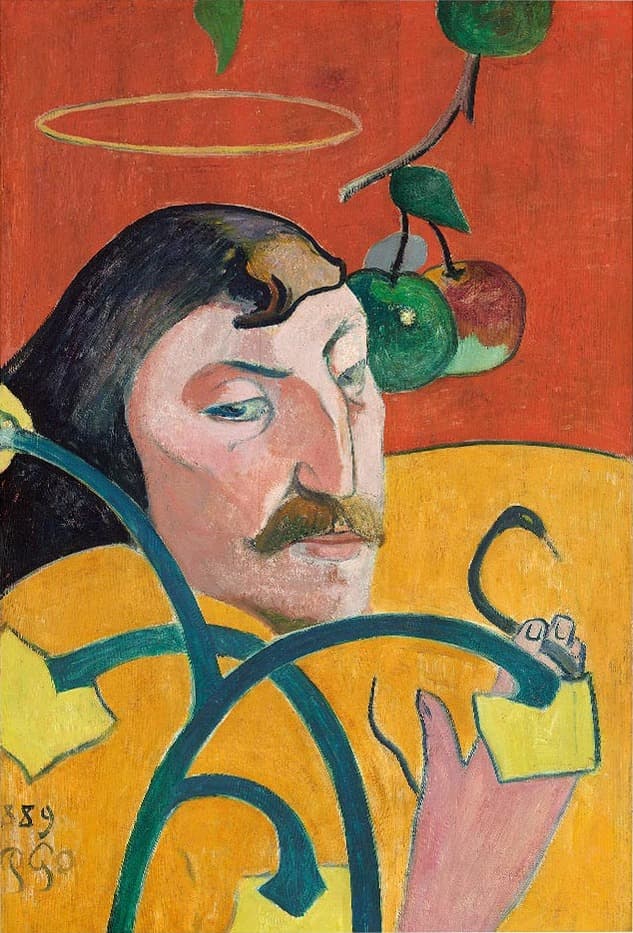
Paul Gauguin was born in Paris in 1848, spent his childhood in Peru, worked as a stockbroker for eleven years and collected Impressionist pictures before deciding, after the 1882 crash, to paint full time.
What a work by Paul Gauguin is worth
Send photographs and whatever paperwork came with it. The first question is what the work actually is — edition or unique, when, and in what condition — because everything else follows from the answer. A valuation is free, made online from the photographs you send, and it commits you to nothing. We act for sellers across the United Kingdom, Europe and the United States.
Write to info@whitebankfineart.co.uk, or start below.
Bio
Paul Gauguin was born in Paris in 1848, spent his childhood in Peru, worked as a stockbroker for eleven years and collected Impressionist pictures before deciding, after the 1882 crash, to paint full time. He left his Danish wife and five children, worked at Pont-Aven in Brittany where he developed the flat, outlined, deliberately anti-naturalistic manner he called Synthetism, spent a disastrous nine weeks with Van Gogh at Arles, and sailed for Tahiti in 1891. He died in the Marquesas in 1903. The Polynesian pictures are inseparable from the colonial circumstances in which they were made, and from his relationships with girls who were children.
Very little comes to market and almost everything of significance is documented; the Wildenstein Plattner Institute catalogue is the reference for paintings. The woodcuts and the monotypes and oil transfer drawings from the Tahitian years are of first importance, technically unlike anything else of the period, and are catalogued by Mongan, Kornfeld and Joachim. Ceramics and carved wood are scarce and heavily studied. Forgery and misattribution are serious problems across the drawings, and provenance research is not a formality here.
At a glance
- Born
- 7 June 1848, Paris
- Died
- 9 May 1903, Atuona
- Movements
- Post-Impressionism, Pont-Aven School, Symbolism
More on Wikipedia.
Pont-Aven, the Volpini show and Hiva Oa
Gauguin showed with the Impressionists from 1879, first a sculpture of his son Émile, while still working at the Paris Bourse, and Pissarro encouraged him when he decided in 1883 to live from painting. At Pont-Aven and Le Pouldu in Brittany he worked with Émile Bernard on the flat, outlined manner of Synthetism, and in 1889 the group showed at the Café Volpini during the Exposition Universelle.
Durand-Ruel showed his first Tahitian pictures in Paris in 1893, and the woodcuts for Noa Noa date from his return to France in 1893 and 1894. Ambroise Vollard became his dealer, and he died at Atuona on Hiva Oa in the Marquesas in May 1903. Where Do We Come From? What Are We? Where Are We Going?, of 1897, is in the Museum of Fine Arts, Boston.
Best auction results
- Maternité II $105.7m
- Oil on canvas, 1899 · New York · 9 November 2022
- Publicly reported
- The artist's auction record. The same canvas had sold in New York on 4 November 2004 for $39.21m, so the record and the benchmark it beat belong to one painting.
- L'homme à la hache $40.3m
- Oil on canvas, 1891 · New York · November 2006
- Publicly reported
- One of the first canvases painted after he reached Tahiti, and the artist's record for the sixteen years that followed.
- Te Fare (La Maison) £20.3m
- Oil on canvas, 1892 · London · 28 February 2017
- Publicly reported
Results as reported at the time of sale, inclusive of buyer's premium. They are a record of what specific works achieved on specific days, not a guide to what any other work is worth.
Whitebank Fine Art is an art advisory and gallery, not an auction house, and is not affiliated with any auction house or with the artist, their estate or their representatives. This page describes the range we advise on. Nothing here is investment advice.