
Henri de Toulouse-Lautrec valuation
Aristocrat who moved into Montmartre and made the poster into an art form.
Henri de Toulouse-Lautrec was born at Albi in 1864 into an old aristocratic family, broke both thigh bones as an adolescent and stopped growing, and settled in Montmartre in his twenties.
What a work by Henri de Toulouse-Lautrec is worth
Send photographs and whatever paperwork came with it. The first question is what the work actually is — edition or unique, when, and in what condition — because everything else follows from the answer. A valuation is free, made online from the photographs you send, and it commits you to nothing. We act for sellers across the United Kingdom, Europe and the United States.
Write to info@whitebankfineart.co.uk, or start below.
Bio
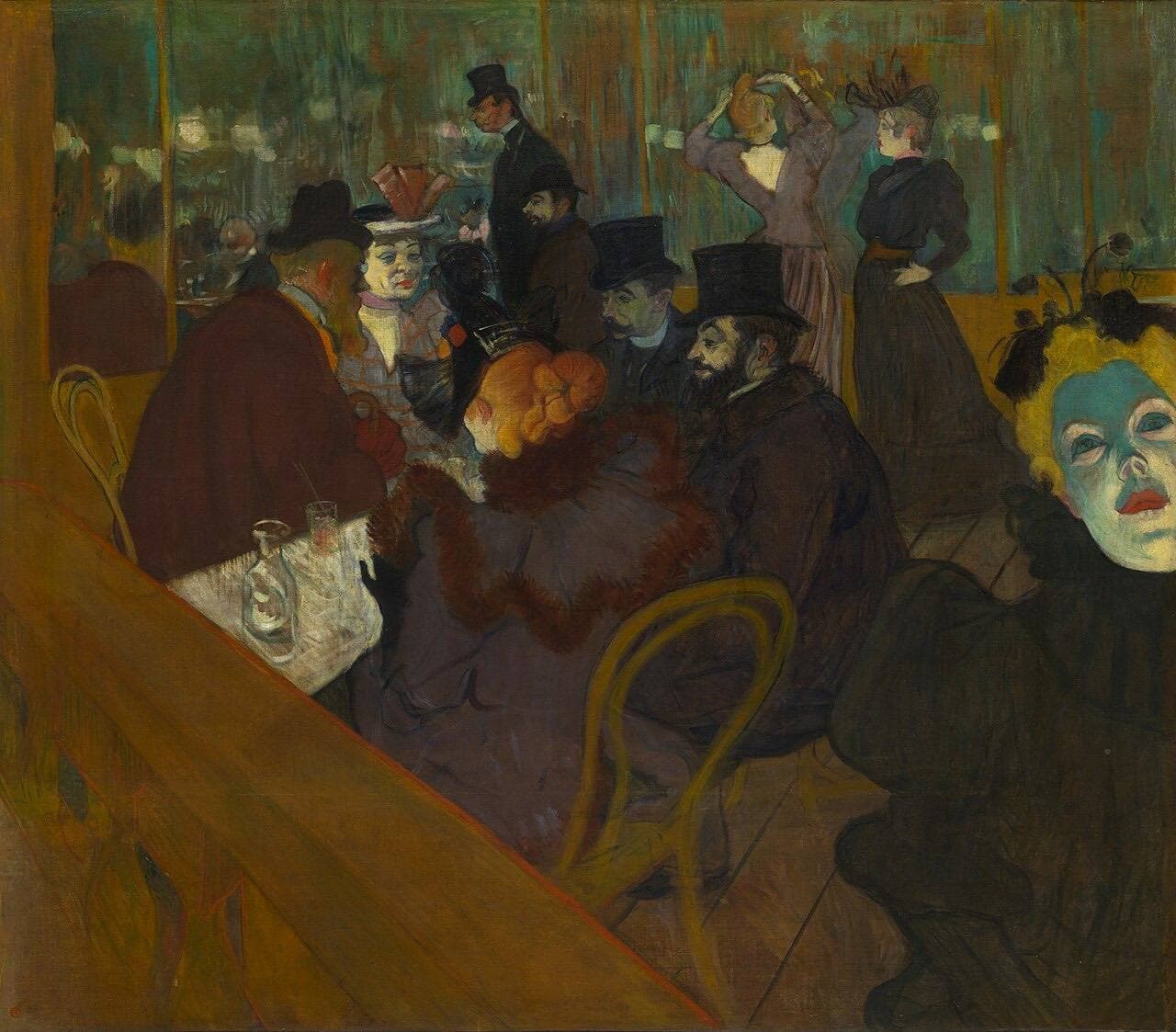
Henri de Toulouse-Lautrec was born at Albi in 1864 into an old aristocratic family, broke both thigh bones as an adolescent and stopped growing, and settled in Montmartre in his twenties. He painted and drew the people there — La Goulue, Jane Avril, Yvette Guilbert, Aristide Bruant, the women of the brothels — with an eye that was affectionate and entirely unsentimental. His colour lithographic posters from 1891 onwards, printed at large scale for the Moulin Rouge and the cafes-concerts, transformed what a poster could be. He died in 1901 at thirty-six.
The lithographs and posters are the substance of this market and are catalogued by Delteil, by Wittrock and by Adriani. Everything turns on the distinction between a lifetime impression and the many later restrikes and photomechanical reproductions in circulation: paper, printer's marks, the monogram stamp, margins and colour freshness are what separate them, and the difference in value is enormous. Large posters were made to be pasted up and survive folded, backed on linen or trimmed, all of which bear on value. Paintings on card are scarce and heavily documented.
At a glance
- Born
- 24 November 1864, Albi
- Died
- 9 September 1901, Saint-André-du-Bois
- Movement
- Post-Impressionism
More on Wikipedia.
Posters, folds and linen backing
The posters were printed to be pasted onto walls, and they were issued folded, so a horizontal crease across the sheet is original to the object rather than damage done to it. Survivors have usually been trimmed at some point, lost margin, or been laid down on linen. Linen backing is normal practice for a poster of this date and is not the defect it would be on a print — it is often what has kept the sheet intact — but it has to be disclosed, because it is irreversible and it changes how the sheet is catalogued.
What separates one impression from another is therefore condition of a very particular kind: the freshness of the colour, whether the margins survive outside the printed image, the state of the folds, and any restoration along them. Photograph the whole sheet flat and square on, then the edges and the reverse, and do not attempt to flatten, clean or unfold anything first.
Best auction results
- La Blanchisseuse $22.4m
- Oil on canvas, 1886–87 · New York · 2 November 2005
- Publicly reported
- The artist's auction record.
- Au lit: le baiser £10.79m
- Painted in 1892 · London · 3 February 2015
- Publicly reported
- One of four compositions the artist made on the same subject.
Results as reported at the time of sale, inclusive of buyer's premium. They are a record of what specific works achieved on specific days, not a guide to what any other work is worth.
Whitebank Fine Art is an art advisory and gallery, not an auction house, and is not affiliated with any auction house or with the artist, their estate or their representatives. This page describes the range we advise on. Nothing here is investment advice.