

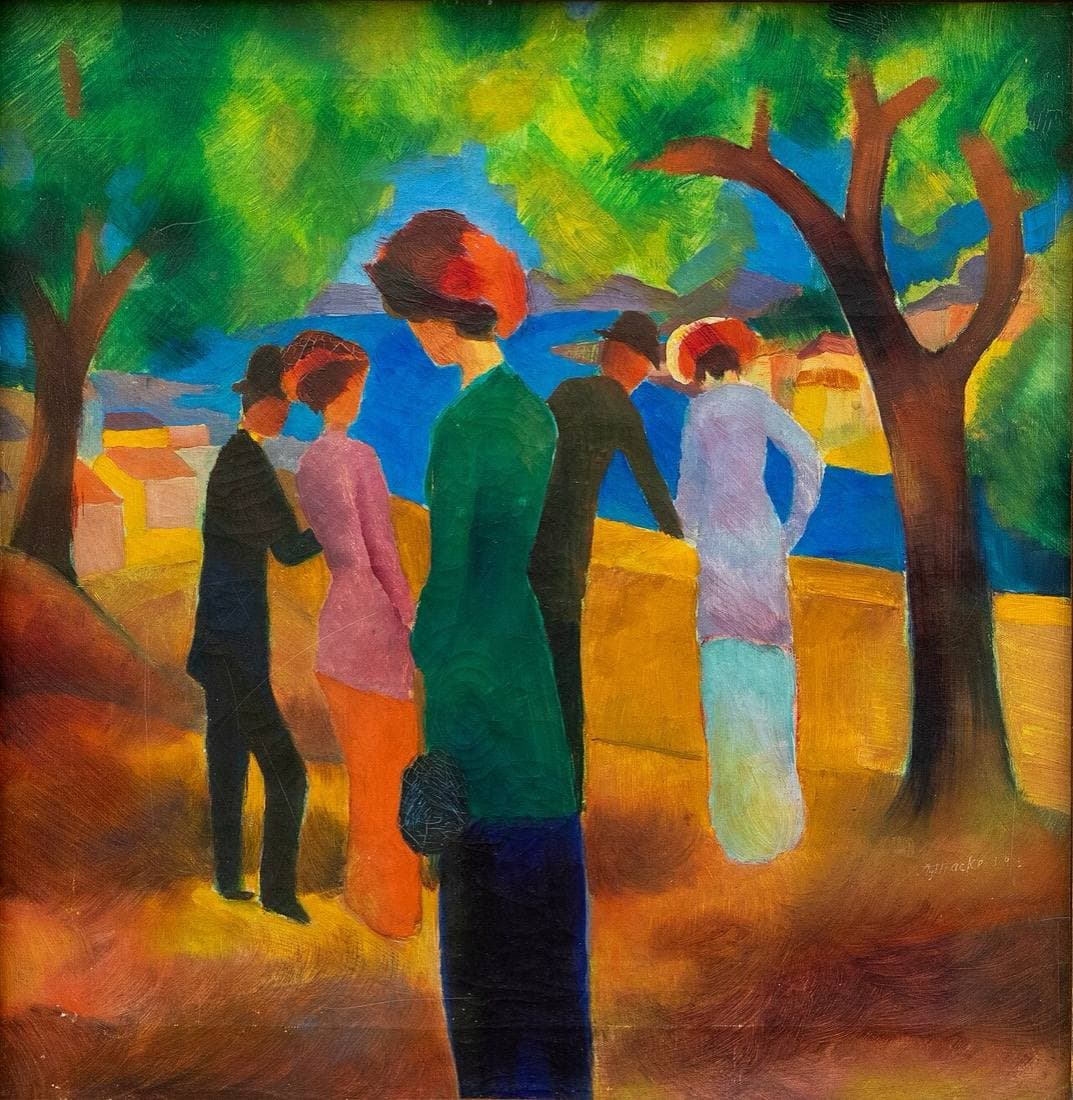
August Macke valuation
Painted shop windows, parks and one Tunisian spring in flat bright colour, and was dead by twenty-seven.
August Macke was born at Meschede in 1887 and trained in Düsseldorf, but the education that counted was four trips to Paris, where he took what he wanted from Impressionism, from Matisse and from Delaunay's colour.
What a work by August Macke is worth
Send photographs and whatever paperwork came with it. The first question is what the work actually is — edition or unique, when, and in what condition — because everything else follows from the answer. A valuation is free, made online from the photographs you send, and it commits you to nothing. We act for sellers across the United Kingdom, Europe and the United States.
Write to info@whitebankfineart.co.uk, or start below.
Bio
August Macke was born at Meschede in 1887 and trained in Düsseldorf, but the education that counted was four trips to Paris, where he took what he wanted from Impressionism, from Matisse and from Delaunay's colour. He joined Kandinsky and Marc in the Blaue Reiter and contributed to its almanac, while keeping to a subject the others largely left alone: people looking into shop windows, women walking in parks, hats, awnings and promenades — modern leisure, set down in flat planes of saturated colour. In April 1914 he travelled to Tunisia with Paul Klee and Louis Moilliet and produced in a fortnight the watercolours that are the best known things he made. He was conscripted in August and killed in Champagne on 26 September 1914, aged twenty-seven.
The career lasted barely eight years, so the output is small and the major oils are largely in German museums. What reaches the market is chiefly works on paper — watercolours, drawings and sketchbook leaves — with oils appearing rarely. Provenance between 1933 and 1945 needs checking, since Macke was among the artists declared degenerate and works were removed from public collections. Vriesen catalogued the paintings and Heiderich the works on paper, and those references are what a serious sale is built on. Watercolour of this date fades, and fading cannot be reversed, so light history matters.
At a glance
- Born
- 3 January 1887, Meschede
- Died
- 26 September 1914, Souain-Perthes-lès-Hurlus
- Movement
- Expressionism
More on Wikipedia.
Bonn, Delaunay and Farewell
Macke lived most of his working life in Bonn, with spells at Lake Thun in Switzerland and journeys to Paris, Italy, the Netherlands and Tunisia. He first went to Paris in 1907, and meeting Robert Delaunay there in 1912 was a revelation; the shop-window pictures are his own reading of Delaunay's Orphism.
His last painting, Farewell, was made as the war began. He is buried in the German military cemetery at Souain-Perthes-lès-Hurlus, and the August-Macke-Haus in Bonn, his home from 1911 to 1914, opened as a museum in 1991.
Whitebank Fine Art is an art advisory and gallery, not an auction house, and is not affiliated with any auction house or with the artist, their estate or their representatives. This page describes the range we advise on. Nothing here is investment advice.
