
Christopher Wood valuation
Painted Brittany and Cornwall with a deliberate naivety, and was dead under a train at twenty-nine.
Christopher Wood was born at Knowsley in 1901 and went to Paris in 1921, where he moved with remarkable speed into the circle around Picasso, Cocteau and Diaghilev.
What a work by Christopher Wood is worth
Send photographs and whatever paperwork came with it. The first question is what the work actually is — edition or unique, when, and in what condition — because everything else follows from the answer. A valuation is free, made online from the photographs you send, and it commits you to nothing. We act for sellers across the United Kingdom, Europe and the United States.
Write to info@whitebankfineart.co.uk, or start below.
Bio
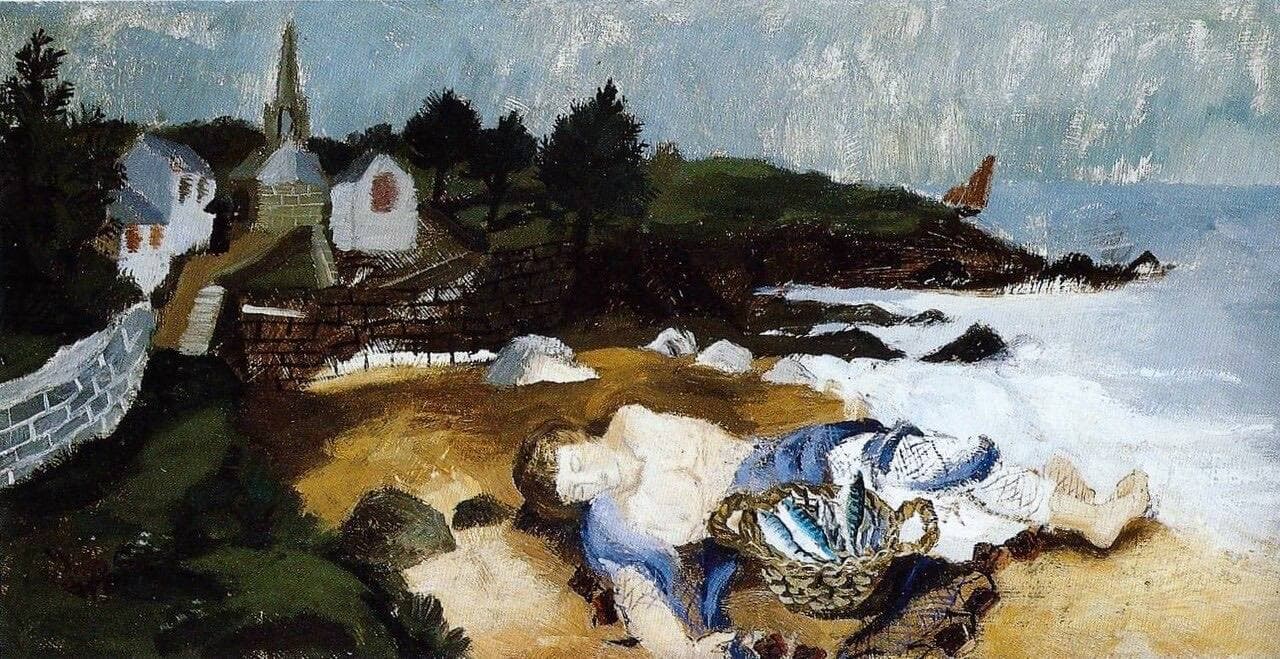
Christopher Wood was born at Knowsley in 1901 and went to Paris in 1921, where he moved with remarkable speed into the circle around Picasso, Cocteau and Diaghilev. With Ben and Winifred Nicholson he discovered Alfred Wallis at St Ives in 1928, and the encounter confirmed the direction he was already taking: a deliberate, sophisticated naivety applied to harbours, fishing boats, Breton churches and Cornish villages. He was addicted to opium and increasingly unstable, and in 1930 he died under a train at Salisbury station, at twenty-nine, in circumstances recorded as suicide.
A career of under ten years, so the body of work is small and finite and the Brittany and Cornwall pictures of 1928 to 1930 are the part the market concentrates on. Paintings are unique and are frequently on board. Because he worked fast and died young, a good deal is unsigned or only initialled and dating is often inferred, which puts weight on provenance, exhibition history and the standing literature. Drawings and gouaches are more numerous. Attribution questions arise against contemporaries working in the same manner.
At a glance
- Born
- 7 April 1901, Knowsley
- Died
- 21 August 1930, Salisbury
- Movement
- Post-Impressionism
More on Wikipedia.
The Ballets Russes, Wertheim and Salisbury
In 1926 Wood designed Constant Lambert's ballet Romeo and Juliet for Diaghilev's Ballets Russes, though the designs were not used, and joined the London Group and the Seven and Five Society. He was preparing for an exhibition at the Wertheim Gallery in London when he died at Salisbury in August 1930, at twenty-nine.
His paintings were shown at the Venice Biennale in 1938, and the Redfern Gallery later mounted a large retrospective. Early exhibition labels, and a history through the Nicholsons, Jim Ede or the Redfern, are among the strongest evidence for a picture.
Whitebank Fine Art is an art advisory and gallery, not an auction house, and is not affiliated with any auction house or with the artist, their estate or their representatives. This page describes the range we advise on. Nothing here is investment advice.