
Max Beckmann valuation
Went to the First World War as a medical orderly and painted Germany's next thirty years from the inside.
Max Beckmann was born in Leipzig in 1884 and was already a successful painter before 1914.
What a work by Max Beckmann is worth
Send photographs and whatever paperwork came with it. The first question is what the work actually is — edition or unique, when, and in what condition — because everything else follows from the answer. A valuation is free, made online from the photographs you send, and it commits you to nothing. We act for sellers across the United Kingdom, Europe and the United States.
Write to info@whitebankfineart.co.uk, or start below.
Bio
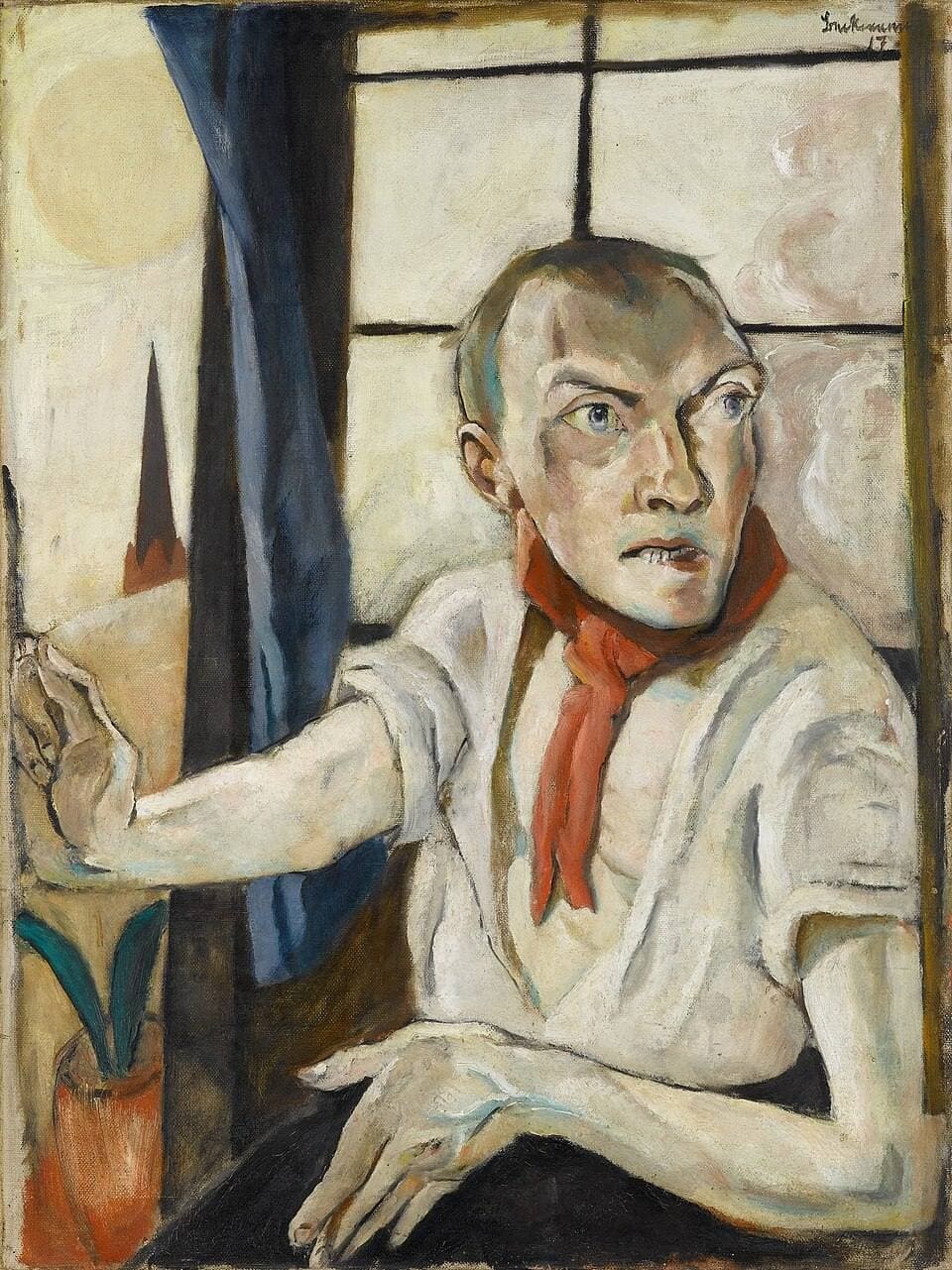
Max Beckmann was born in Leipzig in 1884 and was already a successful painter before 1914. He volunteered as a medical orderly, was discharged after a breakdown in 1915, and everything afterwards is marked by it. Through the 1920s he painted the Weimar republic in hard, compressed, stage-like compositions, teaching in Frankfurt until the Nazis dismissed him in 1933 and included his work in the Degenerate Art exhibition of 1937. He left Germany the day it opened, spent ten years in Amsterdam, much of it in hiding, and reached the United States in 1947. He died in New York in 1950, walking to see one of his own paintings.
Provenance for a Beckmann means Second World War provenance, and any work with a gap in its ownership between 1933 and 1945 requires proper restitution research before it can be sold — this is the single largest factor in whether a picture is saleable at all. Beyond the paintings there is a substantial and important graphic output, particularly the drypoints and lithographic portfolios of the 1910s and 1920s, which are catalogued by Hofmaier and where state, edition and paper are what separate impressions.
At a glance
- Born
- 27 February 1884, Leipzig
- Died
- 27 December 1950, New York City
- Movements
- Expressionism, New Objectivity
More on Wikipedia.
The Städel, Amsterdam and St Louis
Beckmann taught a master class at the Städelschule in Frankfurt from 1925, where his students included Marie-Louise von Motesiczky, and in 1927 he received the Honorary Empire Prize for German Art. Dismissed in 1933 as a cultural Bolshevik, he saw more than 500 of his works confiscated in 1937. In Amsterdam, unable to get an American visa, he painted some of his strongest pictures, among them Self-Portrait with Horn of 1938.
In 1947 he took up a post at the St Louis School of Fine Arts at Washington University, at the invitation of Perry T. Rathbone, and in 1949 a professorship at the Brooklyn Museum Art School. He made the triptych a modern form, beginning with Departure, painted between 1932 and 1935. Retrospectives at the Museum of Modern Art in 1995 and the Guggenheim in 1996 widened his reputation.
Whitebank Fine Art is an art advisory and gallery, not an auction house, and is not affiliated with any auction house or with the artist, their estate or their representatives. This page describes the range we advise on. Nothing here is investment advice.