

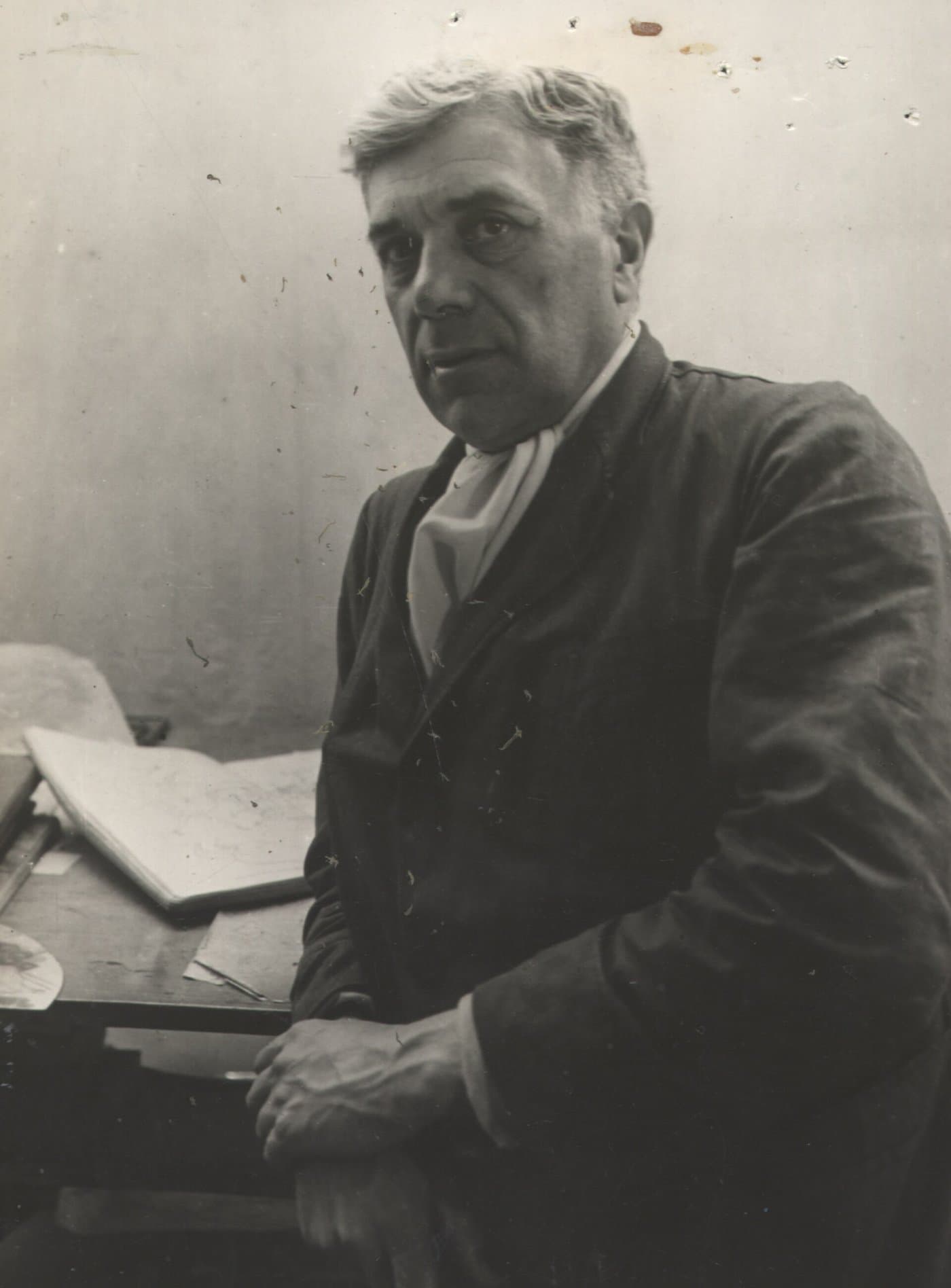
Georges Braque valuation
Invented Cubism alongside Picasso, then spent forty years quietly not being him.
Georges Braque was born in Argenteuil in 1882 and trained as a decorator and house painter, which is where the marbling, wood-graining and lettering that turn up in his Cubist pictures come from.
What a work by Georges Braque is worth
Send photographs and whatever paperwork came with it. The first question is what the work actually is — edition or unique, when, and in what condition — because everything else follows from the answer. A valuation is free, made online from the photographs you send, and it commits you to nothing. We act for sellers across the United Kingdom, Europe and the United States.
Write to info@whitebankfineart.co.uk, or start below.
Bio
Georges Braque was born in Argenteuil in 1882 and trained as a decorator and house painter, which is where the marbling, wood-graining and lettering that turn up in his Cubist pictures come from. Between 1908 and 1914 he and Picasso worked so closely that their canvases of the period are sometimes difficult to tell apart; Braque introduced papier colle in 1912. The war ended the partnership — he was severely wounded at Carency in 1915 and trepanned — and the work afterwards moved into the sombre, tactile still lifes, the Gueridon tables, and finally the Ateliers and the birds, one of which he painted on a ceiling of the Louvre. He died in 1963.
The Cubist years are a small and heavily studied body of work and anything from them requires serious provenance research, including the wartime period. The later still lifes are the bulk of the painting market. Braque also produced a large printed output — etchings, lithographs and the Lettera Amorosa and Cahiers illustrations — much of it published posthumously or in the final years, so distinguishing lifetime impressions, signed editions and later restrikes is the first question with anything on paper. Vallier and Mourlot are the standard references.
At a glance
- Born
- 13 May 1882, Argenteuil
- Died
- 31 August 1963, Paris
- Movements
- Cubism, Fauvism
More on Wikipedia.
The Louvre ceiling and the Métamorphoses
In 1953 the Louvre commissioned Braque to paint three panels for the ceiling of the Salle Henri II, set among sixteenth-century carved woodwork, and Les Oiseaux, birds against a deep blue ground, was unveiled that year.
In his last years he gave the jeweller Baron Heger de Löwenfeld more than a hundred gouaches to be made into jewels, the Métamorphoses, produced between 1961 and 1963 and shown at the Louvre in the spring of 1963, months before his death. Pieces from the series, each named after a figure from classical myth, come to market as jewellery rather than as works on paper, and the date of manufacture and the maker's marks are what should be recorded.
Le Havre, L'Estaque and the word Cubism
Braque grew up in Le Havre and took evening classes at its art school from about 1897 to 1899, then trained as a decorator in Paris, receiving his certificate in 1902, and painted at the Académie Humbert until 1904. After seeing the Fauves in 1905 he painted in their manner alongside Raoul Dufy and Othon Friesz, both also from Le Havre, and travelled with Friesz to L'Estaque and Antwerp in 1906. The Cézanne retrospective at the Salon d'Automne in 1907 turned him toward geometry, and he met Picasso that autumn.
Reviewing his exhibition at Kahnweiler's gallery in November 1908, the critic Louis Vauxcelles wrote that Braque reduced everything to cubes. In the summer of 1911 he and Picasso painted side by side at Céret in the Pyrenees. With Matisse he introduced Picasso to the printer Fernand Mourlot, whose studio printed most of his own lithographs of the 1940s and 1950s, and in 1962 he made the etchings of L'Ordre des Oiseaux with Aldo Crommelynck, to a text by Saint-John Perse. At Varengeville-sur-Mer in Normandy he designed windows for the village church.
Whitebank Fine Art is an art advisory and gallery, not an auction house, and is not affiliated with any auction house or with the artist, their estate or their representatives. This page describes the range we advise on. Nothing here is investment advice.
