

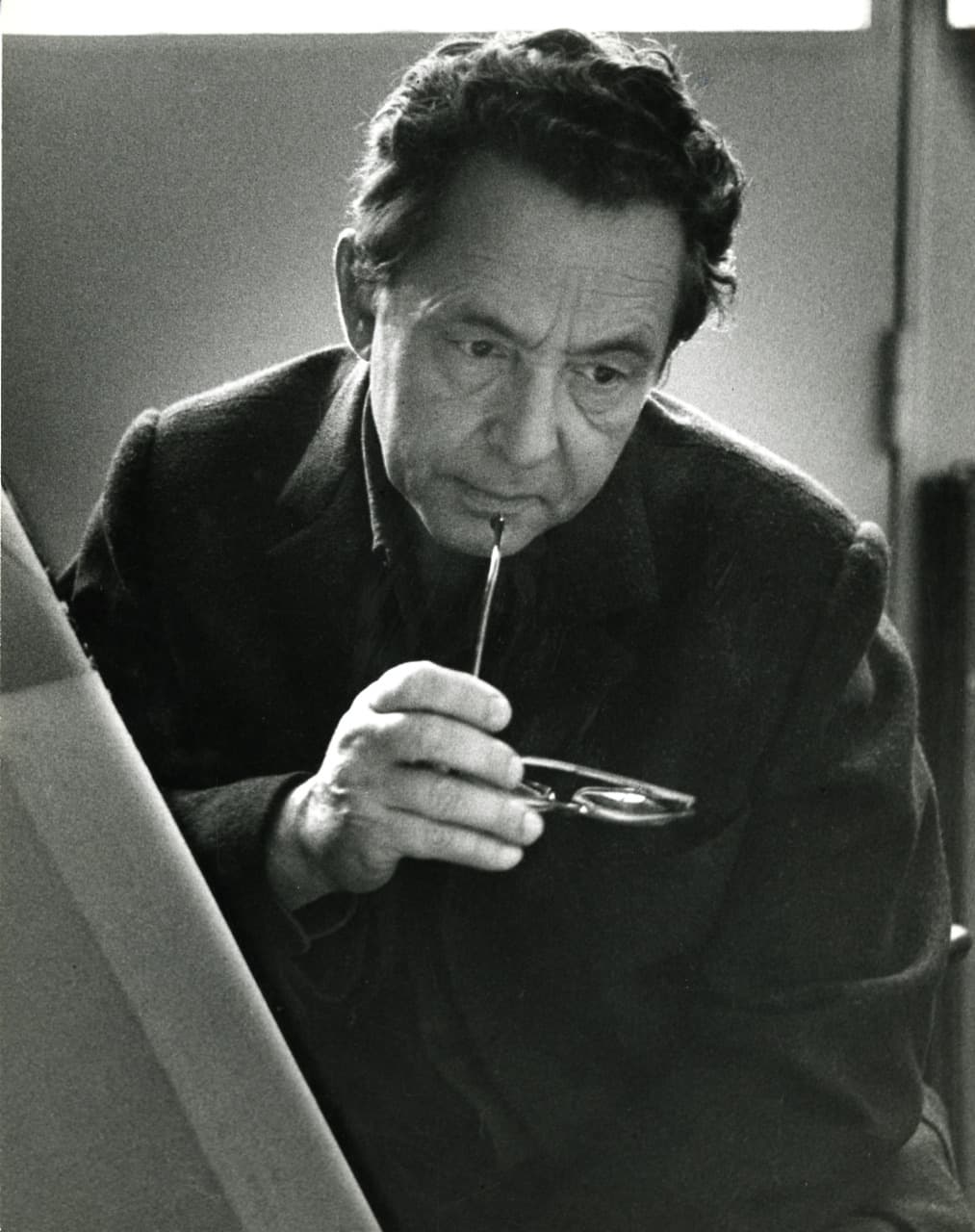
Hans Hartung valuation
Abstraction as pure gesture, from a German who fought with the Foreign Legion and lost a leg.
Hans Hartung was born in Leipzig in 1904 and was making abstract watercolours in his teens, before he had seen much abstract art.
What a work by Hans Hartung is worth
Send photographs and whatever paperwork came with it. The first question is what the work actually is — edition or unique, when, and in what condition — because everything else follows from the answer. A valuation is free, made online from the photographs you send, and it commits you to nothing. We act for sellers across the United Kingdom, Europe and the United States.
Write to info@whitebankfineart.co.uk, or start below.
Bio
Hans Hartung was born in Leipzig in 1904 and was making abstract watercolours in his teens, before he had seen much abstract art. He settled in Paris in 1935, joined the French Foreign Legion in 1939, was captured, escaped, rejoined, and lost a leg in 1944; he took French citizenship after the war. His paintings are built from bundles of black or coloured strokes over luminous grounds, and are the central statement of European Art Informel, though he prepared many of them from careful studies, which complicates their reputation for spontaneity. In his last years, working from a wheelchair, he sprayed paint at enormous scale. He died at Antibes in 1989.
The 1950s and early 1960s canvases lead, with the late sprayed works of the 1980s now increasingly sought after a run of major exhibitions. The Fondation Hartung-Bergman at Antibes holds the archive and is the reference for attribution. Hartung produced a great many works on paper — ink, pastel, vinylic paint on card — and a substantial printed output in lithography and etching. Titles follow a code of letter, year and number, which is normally on the reverse and is the fastest route to identification.
At a glance
- Born
- 21 September 1904, Leipzig
- Died
- 7 December 1989, Antibes
- Movement
- Abstract Expressionism
More on Wikipedia.
Dresden, González and the Venice prize
Hartung studied philosophy and art history at Leipzig University from 1924 and then at the Dresden academy, and in 1928 studied painting technique in Munich. In 1935 he fled Berlin, where the police tried to arrest him, and back in Paris the sculptor Julio González lent him his studio; in 1939 he married González's daughter Roberta.
His first solo exhibition in Paris was in 1947, and in 1960 he won the International Grand Prize for painting at the Venice Biennale. In 1957 he remarried the painter Anna-Eva Bergman, his first wife, and the Fondation Hartung-Bergman is in the house and studios they built at Antibes.
Dresden 1926, Menorca and the Rubens Prize
As a young man Hartung admired Rembrandt, Lovis Corinth, Kokoschka and Nolde. The modern French and Spanish painting he saw at the Internationale Kunstausstellung in Dresden in 1926 decided him to leave Germany, and after a bicycle trip through Italy he went to Paris, where he copied old and modern masters and, in the south of France, studied Cézanne and the golden section. He married Anna-Eva Bergman in 1929, lived at Leucate and then in the Balearics, settling on Menorca, and first exhibited in Dresden in 1931.
Christian Zervos helped him get out of Germany in 1935. During the war the French police held him for seven months, and after he was wounded fighting with the Legion he received French citizenship in 1945 and the Croix de Guerre. In 1957 he was the first painter to receive the Rubens Prize of the city of Siegen. His long, rhythmic strokes set a precedent for the American Lyrical Abstraction of the 1960s and 1970s, and he appears in Warren Forma's 1963 documentary School of Paris: 5 Artists at Work.
Whitebank Fine Art is an art advisory and gallery, not an auction house, and is not affiliated with any auction house or with the artist, their estate or their representatives. This page describes the range we advise on. Nothing here is investment advice.
