

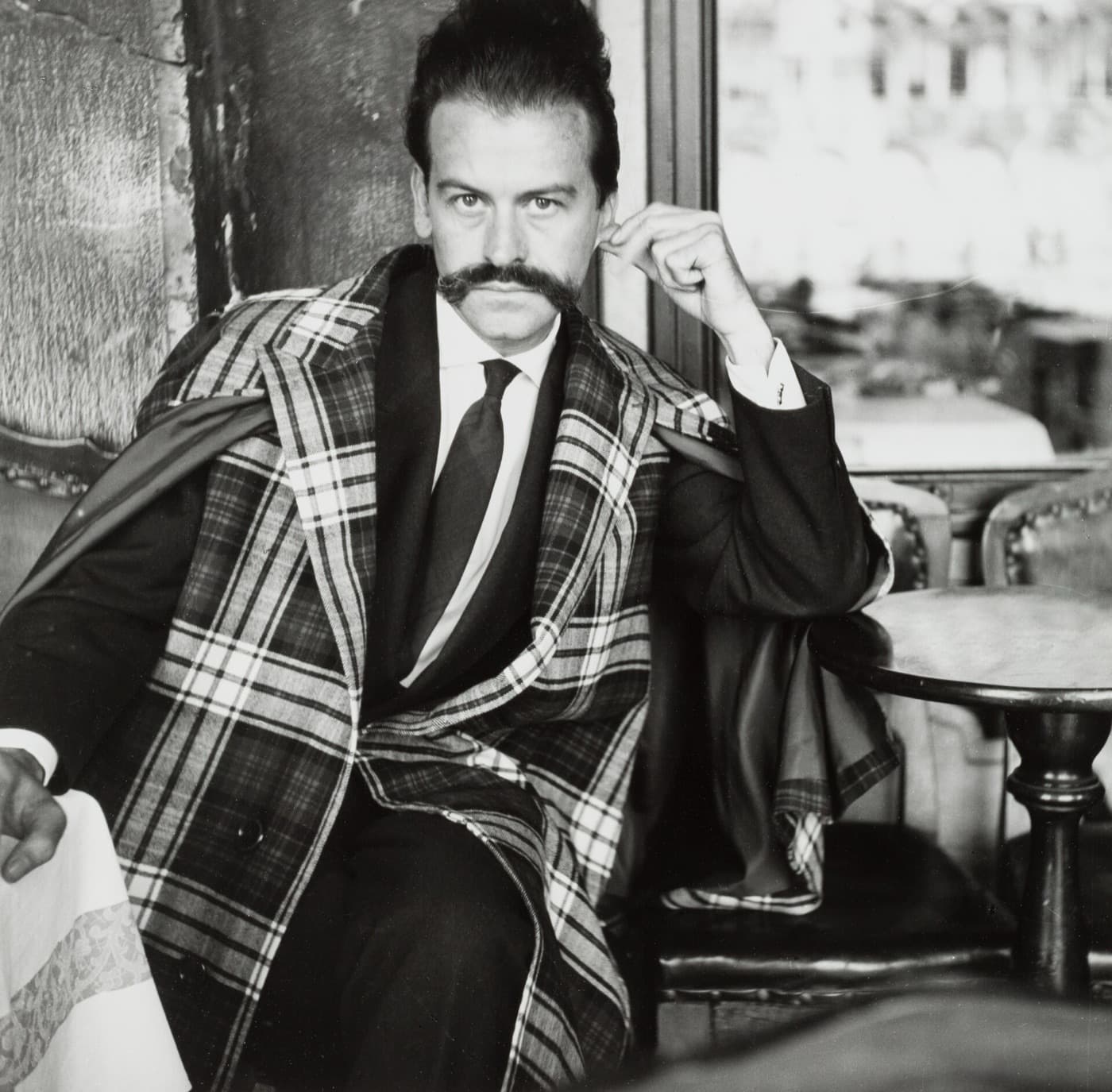
Georges Mathieu valuation
Painted enormous canvases in public, at speed, in costume, and designed the ten-franc coin.
Georges Mathieu was born at Boulogne-sur-Mer in 1921, studied law and English literature, and came to painting late and theatrically.
What a work by Georges Mathieu is worth
Send photographs and whatever paperwork came with it. The first question is what the work actually is — edition or unique, when, and in what condition — because everything else follows from the answer. A valuation is free, made online from the photographs you send, and it commits you to nothing. We act for sellers across the United Kingdom, Europe and the United States.
Write to info@whitebankfineart.co.uk, or start below.
Bio
Georges Mathieu was born at Boulogne-sur-Mer in 1921, studied law and English literature, and came to painting late and theatrically. He coined the term Lyrical Abstraction for the French answer to action painting, and made the act of painting a public performance: enormous canvases attacked with paint squeezed straight from the tube, completed in front of audiences in under an hour, sometimes in period costume, with titles drawn from French royal history. He also designed the ten-franc coin, stamps, tapestries and Air France posters, and argued for the artist's role in public life. He died in 2012.
The 1950s and early 1960s canvases lead this market decisively; the much larger later output, produced at speed over five decades, is a broad and considerably more modest field, and separating the two is the substance of a valuation. Mathieu's paint is applied very thickly and directly from the tube, and it has often cracked, slumped or lifted, so structural condition needs proper assessment. There is a large output of works on paper and of lithographs. The market is principally French, with growing interest from Asia.
At a glance
- Born
- 27 January 1921, Boulogne-sur-Mer
- Died
- 10 June 2012, Paris
- Movements
- Abstract Expressionism, Lyrical Abstraction
More on Wikipedia.
L'Imaginaire, Japan and the Grand Palais
Mathieu studied English and law at the University of Lille. His first abstract paintings were shown at the Salon des moins de 30 ans in Paris in 1946, and he founded the group L'Imaginaire with Wols, Atlan, Hartung, Bryen and Riopelle. From 1953 to 1963 he edited the United States Lines Paris Review, and from 1957 he painted in Japan and the United States, and in 1959 in South America and the Middle East.
In 1965 he showed a hundred paintings at the Galerie Charpentier in Paris, painting Paris, Capitale des Arts for the occasion, and in 1978 the Grand Palais gave him a retrospective of the previous fifteen years. He was a member of the Académie des Beaux-Arts, and he died at Boulogne-Billancourt in June 2012.
United States Lines, the Sarah-Bernhardt and Kenny Clarke
Mathieu's father managed a Barclays bank and his mother taught him to draw. He taught English at the lycée in Douai from 1942 and was an interpreter for the American army at Cambrai in 1944, the year he made his first non-figurative painting, Inception, after reading Edward Crankshaw on Joseph Conrad. In Paris from 1947 he looked after passengers travelling between Le Havre and Paris for the United States Lines, which brought him a wealthy clientele and a first meeting with Dalí, and the company's free Paris review, printed in 15,000 copies, let him interview John Cage, Pierre Boulez, Henry Miller and Albert Einstein.
In 1948 he set French and American avant-garde painting side by side in Paris and showed a French audience what Jackson Pollock was doing. He set four conditions for Lyrical Abstraction: speed of execution, no borrowed forms, no premeditated gestures, and a state of ecstasy. In 1956 he painted Hommage aux poètes du monde entier, four metres by twelve, in front of 2,000 people at the Théâtre Sarah-Bernhardt, using more than 800 tubes of paint, and in 1959 Le Massacre de la Saint-Barthélemy, two and a half metres by six, in under half an hour to the drumming of Kenny Clarke. He was elected to the Académie des Beaux-Arts in 1976.
Whitebank Fine Art is an art advisory and gallery, not an auction house, and is not affiliated with any auction house or with the artist, their estate or their representatives. This page describes the range we advise on. Nothing here is investment advice.
