
Pierre-Auguste Renoir valuation
Painted porcelain as a boy, then dappled light on skin for the rest of a very long career.
Pierre-Auguste Renoir was born at Limoges in 1841 and began as a porcelain painter, which taught him a lightness of touch he never lost.
What a work by Pierre-Auguste Renoir is worth
Send photographs and whatever paperwork came with it. The first question is what the work actually is — edition or unique, when, and in what condition — because everything else follows from the answer. A valuation is free, made online from the photographs you send, and it commits you to nothing. We act for sellers across the United Kingdom, Europe and the United States.
Write to info@whitebankfineart.co.uk, or start below.
Bio
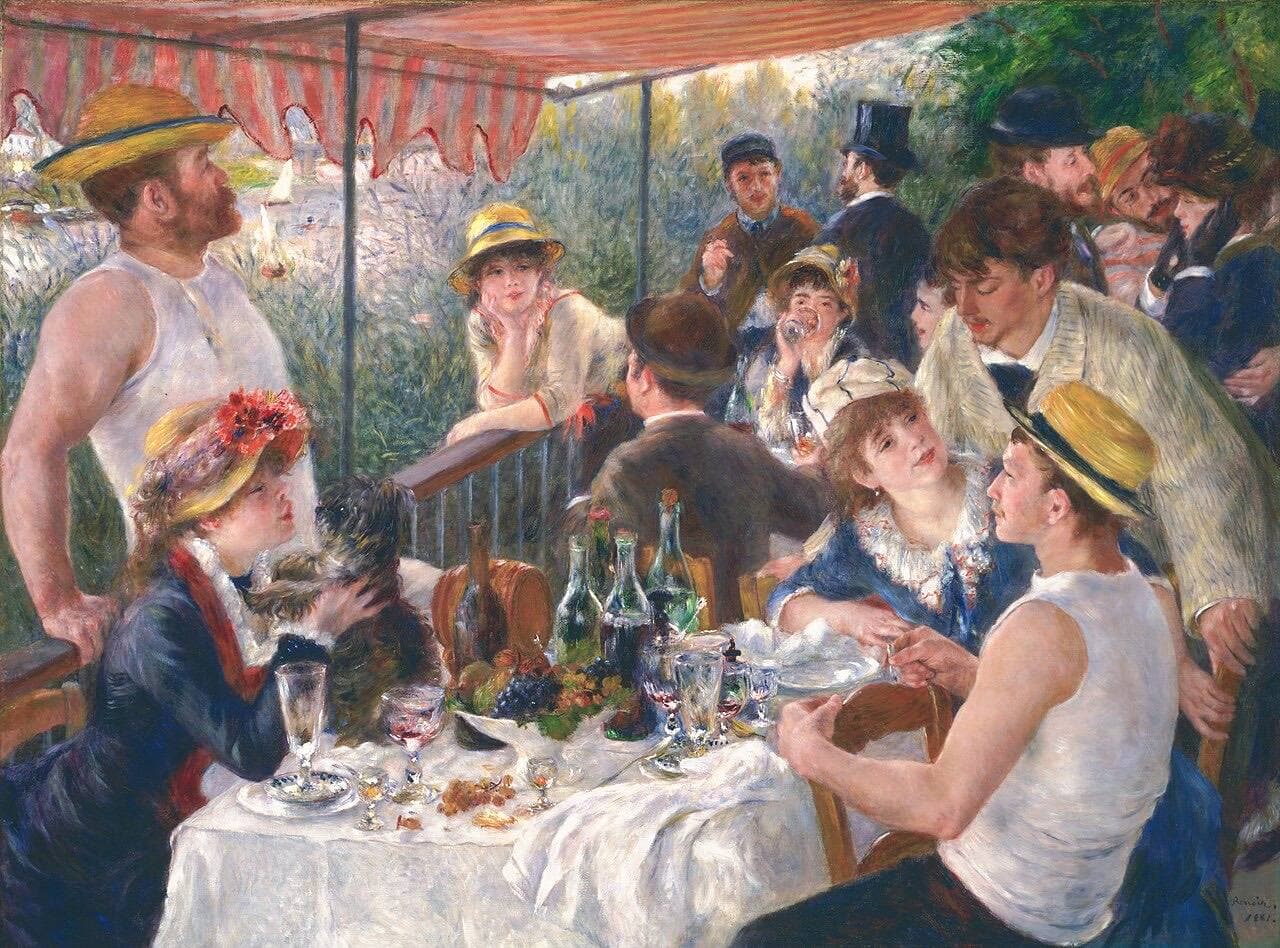
Pierre-Auguste Renoir was born at Limoges in 1841 and began as a porcelain painter, which taught him a lightness of touch he never lost. He was central to Impressionism through the 1870s — Bal du moulin de la Galette, Luncheon of the Boating Party — then broke with it after a trip to Italy in 1881, tightening his drawing under the influence of Raphael and Ingres before loosening again into the warm, red-toned bathers of his last decades, painted at Cagnes with brushes strapped to hands crippled by rheumatoid arthritis. He died in 1919.
Renoir is among the most forged artists in existence and also among the most reproduced, and the two problems compound each other. The Wildenstein Plattner Institute catalogue raisonne is the reference for paintings, and expert opinion is normally required. The late work is a very large body and is valued quite differently from the Impressionist decade. Provenance across 1933 to 1945 requires checking for pictures that passed through European collections. Bronzes made in collaboration with Richard Guino are a distinct and complicated category, with lifetime and posthumous casts.
At a glance
- Born
- 25 February 1841, Limoges
- Died
- 3 December 1919, Cagnes-sur-Mer
- Movement
- Impressionism
More on Wikipedia.
The bronzes, and why they are complicated
Sculpture signed Renoir is a category of its own and a trap for anyone assuming it works like the paintings. By the time the sculpture was made the artist's hands were too damaged by arthritis to model, so the work was executed by an assistant, Richard Guino, under his direction. French courts have considered the question of authorship more than once, and the result is that a Renoir bronze is a collaborative object with a contested history rather than a straightforward work by one hand.
On top of that sit the casting questions that attach to any bronze of this period: whether a cast is lifetime or posthumous, which foundry made it, what the edition was, and whether the foundry mark and number are present and legible. None of this makes a bronze unsaleable. It does mean the paperwork decides the outcome to a degree that surprises people who have only ever sold pictures.
Best auction results
- Bal du moulin de la Galette $78.1m
- Oil on canvas, 1876 · New York · 17 May 1990
- Publicly reported
- The smaller of the artist's two versions of the subject; the larger hangs in the Musée d'Orsay. Still the record for the artist more than thirty years later.
Results as reported at the time of sale, inclusive of buyer's premium. They are a record of what specific works achieved on specific days, not a guide to what any other work is worth.
Whitebank Fine Art is an art advisory and gallery, not an auction house, and is not affiliated with any auction house or with the artist, their estate or their representatives. This page describes the range we advise on. Nothing here is investment advice.